Feeds:
Posts
Comments

Posts Tagged ‘Vermont locavore’

Since this is a locavore blog, in some ways, I have to admit, I misrepresent myself.  For example: beer versus wine.  I’ve written more about beer, and expressed a lot of enthusiasm about local ales, but I’m really much more of a wine drinker.  Lately it’s been Spanish reds, and vinho verde.  I love the different tones of garnacha, and the refreshing effervescence of that Portuguese “green wine.”  I also love the whites of Alsace.  And the infinite varieties of rosé! From the elegant Tavel to the earthy South African pinotage rosé, I love them all.  If I still lived in Berkeley, there wouldn’t be the whiff of hypocrisy in calling myself a locavore eater and drinker, because I’d still be drinking those great Sonoma, Paso Robles, Santa Cruz, and Mendocino wines we could get in the grocery store.  I miss you, Bonny Doon.  Wish I could be there in the tasting room to try your new, more restrained bottlings, which I’ve now only read about, wistfully, in the New York Times. (Not to mention all the great things I could be eating: mission figs and meyer lemons from neglected trees on my block of Euclid Ave., for example….)

Enough gushing, now.  The reason I started writing this post has to do more with ale and my country-girl nostalgia.  In Burlington, at Greg and Patti’s, we started the evening with Otter Creek Copper Ale, which I love, and which brought back memories (not all pleasant) of my stint as an “environmental educator” at a school-trip camp near Middlebury, Vermont.  We slept in cabins so rustic, the frosty mid-March air gusted in the cracks between the aged two-by-fours during the night.  I slept in my -40 down “mummy” sleeping bag in long underwear, a sweater, and a wool cap.  The kids arrived on full school buses on Monday, we introduced them to things like recycling, organic carrots, and sphagnum moss, and they were gone by Friday.  And then, if it was sunny, we’d drag all of the Adirondack chairs out to the middle of the lawn at the camp’s center overlooking the lake, set a bunch of six-packs of all of the Otter Creek brews here and there, and sample them all afternoon.  Copper Ale, Pale Ale, Stovepipe Porter, Spring Ale, Mud Bock!  We were single, outdoorsy, and glad to be free.

Otter Creek Brewery is a family owned business in Middlebury, Vermont, which also makes certified organic beers under the Wolaver’s label.  They host a regular beer and cheese tasting, which at first glance smacks of wine-culture-imitation opportunism, but then I remember how good I think the sharp Vermont cheeses taste with beer.  Here’s how they advertise it:

Not only is Vermont home to 19 craft brewers (at last count), the most breweries per capita in the country, we also are lucky enough to have 35+ artisanal cheesemakers here, too!  This makes us arguably the best state for cheese and beer pairings in the country!

You know what else is good with beer?  Peanut butter.

Read Full Post »

I spotted pint bottles of McNeill’s Firehouse ale in the Co-op today, and grabbed one.  This ale brings back memories, because it was one of my first draft beers. Definitely the best.  The brewery is in my high school hometown of Brattleboro, Vermont, where it is served in its own well-resepected run-down-floorboarded pub just off Main Street.  Firehouse is a dark amber ale, pretty hoppy but not overly.  Flavorful, a pleasure to drink with some salty green olives, sharp cheese, or just some bar mix.  It’s also conducive to déjà vu for me because it was what Peter and I drank on our first New Year’s Eve together.  Neither of us is one for sentimentality about holidays, but this one was just good fun.  After having dinner with my parents at home, we looked into The Marina, a bar on the West River, but it was just as I expected: crowded with all of the jocks and hometown girls who’d already married and had children.  We decided to go downtown.  It was colder than cold—around zero.  I remember, I was wearing not just a thick wool sweater but a thick wool turtleneck sweater.  At McNeill’s, there were a few small groups of locals and Marlboro College types sitting around at little tables, which were home-crafted just like the brews.  I was twenty-one, but Peter was a year younger.  I went up to the bar attempting to be cool as a local (cucumber).  “Two pints of Firehouse?” Not a look or a word questioning my legitimacy as a beer-purchasing adult.  It was New Years Eve.  We sipped our first pints happily.  They were probably playing The Band.  We started a game of darts.  Cheers to ’97!

mcneills

Read Full Post »

honey

We drove up I89 yesterday to Vermont’s city, Burlington, to have dinner with Peter’s friend, the Irish poet, Greg Delanty, his wife Patti, and their son Dan (who gave Jack his outgrown tractor toys on indefinite loan).  It was rainbow weather.  The sky had been heavy and dark in Norwich—rain for days, all the Vermonters complaining about such an injustice, and on the solstice too!  But as we drove through the Green Mountains and into the Champlain Valley, the sky opened into a shifting patchwork of gray, white, and blue.  Some mountain tops were hidden in dark blurs, some were lit up bright green by shafts of sunlight. Some clouds were white wisps, some were poofy cumulous towers. We saw a rainstorm up ahead over the next valley, we were in it, and back in the hot sun again.

After this beautiful drive, we were welcomed onto a sunny deck by Patti, who is passionate about local food: there was late-afternoon local beer, and asparagus with dinner (to green up the Irish ham and potato plate).  This morning there were jumbo eggs from a nearby farm, toast from a nearby bread baker’s.

But the most delicious element of either meal was also the most local: Patti’s honey.  She keeps a hive in a wooden box in the side yard, the yellow walls of which match the yellow and purple trim on their old New England house, which stands at the corner of the lake-front street packed with other little old houses whose clapboards are whimsically painted other shades of purple, orange, or bright blue.  After breakfast, Jack and I went for a walk and stopped to sniff the roses, peonies, and lilies planted in abundant disorderly patches of overgrown grass in front of the porches along the way.  We saw bees dipping into these polleny perennials as well as into the flowering vines covering the fences and the little nosegays of wildflowers in cracks on the sidewalk and on the edges of driveways and yards.  Patti’s honey has all of the flavors and aromas of this big mixed bouquet.

Because of bees’ omnivorousness when it comes to nectar, and the portion of pollen that ends up in the honeycombs, eating local honey can help us ward off seasonal allergies, and is said to be an immunity booster in general.  But more importantly, honey is a comfort food for me: I associate it with childhood, with the pink and white clovers and buttercups of Vermont, and with Winnie the Pooh’s “little smackerel of something.”  I still enjoy it on toast and in tea, but there are more grown-up ways to eat it too: as a dressing for Mission figs and manchego; drizzled on soft goat cheese; or as a seasoning with braised lamb.

Read Full Post »

cheese sample

Vermont is, of course, known for its dairy farms, along with its maple syrup.    The two events I went to today, the Norwich Farmers’ Market and the Co-op’s annual Dairy Day, are really celebrations of the richness, variety, and history of Vermont’s dairies, which stretches back to the seventeenth century. While stories of small dairies going out of business or being bought out by large conglomerates are common these days, some of the most successful operations now are small.  They have simply shifted their market focus and serve the (expanding) niche markets defined by the desire for food that is of a high quality, is local, and is artisanal in some way.  The desire for these traits goes along with a conservationist ethos that looks both forward and back.  Heirloom seeds and techniques are prized for their history as well as for the continuity and contribution to biodiversity they offer to the future.

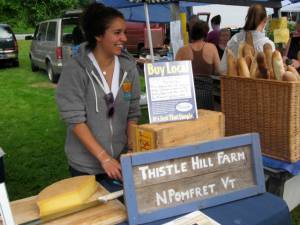
Today, I settled on a cheese from Thistle Hill Farm, in North Pomfret, Vermont, a dairy which epitomizes this cultural and environmental ethos in their cheesemaking.

pomfret cheese

They specialize in a semi-hard cheese named Tarentaise, after the Tarentaise Valley in the Savoie region of the French Alps.  The organic milk from their Jersey cows is combined with imported French cultures and their own rennet in a custom-made copper vat like those used in the Savoie.  The Putnams write on their website:

From its humble beginnings as organic raw milk to its natural aging and rind development, Thistle Hill Farm Tarentaise is as unadulterated a cheese as you will find. The imported French cultures impart flavor and texture. The traditional rennet provides structure and further complexity to the flavor of the cheese. Thistle Hill Farm Tarentaise has no added preservatives, synthetic flavors or additives. No herbs are used to hide its flavor; no waxes or plastics simplify its aging process.

Tarentaise is unique to North Pomfret Vermont’s terrior – its soil, geography, climate and flora – which gives Tarentaise its characteristic smooth, subtle nut flavor and complex finish. http://www.thistlehillfarm.com/default.htm

We sampled little cubes, and then bought a big slab.

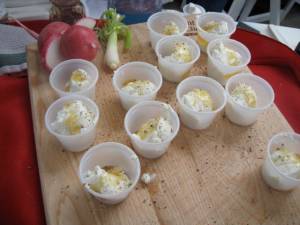
Just before lunch, we migrated to the Lebanon Food Co-op’s Dairy Day, where everything from root beer floats to Greek yogurt could make a mid-morning snack.  While Jack and his cousin went for the root beer and balloons, I sampled the Vermont Butter & Cheese Company’s creamy goat cheese dressed with honey and black pepper, and an assortment of other cheeses, including more Tarentaise.

VT B&C goat
But I was also on the hunt for a sweeter evocation of fields, forages, and herbs.  Some of you might recall my daydreams about the ice creams of Strafford Organic Creamery, the small Guernsey dairy in my first hometown (and the town where Peter and I got married in the meeting house).

Strafford

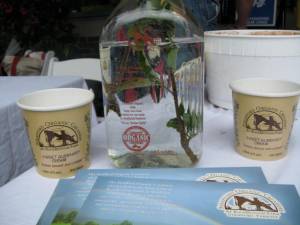
At last, I found their table, where melting ice cream in plastic buckets was being scooped into a constant stream of drippy cones.  I ordered fresh mint, and could taste the herb garden.  Bridget ordered coconut, and my mom got coffee, with its milk-brewed grounds.  Our favorites? It was a toss-up between fresh mint and coffee.  (Strafford Organic Creamery)

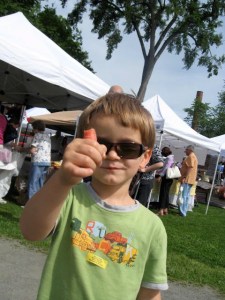
the kind of shot you get from a 4-year-old portraitist

the kind of shot you get from a 4-year-old portraitist

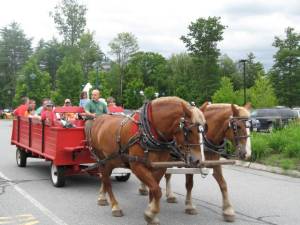
Since it was an event aimed mainly at children and their families, there were the requisite horse-drawn wagon rides around the parking lot.
horsesAnd, of course, Ben and Jerry’s:

B & J's

Read Full Post »

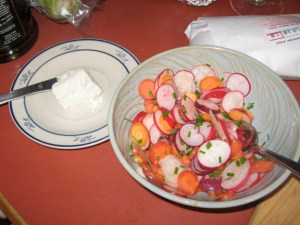
We have fresh local radishes and those salmon colored carrots, as well as about an ounce of fresh goat cheese.  The combination of these flavors–peppery, sweet, and earthy-tangy, will make a delicious salad to go with our pasta tonight.

radish salad

I sliced the carrot and radish into thin discs, tossed them with a spoonful each of red wine vinegar and evoo, and sprinkled them with salt and pepper.  I remembered that there was a huge chive patch out front, so I went out into the drizzle with my scissors and snipped a small bunch.  I snipped these right into the bowl, and then dropped in the goat cheese, and mashed it around a bit. Yum!

Read Full Post »

How to cook kale?  There are many theories which involve long cooking and lots of water, but I prefer to saute it fairly quickly in a hot pan with a bit of olive oil.

Last night, I cooked purple kale.  I pulled large bite-sized pieces off of the stalk, and washed them in cold water.   Sometimes, as with spinach, I’ll grease the pan by cooking some small pieces of bacon or pancetta, then throw the kale in just before the pork gets crunchy.  I always use garlic, and have found that the kale gets most garlicky when several crushed cloves of garlic have been simmered in the oil for a few minutes, so that its skin is slightly caramelized.  After putting in the kale, you can put the lid on for a few minutes to steam it a bit, and when it gets wilty, leave the lid off and toss it with tongs.   I strongly recommend tongs, so that you can squeeze out the excess water before plating it.

Kale is also delicious when it’s tossed together in the pan with mustard greens and spinach.  Red pepper flakes are a nice addition at the end.

Read Full Post »

My favorite way to cook asparagus is to roast it.  The caramelization that happens in the oven brings out the natural sweetness of this grassy green, and the dry heat softens the stalks without turning them to mush.

Preheat oven to 425. Roll asparagus on a cookie sheet in olive oil, salt, and pepper.  Roast for about 10 minutes, until lightly browned but not shriveled.

Asparagus goes particularly well with the breakfasty flavors of eggs and bacon.  For a substantial side or light meal, you could roast the asparagus with bacon, pancetta, or proscuitto pieces sprinkled around, then dress it with a chopped eight-minute egg.

Asparagus is also great with a bit of lemon zest.

Read Full Post »

radishes
After a stop at the Norwich Bookstore and Nana’s apartment, we went to the Hanover farmers’ market, on the Dartmouth green.  I’d had some pent-up desire for this kind of variety and plenty, and I went a little wild.  Jack and I ate half of the bunch of salmon colored carrots right away.
carrot

Then, after craning my neck to assess the competition, I settled on Fable Farm for my armfuls of kale, lettuce, and motley radishes.

fable farm

Then there was raw-milk cheese from Piermont, New Hampshire to sample.  I bought some of the manchego style “Manch-vegas.”  (Did it have that name because it was so over-the-top-flashy-flavorful?  It had to be followed by a full-bodied red.)

cheese

Strawberries!  Next weekend Cedar Circle Farm will have their annual strawberry festival, but we had to stock up before then.

cedar strawberries
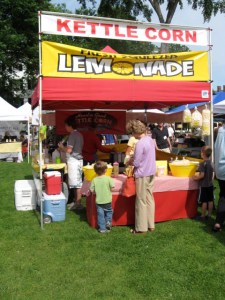
There were sausages, pasture-raised chickens, eggs, breads and baked things of all sorts, fresh-squeezed lemonade, popcorn popped in an aluminum vat the size of a bathtub:

lemondae

beef pork

And asparagus.

asparagus I got a big bunch.  The vendor suggested grilling them, which we did later.  I usually roast them, and I have to say, I’m going to stick with roasting.  They were fine grilled, but they got a bit black.  It’s easier to control the cooking when they’re on a pan in the oven, rolling around in olive oil rather than errant flames.

Around here, it almost goes without saying that the produce, poultry, meat, fruit, and fungi are raised without the help of synthetic chemicals.  Here is a fiercely proud bastion of organics where the suggestion of doubt would be taken as an affront to the dignity of the farmer and her land.  The collective identity of this community, which is scattered across mountains and back roads, is strong in spite of, or because of, the old New England ethos of pioneering individualism and eccentricity that is summed up on New Hampshire’s license plates: “Live Free or Die.”

Jack, exercising his right to sit down wherever he wants to.

Jack, exercising his right to sit down wherever he wants to.

Later on, for dinner, we grilled sausages and the asparagus, sautéed the kale with some crushed garlic, sliced the walnut ficelle, and ate outside while the sun went down.

Read Full Post »

I was listening to “John Wesley Harding” this morning and thinking that Bob Dylan is someone who cultivates oddness—in a way that seems oddly genuine.  (But what is authenticity in a celebrity?  One of the subjects of my British lit. dissertation….)  Anyway, that got me thinking about what an encompassing, useful word “cultivate” is.  We cultivate land, relationships, our intellects, our tastes, even our eccentricities.  Or if you’re a four-year-old boy who loves tractors, you’ll cultivate just about any surface.

cultivator

There are no surprises in its etymology: since its entrance into English, by way of medieval Latin, it has had both a literal and a figurative sense.  It has always meant: to till the soil, to promote the growth of plants and to educate, train, refine a person or intellect; to promote the growth of a science, an art, a sentiment, a friendship; to devote one’s attention to these things.  It is close to nurturing.  We like to help things grow.  Cultivation is culture in the abstract as well as in the most basic form of crops planted for us to pick and eat.

As an adjective applied to the land, it implies an opposite: land is either cultivated or it’s wild or waste.  I like the way Michael Pollan, in my favorite of his books, Second Nature, puts cultivation in the middle of two seemingly opposed concepts in our modern Western paradigm: nature and culture.  Pollan argues, with grace and good sense of humor, that between these, which are not really opposed, must be cultivation. In fact, nature as we know it is already cultivated—as a science, an art, a sentiment.  Since we’ve already had our hand on almost every inch of nature, our obligation is to cultivate it.  Not to turn it all into cornfields, for crying out loud, but not to let it become waste.  To cultivate wilderness that we’ve already tampered with—even if just by demarcation—rather than consider it “virgin” and expect it to fend for itself in the midst of the mean world of modern civilization and its pimps.

Read Full Post »

I came to a junction in the back roads of my mind the other day when I read an article in the New York Times about organic dairy cows in Highgate, Vermont munching alfalfa and flaxseed rather than corn, to make their burps less methane-laden.  The farm supplies milk to Stonyfield Farms, maker of Oikos—organic Greek-style yogurt—of which I’ve just become a big fan. The one with honey on the bottom is the best; when Jack doesn’t finish his dessert honey yogurt, Peter and I jump in to scoop up the last bites.

The last time I was in Highgate, I was the one standing in a field, but I was munching a messy falafel pocket at one of the Grateful Dead’s last shows.  I don’t remember a whole lot about it beyond Dylan’s shiny silver jacket (he was the opening act), crowd anxiety, the falafel, and the way we punned on the name of the town as if we were the only ironic dorks who had thought of it.

One of the dairy products I’m most looking forward to slurping up, when I get to Vermont next week, is the ice cream from Strafford Organic Creamery.  The dairy-farm is owned by the Ransoms, one of whom—William—I went to kindergarten and first grade with, in Strafford.  Here’s an incitement to a craving:

We make our ice cream in small batches, one day each week.  We wouldn’t dream of blending our cows’ cream with anything but the highest-quality organic ingredients. We separate fresh eggs by hand, handpick the mint and black raspberries, and grind the coffee just before we brew it into the milk.

Mmm….

Read Full Post »

« Newer Posts - Older Posts »