Feeds:
Posts
Comments

Posts Tagged ‘eat locally’

The other day, I went back to visit friends from high school, whom I hadn’t seen in about fourteen years, in the town I haven’t visited much since then.  Why not, I can’t really explain.

It was one of the strongest experiences of sense-memory: watching the curve of the off-ramp come into view; feeling the curve in the tilt of my car; knowing when to slow down.  Driving from the Putney Road strip into the little downtown: they’ve redirected traffic, one way past the Common now, so where I expected the stop sign I’d failed to stop at during driver’s ed.—with the bulldog-owning bulldog of a teacher jamming on the breaks—there was none.  Past the library on the right, where I’d spent so many after-school afternoons.  Down the slope.

I can’t believe how much has stayed the same over the decades. The same businesses with the same awnings, not updated in twenty years. (The sign remains for the Common Ground, though the restaurant is no more.  It was a true hippy spot: a cooperatively run restaurant, on the second floor, with creaky floorboards, a bottomless bowl of salad with great tahini dressing, and dense, buttery cornbread.)

common ground

Over other storefronts, new signs : shiny, with spiffy, computer-designed lettering, but keeping in the spirit of the town–a store selling natural body products, another new-age bookstore.  I parked on Main Street, across from The Shoe Tree—there for as long as I can remember.  Above those buildings to the left (east) I see the top of Wantastiquet, that huge hump of a mountain I’d walked up and down with these friends so many times, (and remember parking in its secluded parking lot at night), rising up abruptly from its foot in the Connecticut River.
wantastiquet

I looked up Elliot St. and saw that familiar block between Main Street and the Harmony Lot, where we’d always circled slowly a few times before finding a spot.  There was McNeill’s Brewery on the left, Maple Leaf Music on the right, where I had my first real job (lots of dusting and re-alphabetizing of sheet music).  Just across Elliot Street, down the beginning of the steep hill to Flat Street, was the slanted storefront of Mocha Joe’s coffee shop, where I had my second, and probably favorite, job.  Everything inside was exactly the same.  Four steps down to the counter, display of Bodum pots, tea things, and tee shirts on shelves on the left, a little round table to the right, and the milk-sugar station, the high counter straight ahead.  They were playing The Smiths.  That sounds familiar.

I saw Shannon first at a table at the center of the same ancient-stylized floor painting of a bird’s head in a circular design.  She looked like Shannon.  She said, “you walked right past Ham.”  He was at the counter.  We gave each other a big hug.  I was shaking!  Shannon said she’d reached Amy, who had said she’d be here.  We waited just a few minutes and saw her coming down the stairs, looking exactly like herself.  She said, “I saw you on the street, and thought, yup, that looks like her.” It’s hard to express the feelings in all of our looks and hugs.  We’d known each other so well, and then had been so far apart.  We all felt as if we couldn’t explain why we’d lost touch. We stayed there for a few minutes and then walked down the hill toward the bridge to New Hampshire to the Riverview Café.  We sat on the deck above the river, looking over at Wantastiquet—that mountain that figures so prominently in my memories of high school.
wantastiquet bridge
Our personalities were the same, though we were all more comfortable in our own skin, and talked more like adults, less like self-conscious teenagers.  I remember all of their voices so well. And their laughs, mannerisms, bodies.  It was like seeing distant cousins you used to know well, but more complicated.  We didn’t do much reminiscing in part, I think, because our group memories weren’t always happy.  There was also the feeling that we didn’t need to repeat old stories: the stories were in the air around us.  We had so many shared memories, they were there in our looks more than our words.  We had a decade and a half to catch up on.  The fourteen years when we became “grown-ups” and made our lives what they are now.

One has traveled all over the world and lives in New York City, where he writes headlines for The New York Times; another lives in her childhood house, farms the land of Circle Mountain farm, and sells her organic eggs and produce to the locals; a third is a scientist studying the impact of climate change on different species, and on humans.  I’m working on a Ph.D. in literature and writing a blog about local food, living in Alabama, and moving to Rome.  All of these endpoints, and the paths that took us there, make perfect sense for who we were and at the same time seem paradoxically outlandish.  When I told Amy my dissertation was about eighteenth-century British literature, we both started laughing.  Shannon laughed at herself for knowing so much about the different beetles that are killing off the trees of New England.  Hamilton laughed about having a job that feels like professional ADD, and Amy said, “I’m a farmer,” and we all laughed.

Walking with them, back up to Mocha Joe’s, where Ham went in for another coffee, and then up Elliot St. and around the corner into the Harmony lot, felt so familiar.  My feet, legs, body, eyes remembered all of the little details: even the concrete sidewalks haven’t been updated. There was the little triangle of grass at the corner of the lot and the street that always gets trodden down to mud. The lot, and the back doors of old buildings leading to the same shops (The Book Cellar, Galanes’) were exactly the same.

As I drove up the hill, I remembered—in a deep mind/body memory—the little y intersections and nineteenth-century houses along the streets that led up to Western Ave.  I took a right onto the interstate, but if I’d gone straight, the third right would have been Orchard Street, the hill I walked up and rode my bike up so many times, to Meetinghouse Lane, and home.

Incidentally, the food we had was mostly local: goat cheese salads, grass fed cheddar-bacon burger, pulled pork.  We ate and talked.   The hours went by, and we barely noticed.

Read Full Post »

Roving is a romantic way of saying moving from place to place.  At one time, the word contained more layers of significance than it does now, including something like “lookin’ for love.”  This sense finds its beautiful epitome in Byron’s love lyric, “We’ll go no more a-roving.” More than a poem of love, this is a poem of eros.  The short, simple poem, which Byron wrote while in Venice, speaks of the sweetness of longing and nostalgia as it relishes ironic double entendre.

Today, I’ve had a decidedly more banal, and boring, experience of roving: I drove all around this spread-out rural center of civilization in the northeast—seemingly just to keep the car capable of more driving.  It was a day of logistics: dropping the boys at camp; driving to White River Junction with my sister to get her tire repaired for $13, which took all day; driving to drop off my sister at my dad’s office so that she could use his car; driving to the library for two hours of 1794 literary journals on microfilm; driving to pick up my boy; driving to CVS and the Hanover Food Co-op; driving back to the back roads of Norwich to drop off the cold food; driving to my dad’s office to pick up my sister; driving to the mechanic’s to pick up her car.  On the way out of there, my automatic transmission problem alert signal came on.  It’s an orange-lighted gear with an exclamation point in the center.  Whoa!  So, then we drove, in caravan, to another mechanic’s, who directed us to another, farther south along route 5 in Vermont.  This will probably cost me quite a bit more than $13.

And then we drove back up route 5, which, happily, leads to Killdeer Farm Stand.  I dropped off my sister and the boys at the UPS warehouse to see the trucks (my nephew’s current obsession) and drove to Killdeer.  After a day of aggravation, this was bliss.

The vegetable baskets are more bountiful every day.  I wanted to make a pasta dish with a classic combination of vegetables.  I bought an eggplant, sweet green pepper, sweet onion, costata romanesca.  I looked at everything, admired everything, knew I’d be back tomorrow.

spring veg

I left, reluctantly, to do more driving.

For dinner we had farfalle with all of the above, and some sweet Italian sausage, flavored with fennel seeds, from Cloudland Farm, which we’d had in the freezer.  It was warm, green, springy, delicious.

Spring Pasta

Get the water boiling for pasta.  Meanwhile, break a half-pound of sweet Italian sausage into chunks, and slice half of a sweet onion, one or two Japanese eggplants (their skin is more tender), one sweet green pepper, and one costata romanesca.  Sauté the sausage until mid-rare and let drain in a bowl lined with paper towel.  Sauté the vegetables, beginning with the onion, followed by the eggplant, pepper, and eggplant.  Cook the pasta.  When the vegetables are lightly caramelized, spoon in a couple of big spoonfuls of pasta-cooking water, and cover for a minute or less.  Put the sausage back in the pan, and then combine pasta and vegetables in a big bowl or pot and toss with grated parmgiano  reggiano.  Serve with extra cheese at the table.

Read Full Post »

romanesca
The Italian heirloom summer squash posing as a fluted Roman column.  Striated and flecked with green on shades of green.  When you slice it crosswise, the shapes are floral in a stylized, modern design kind of way.  It maintains a firm, tender-bite texture unlike its more watery cousins, zucchini or yellow summer squash, and has a sweeter, nuttier flavor.

A bit of pork flavor—in the form of browned pancetta or proscuitto—complements costata romanesca beautifully.

We bought some of these squash at Killdeer Farm stand in Norwich to go with our grilled chicken legs last night, I sautéed the flower-shaped discs with some sliced prosciutto and olive oil.   First over moderately high heat, until they started to brown, and then over medium-low heat until they softened a bit.  Seasoned just with sea salt and black pepper.

Read Full Post »

Pork chops, like buttercups, are my Proustian objects.  At the taste of a chop, especially one brined in cider or served with applesauce, I’m back on Old City Falls Road, at the big yellow house in Strafford, Vermont.  Up the steep hill behind the house and barn—a catch-all space housing tools, lumber, a VW bus, my Dad’s darkroom, a sauna—was the pond where I learned to swim and skate, and the pig pen.  My parents, on the run from suburbia back to the land, had set up a small homestead with a vegetable garden, chickens, pigs, a goat, and two little girls running around in Wonder Woman Underoos in January, because the wood stove kept the living room so hot.

The pigs, Gruntly Squatwell and Squatly Gruntwell, were contented animals until that particular date when my uncle and a few other guys would show up in their pickup trucks for the big pig roundup.  Then the pigs ran around and around their pen squealing for their lives, though they didn’t know it.

The result was a freezer full of pork.  For some reason, I remember the chops best of all.  Sweetish and salty, for me the essence of pork—until I tasted pancetta, but that’s a different kind of experience.  The best, more recent, pork chops I’ve had were grilled by our friend Donia, the energetic and lovely Palo Alto chef and writer.  Her cooking—whether in her restaurant or home—is less a performance than an expression of her nurturing nature.  The food is loved and cared for, as are the friends she feeds.

The technique here is so simple, it barely warrants the formalization of a recipe, but here goes:

Donia’s Pork Chops

In the morning, place four thick-cut bone-in pork chops (organic if possible) in a large baking dish, and pour in a fruity red wine—a Beaujolais, or a zinfandel, perhaps—just to cover them.  Turn them over once or twice during the day.  Just before grilling—preferably over charcoal—season them liberally with salt and pepper.  Grill to mid-rare over moderate heat.  Throw some perfectly ripe buttered halved peaches onto the grill too, for a taste sensation.  Donia also served cornbread and salad, outside on the deck.  What a memorable meal!

Read Full Post »

It’s a comfort, shaping meatballs.  Only my fingertips touch, shape, nudge, they are so delicate. Unlike the muscle and torque involved in kneading bread, the pressure here has to be slight.  The way you might hold an infant’s foot.

Yes, I know. I’m talking about raw meat.  But I love making these meatballs in part because I use a recipe from a friend I’ve lost touch with, and they remind me of the dinners he cooked for us–at once so scrupulous and so lax.  Jonathan was exact about ingredients, cooking temps and times, the composition of courses.  And relaxed about the way the evening stretched late into the night, about lipstick marks on wine glasses–from previous drinkers–about the terrifying mess in the kitchen.

We had a delicious rivalry.  He would cook us a multi-course meal with wines to match, and we’d follow up the next weekend at our apartment, just up the hill from his, on Euclid Ave. in Berkeley.  It went on, as we attempted amicably to one-up each other.

The meatballs were one of the best meals.  Here is his basic recipe, as I remember it, which came from his Nonna, his Italian grandmother.

Jonathan’s Meatballs

1 lb. ground beef
1 egg
1/2 eggshell water
1/3 c. fresh bread crumbs
small handful chopped parsley
4 cloves garlic, minced
plenty of salt and freshly ground black pepper or some red pepper flakes for spice

Combine all ingredients, and shape gently into meatballs, either large or small.  Cook over moderate heat in an oiled or buttered pan, turning occasionally, until done.  Serve immediately.

Tonight, I had the luxury of local grass fed ground beef, local fresh eggs, and of course local herbs.  I substituted blanched garlic scapes for the garlic cloves.


Read Full Post »

Saturday morning, Norwich Farmers’ Market.  We got there too late for the golden beets: I saw the last bunch go at 10:15.  Maybe next week….

peas

But oh, the potatoes and peas!  The Fairlee, Vermont farm, coyly called “Your Farm,” had baskets upon baskets of sugar snap peas–the kind you can eat right off the vine, pod and all.  Jack was working it like a boiled, salted edamame pod, but was happy finally to eat the whole thing.

eating pea

These peas taste so good raw, they may not last until later, when I’ll make a salad of new potatoes, scapes, herbs and peas.  New potatoes are here in abundance: they are so tender and waxy it’s almost tempting to eat them raw, but lightly boiled will agree with tummies much better. I bought a couple of pounds at the Hurricane Flats farm stand.  (This farm is located on the banks of the beautiful White River, a tributary of the Connecticut, in South Royalton, VT.)

potatoes

New Potato Salad

Potatoes are a blank slate, upon which a thousand personalities can be written.  Bacon is always a good friend to potatoes, as are peas, corn, green beans, and fresh herbs like dill, tarragon, thyme, and parsley.   Caraway seeds are interesting additions to a potato salad dressed generously with a dijon-based vinaigrette.  Here’s what I’ll do with my potatoes, scapes, and maybe peas, today.

Boil potatoes until fork-tender.  Quarter them, and toss with a spoonful of vinegar (red wine, champagne, or cider are good) and two spoonfuls of extra virgin olive oil, salt and pepper. (The quantities depend on how many potatoes you have; they should be dressed but not dripping.)

Then, add some crisped bacon/pancetta/prosciutto bits, and any combination of the above suggested veggies and herbs.  Today, I’m also going to add some lightly sauteed, then smashed, garlic scapes.

Let the salad sit and steep for awhile, and serve warm or chilled.

Read Full Post »

Gorgeous green curlicues, Watteauesque arabesques…

scapes
Not to be confused with green garlic (long spring stalks with the bulbs attached) or ramps (wild leeks, whose season is earlier), scapes are the seed pod portion of the garlic plant that must be culled before they harden and pale from green to beige.  Snipping them helps the garlic bulb below fatten up.  Scapes’ season is fleeting, their flavor mere essence, evanescence.

Unlike the stronger-tasting bulbs, mild scapes can stand alone: blanched and tossed on a salad or ground into a pesto; sautéed with baby bok choy and thrown together with noodles; mixed in sneakily with green beans for an added dimension of flavor.

At the Hanover farmers’ market on Wednesday afternoon, I bought a small bunch.  Last night, my mom diced scapes and added them to her summery corn and edamame salad.  The night before, I sautéed them with local greens in a dish I make frequently, which is based on yaki-soba.  Here’s the recipe:

Garlicky Noodles and Greens
Serves 4

1 package soba (buckwheat) noodles
1 lb. fresh spinach, washed and torn up
2 heads baby bok choy, roughly chopped
5 garlic scapes, chopped
1 lb. flank steak or chicken breast, sliced
2 tbs. sesame oil
2 tbs. mirin
2 tbs. soy sauce
Thai hot sauce
Lime slices

In a small bowl, combine oil, mirin, and soy sauce; set aside. Sauté the meat until mid-rare, and set aside.  In the same pan, with a bit more oil, cook the greens and scapes, covered, over moderate heat.  After a few minutes, remove the lid, to let the water evaporate.  Meanwhile, bring a large pot of water to a boil, add the soba noodles, and cook for 5 minutes.  Drain, and pour into a warmed serving bowl.  Just before serving, put the meat back in the pan with the greens to re-warm.  Combine greens & meat with noodles, pour the sauce over, and toss to coat.  Add hot sauce and lime juice individually to taste.

Read Full Post »

cheese sample

Vermont is, of course, known for its dairy farms, along with its maple syrup.    The two events I went to today, the Norwich Farmers’ Market and the Co-op’s annual Dairy Day, are really celebrations of the richness, variety, and history of Vermont’s dairies, which stretches back to the seventeenth century. While stories of small dairies going out of business or being bought out by large conglomerates are common these days, some of the most successful operations now are small.  They have simply shifted their market focus and serve the (expanding) niche markets defined by the desire for food that is of a high quality, is local, and is artisanal in some way.  The desire for these traits goes along with a conservationist ethos that looks both forward and back.  Heirloom seeds and techniques are prized for their history as well as for the continuity and contribution to biodiversity they offer to the future.

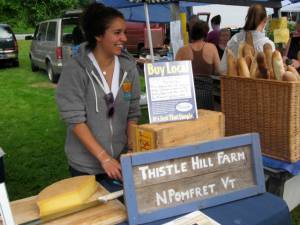
Today, I settled on a cheese from Thistle Hill Farm, in North Pomfret, Vermont, a dairy which epitomizes this cultural and environmental ethos in their cheesemaking.

pomfret cheese

They specialize in a semi-hard cheese named Tarentaise, after the Tarentaise Valley in the Savoie region of the French Alps.  The organic milk from their Jersey cows is combined with imported French cultures and their own rennet in a custom-made copper vat like those used in the Savoie.  The Putnams write on their website:

From its humble beginnings as organic raw milk to its natural aging and rind development, Thistle Hill Farm Tarentaise is as unadulterated a cheese as you will find. The imported French cultures impart flavor and texture. The traditional rennet provides structure and further complexity to the flavor of the cheese. Thistle Hill Farm Tarentaise has no added preservatives, synthetic flavors or additives. No herbs are used to hide its flavor; no waxes or plastics simplify its aging process.

Tarentaise is unique to North Pomfret Vermont’s terrior – its soil, geography, climate and flora – which gives Tarentaise its characteristic smooth, subtle nut flavor and complex finish. http://www.thistlehillfarm.com/default.htm

We sampled little cubes, and then bought a big slab.

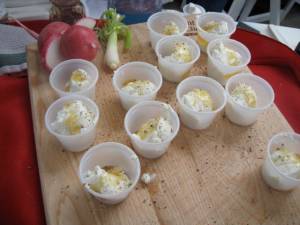
Just before lunch, we migrated to the Lebanon Food Co-op’s Dairy Day, where everything from root beer floats to Greek yogurt could make a mid-morning snack.  While Jack and his cousin went for the root beer and balloons, I sampled the Vermont Butter & Cheese Company’s creamy goat cheese dressed with honey and black pepper, and an assortment of other cheeses, including more Tarentaise.

VT B&C goat
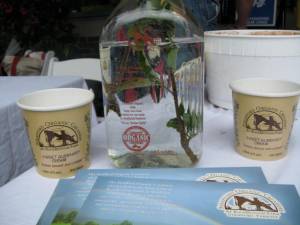
But I was also on the hunt for a sweeter evocation of fields, forages, and herbs.  Some of you might recall my daydreams about the ice creams of Strafford Organic Creamery, the small Guernsey dairy in my first hometown (and the town where Peter and I got married in the meeting house).

Strafford

At last, I found their table, where melting ice cream in plastic buckets was being scooped into a constant stream of drippy cones.  I ordered fresh mint, and could taste the herb garden.  Bridget ordered coconut, and my mom got coffee, with its milk-brewed grounds.  Our favorites? It was a toss-up between fresh mint and coffee.  (Strafford Organic Creamery)

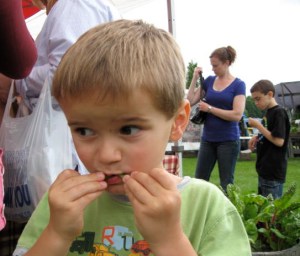
the kind of shot you get from a 4-year-old portraitist

the kind of shot you get from a 4-year-old portraitist

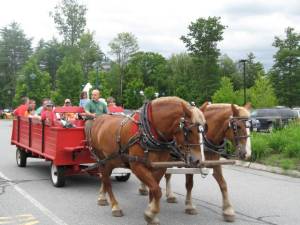
Since it was an event aimed mainly at children and their families, there were the requisite horse-drawn wagon rides around the parking lot.
horsesAnd, of course, Ben and Jerry’s:

B & J's

Read Full Post »

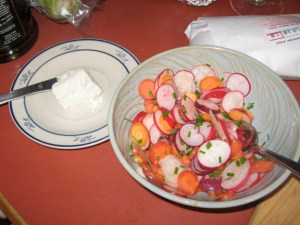
We have fresh local radishes and those salmon colored carrots, as well as about an ounce of fresh goat cheese.  The combination of these flavors–peppery, sweet, and earthy-tangy, will make a delicious salad to go with our pasta tonight.

radish salad

I sliced the carrot and radish into thin discs, tossed them with a spoonful each of red wine vinegar and evoo, and sprinkled them with salt and pepper.  I remembered that there was a huge chive patch out front, so I went out into the drizzle with my scissors and snipped a small bunch.  I snipped these right into the bowl, and then dropped in the goat cheese, and mashed it around a bit. Yum!

Read Full Post »

How to cook kale?  There are many theories which involve long cooking and lots of water, but I prefer to saute it fairly quickly in a hot pan with a bit of olive oil.

Last night, I cooked purple kale.  I pulled large bite-sized pieces off of the stalk, and washed them in cold water.   Sometimes, as with spinach, I’ll grease the pan by cooking some small pieces of bacon or pancetta, then throw the kale in just before the pork gets crunchy.  I always use garlic, and have found that the kale gets most garlicky when several crushed cloves of garlic have been simmered in the oil for a few minutes, so that its skin is slightly caramelized.  After putting in the kale, you can put the lid on for a few minutes to steam it a bit, and when it gets wilty, leave the lid off and toss it with tongs.   I strongly recommend tongs, so that you can squeeze out the excess water before plating it.

Kale is also delicious when it’s tossed together in the pan with mustard greens and spinach.  Red pepper flakes are a nice addition at the end.

Read Full Post »

« Newer Posts - Older Posts »