Feeds:
Posts
Comments

Archive for the ‘Whimsical’ Category

File:Rosetti02.jpg

Here is Dante Gabriel Rossetti’s luxuriant post-Romantic Persephone, holding the fruit that completed her curse and imposed the season of winter on the world.   Abducted by Hades, and held in his realm, she was tricked into eating four seeds of the pomegranate.  Every year thereafter, she was forced to spend four months in the Underworld.  During these months, her mother, Demeter, the goddess of fertility, who mourned the loss of her daughter, neglected her duties and let the fruitfulness of the world die away.

This fruit has incredible baggage.  It is associated with fruitfulness in many traditions, and carries the whiff of the forbidden in Greek myth and Hebrew tradition (some believe Eve ate not an apple but a pomegranate).  In a contemporary version of myth and the mysteries of the body—nutrition science—the pomegranate is again a hallowed fruit, worshiped for its antioxidants, the free radicals (a great phrase) that may help to reduce the likelihood of everything from heart disease to breast cancer from developing.  Many Americans spend as much on a bottle of pomegranate juice as they do on a bottle of wine, and feel just as cultured and more virtuous for doing so.

poms

The other afternoon, I thought I might be in paradise.  The sun was warm and the breeze was cool in the garden at the American Academy.  I lay down in the long grass beneath the long, bowed, branches of the pomegranate tree, which were heavy with fruit. I heard the happy voices of Jack and his friends, as they ran around, frolicking and gamboling.  (Here’s an opportunity to use that word unironically–almost.)  I reached up to pick the biggest fruit, and later on enjoyed seeing Jack discover all of the secret chambers full of sweet-tart drippy seeds.

open pom

eat pom

We seem to have avoided any curses, unless that thunder storm that woke us up this morning counts.

Read Full Post »

It seems fitting that in such an ancient/modern city as Rome, hunter-gatherers should coexist peacefully with perennial lovers-on-blankets and with i-pod-wired joggers.  The largest public park, Villa Doria Pamphili, exemplifies this shared experience of urban life.

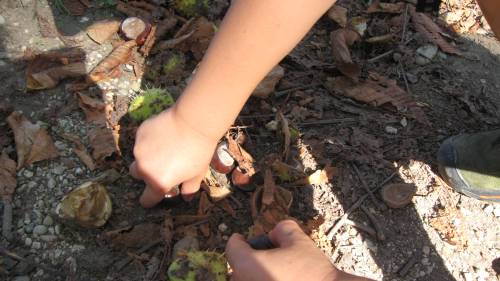
It’s relatively nearby the American Academy, and I’ve been running there on recent mornings.  While I admit I haven’t seen any true hunting, unless you count fit men doing pull-ups eyeing the passing women sweating it up in their requisite black tights, I have seen old men and young boys fishing in the pond, random gatherers of the chestnuts that are falling fast and hard from the trees, and a man with a large sack clipping the last of the dandelion greens, before the mowers arrived.  Free urban harvesting lives on.

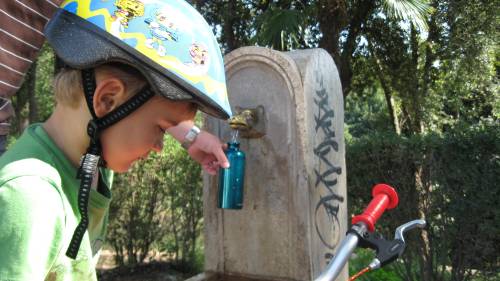
We took Jack there today, to ride his bike.  This park is one of the scenes I love about this city, because it blends the ancient with the baroque with the modern—not seamlessly at all, but with the surprise of oddly continuous juxtapositions.  When you take your eyes off of the contemporary Romans, who are surprising for their collective attractiveness and style, you see alongside these modern habits—jogging, doing leg-lifts and push-ups along the “Percorso Salute” (the Health Course) with its exercise stations marked out—the ancient forms of aqueducts and arches, the baroque curlicues of stone leaves and niches.  (Exercise and self-care aren’t modern inventions by far, but that’s another post.)

J aqueduct

gathering chestnuts

Villa Doria Pamphili is the largest public park in Rome.  The baroque villa, built on the prominent hilltop acreage in the early seventeenth century, is now a museum, and the former vineyard and garden—which also played an important strategic role in Garibaldi’s defeat of the French, and so in Italian unification as a nation, with Rome as the capital—is now a park landscaped as if designed to speak one word: leisure.

the villa

the villa

topiary mazes

topiary mazes

J & swans

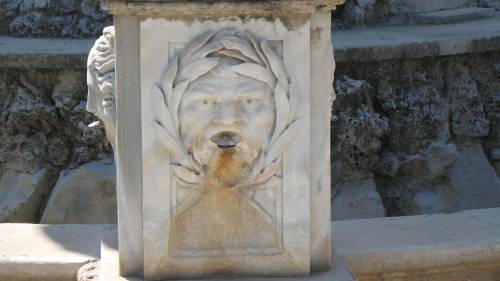
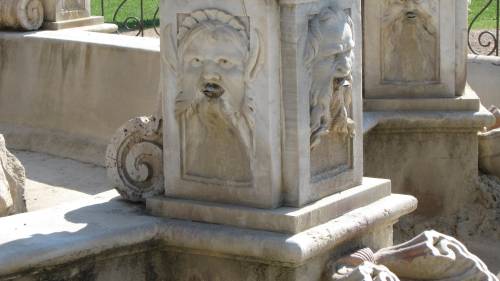
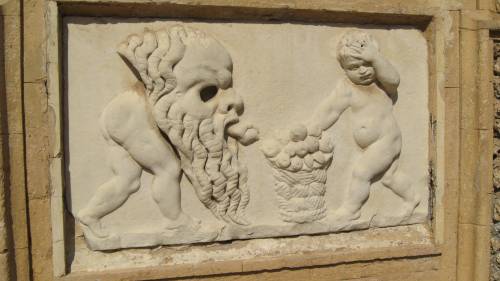
What I love best about the park, though, aside from the people watching, is the baroque interpretation of “pagan stuff”: weird wizardly men as the fountain faces, and funny scenes involving putti.  Here are a few of my favorites.

font face 2

fontana

font. face 3

nice ears

Check out these putti at play:

putti

Filling up, at the wolf’s mouth:

wolf fountain

This is a civilization that knows how to eat well, exercise well (though sometimes stopping for a smoke), drink well, sculpt well, kiss well, relax well.

I sauteed a huge bagful of dandelion greens tonight, which I’d bought at an open market stall a few days ago.  Wonder where those greens were gathered.

I’m not sure what we’ll do with Jack’s collection.  There is a good grill out back….

chestnuts

Read Full Post »

Back in Vermont, now, where we’re having the hottest night of the summer.  Haze turned the Green Mountains graduated shades of blue-gray today, on our long drive home.  Our last day on Nantucket was a full one–from bikes and beach in the morning to a wedding party in the evening.  Blank from a day of travel, I’ll just post the highlights.

ubiquitous blue hydrangea

ubiquitous blue hydrangea

Jack and the tree that was probably a sapling when our ancestors, the Rodmans, Rotches, and Husseys were on this island worshiping the whales:

tree

Waiting for waves at Cisco Beach:

wave

And boogie boarding:

boogieb

Then, we were off to the celebration in Siasconset.  Ginger ale or Veuve?

shirley
Jack liked the “shrimp lollipops.”

shrimp

Jeremiah liked the Boston lettuce:

salad

And everyone liked the chocolate-espresso pot de creme:

choc. pot

And, since I did more body-surfing than web-surfing or researching of any kind, I’ll put in a link to an article on “Slow Fish” on a related island, Martha’s Vineyard.

Read Full Post »

We’re on Nantucket for a bit this week.  My cousin’s getting married, so our family (minus Peter, who’s at Breadloaf) is crashing in a mothbally cottage that sits on a rare high hill on this island, and would have a 360-degree view if it weren’t for the fog, clouds, and rain.  “It’s ANOTHER blustery day!” shouts Jack, thrilled by any weather.

I’ve been enjoying local food steadily, but don’t have a steady stream of internet access.  I’m sitting in a corner in the “Atheneum”–the town library–right now, but I forgot to upload the great pictures I took last night of three tunas being butchered dockside.

So… more on tuna and other treasures of the sea, and the organic farm, and Something Natural, later.

Jack and I enjoyed a simple meal on the ferry on the way over: slices of Jarlsberg, “crispy wheats,” amber ale, lemondade.

Jack ferry

His favorite part was watching the wake.

Read Full Post »

Artist friends, look at this!

Purple beans

Look at these colors.  They don’t spring out.  They are dark and intuitional, like Arthur Dove’s.  Not as overt as Georgia O’Keefe’s, though I’m asking you to look at the small, wet extremity that splits the color spectrum into two.

It’s shocking, disappointing, and then, simply life.  These beans, when boiled, go from purple to green.  The most intense purple, deep, darkly fertile.  To green.  Basic beany green.

Romano.  String. Wax. Green.  Jack and the bean stalk.  There’s still some magic, despite the Anglo-Saxon simplicity of name.

Jack's sprout

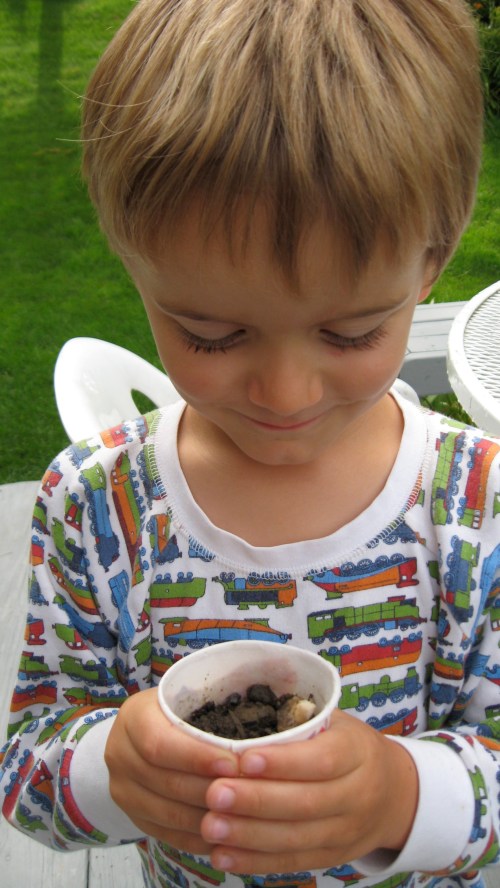
Jack is thrilled to see his bean coming to fruition. Fruition. It is a fruit. First the little, tender stem. Then, the tiny, furled leaf.  He planted it in a Dixie cup full of soil. He didn’t, and doesn’t, know what it was.  But his enthusiasm for the greenness of the green shoot is boundless.  He’s contemplative, in awe, amazed, incredulous, proud. It’s a pleasure to watch. Does it have anything to do with his asking, “Mommy, why did you decide to grow a baby? … I mean me?”

Read Full Post »

It’s been nice hearing from all of you, good friends, from Berkeley, in the past few days, especially after getting an official notice telling me my email account was being closed.  Is that some desperate attempt at cost-cutting on the part of the university?  

I have such good memories of Berkeley, and these memories tend to focus on food and walks.

Running down the hill this morning made me think about another regular route I used to take all the way down a steep hill, and then back up.  Not the one to campus, no.  The one to the Cheese Board and to Peets.  Especially during Jack’s first year, I had the need to walk a lot.  Sometimes I’d walk with Bea and our boys in the strollers all the way down the streets and paths to Solano Ave., to Thousand Oaks School, where they had a tot playground with lots of castoff Little Tikes toys.  Most days I’d walk by myself, with Jack strapped in the Ergo on my back, down Euclid, the Vine Lane path, and Vine, to Peets for a latte and across Shattuck Ave. for a corn cherry scone:  the yummiest, most comfort-foody cornmeal drop scone full of dried slightly sour bing cherries. No other scone has ever measured up.

Read Full Post »

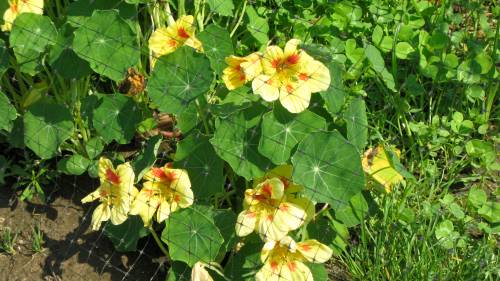
nasturtiums

I put myself through another onrush-of-memories experience this morning.  I stopped by the Dartmouth Organic Farm, three miles north of campus on Lyme Road.  There was a space in the dirt driveway, so I parked my car next to the house I lived in senior year, and walked across the yard that, on my graduation morning, was a brilliant swath of dandelion yellow.

house

Things looked pretty much the same—seedling trays in the greenhouse here and there, the dry-erase board marked up with to-do lists and sunshine doodles, cast-off chairs and tables and grills in the garage—except for the plant life.  I couldn’t believe how overgrown the hillside had become.  I took the familiar path down the hill to the garden, (remembering how annoyed we got when people stepped over instead of around the switchback we’d built to keep the hillside from eroding) but what used to be an airy walk through saplings had become a dark walk through forest dense with vines.  Twelve years have gone by.

a freight train goes by now

a freight train goes by now

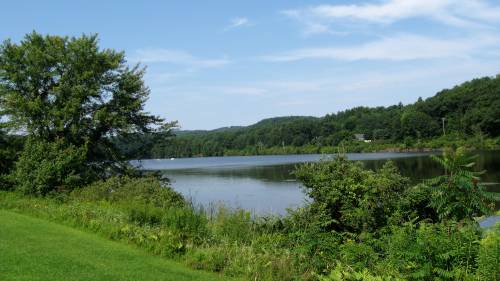
The garden, though, when it came into view, looked unchanged.  Beds of lush vegetables, some beds of mixed cover crops, stretching down to the grassy bank of the Connecticut River. The valley fog was just burning off.

Scott Stokoe, the farm manager, was talking with the head intern, John, about what had to be done before the CSA delivery to students this afternoon.  He acknowledged the growth on the hillside when he pointed out the shade that was keeping down the winter squash.

shade

John went off to start harvesting, and Scott and I had a long conversation about the farm’s evolution over the past decade, about that first year, when it was a pilot program and I lived there with three friends—weeding, planting, picking, eating well—and about integrating sustainability into the liberal arts curriculum (which I’m involved with at Auburn).

I walked through the fields snapping pictures, and then helped the interns harvest sungold tomatoes for the afternoon delivery.  They were ripening nicely, but the vines were sparse because of the hungry deer who come for a nightly meal.  The students recently erected a fence, which will hopefully keep the deer away from everyone’s favorite crop—the unbelievably sweet sungolds.

sungolds

I looked up the hill to the north, where we used to swing from a rope into the river and swim upstream as far as we could go until we got tired.

There was another familiar sight: crew practice.

crew

onions

onions

John, who lives in the house now, said he didn’t mind if I peeked in.  The year I lived there, 1996-7, was the first year it was used by the College as “the farm house.”  It had been a long time since it had been occupied.  It’s a solidly built old farmhouse with sturdy hardwood throughout.  I moved in with three girlfriends—Amy, CJ, and Christine—and we brought just a few pieces of furniture and kitchenware.  It was spare and neat.  After twelve years of both female and male undergrads moving in and moving out, let’s just say the house looked lived-in.  I opened the solid wood door to the screened-in porch out back.  You used to be able to see the river.  I remembered the first time I invited Peter—now my husband—over for dinner.  We cooked vegetables harvested that day on the fields below, and ate on the gray-painted floor of the porch (we had no chairs).  I also went up to the room that used to be mine and looked out the windows at the familiar view of the river.  I remember sitting at my desk—a door on cinderblocks with a batik tapestry on top—and writing a poem about the ice on the river breaking up in the spring.

That was a good year I spent there.  I’m glad I went back.

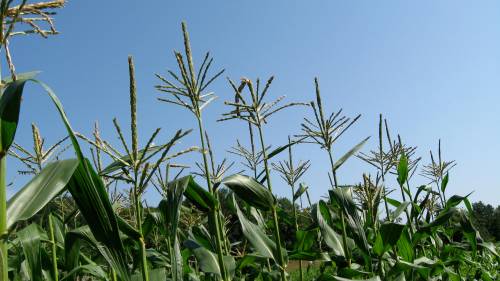
tassels

Read Full Post »

The other day, I went back to visit friends from high school, whom I hadn’t seen in about fourteen years, in the town I haven’t visited much since then.  Why not, I can’t really explain.

It was one of the strongest experiences of sense-memory: watching the curve of the off-ramp come into view; feeling the curve in the tilt of my car; knowing when to slow down.  Driving from the Putney Road strip into the little downtown: they’ve redirected traffic, one way past the Common now, so where I expected the stop sign I’d failed to stop at during driver’s ed.—with the bulldog-owning bulldog of a teacher jamming on the breaks—there was none.  Past the library on the right, where I’d spent so many after-school afternoons.  Down the slope.

I can’t believe how much has stayed the same over the decades. The same businesses with the same awnings, not updated in twenty years. (The sign remains for the Common Ground, though the restaurant is no more.  It was a true hippy spot: a cooperatively run restaurant, on the second floor, with creaky floorboards, a bottomless bowl of salad with great tahini dressing, and dense, buttery cornbread.)
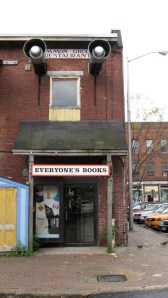
common ground

Over other storefronts, new signs : shiny, with spiffy, computer-designed lettering, but keeping in the spirit of the town–a store selling natural body products, another new-age bookstore.  I parked on Main Street, across from The Shoe Tree—there for as long as I can remember.  Above those buildings to the left (east) I see the top of Wantastiquet, that huge hump of a mountain I’d walked up and down with these friends so many times, (and remember parking in its secluded parking lot at night), rising up abruptly from its foot in the Connecticut River.
wantastiquet

I looked up Elliot St. and saw that familiar block between Main Street and the Harmony Lot, where we’d always circled slowly a few times before finding a spot.  There was McNeill’s Brewery on the left, Maple Leaf Music on the right, where I had my first real job (lots of dusting and re-alphabetizing of sheet music).  Just across Elliot Street, down the beginning of the steep hill to Flat Street, was the slanted storefront of Mocha Joe’s coffee shop, where I had my second, and probably favorite, job.  Everything inside was exactly the same.  Four steps down to the counter, display of Bodum pots, tea things, and tee shirts on shelves on the left, a little round table to the right, and the milk-sugar station, the high counter straight ahead.  They were playing The Smiths.  That sounds familiar.

I saw Shannon first at a table at the center of the same ancient-stylized floor painting of a bird’s head in a circular design.  She looked like Shannon.  She said, “you walked right past Ham.”  He was at the counter.  We gave each other a big hug.  I was shaking!  Shannon said she’d reached Amy, who had said she’d be here.  We waited just a few minutes and saw her coming down the stairs, looking exactly like herself.  She said, “I saw you on the street, and thought, yup, that looks like her.” It’s hard to express the feelings in all of our looks and hugs.  We’d known each other so well, and then had been so far apart.  We all felt as if we couldn’t explain why we’d lost touch. We stayed there for a few minutes and then walked down the hill toward the bridge to New Hampshire to the Riverview Café.  We sat on the deck above the river, looking over at Wantastiquet—that mountain that figures so prominently in my memories of high school.
wantastiquet bridge
Our personalities were the same, though we were all more comfortable in our own skin, and talked more like adults, less like self-conscious teenagers.  I remember all of their voices so well. And their laughs, mannerisms, bodies.  It was like seeing distant cousins you used to know well, but more complicated.  We didn’t do much reminiscing in part, I think, because our group memories weren’t always happy.  There was also the feeling that we didn’t need to repeat old stories: the stories were in the air around us.  We had so many shared memories, they were there in our looks more than our words.  We had a decade and a half to catch up on.  The fourteen years when we became “grown-ups” and made our lives what they are now.

One has traveled all over the world and lives in New York City, where he writes headlines for The New York Times; another lives in her childhood house, farms the land of Circle Mountain farm, and sells her organic eggs and produce to the locals; a third is a scientist studying the impact of climate change on different species, and on humans.  I’m working on a Ph.D. in literature and writing a blog about local food, living in Alabama, and moving to Rome.  All of these endpoints, and the paths that took us there, make perfect sense for who we were and at the same time seem paradoxically outlandish.  When I told Amy my dissertation was about eighteenth-century British literature, we both started laughing.  Shannon laughed at herself for knowing so much about the different beetles that are killing off the trees of New England.  Hamilton laughed about having a job that feels like professional ADD, and Amy said, “I’m a farmer,” and we all laughed.

Walking with them, back up to Mocha Joe’s, where Ham went in for another coffee, and then up Elliot St. and around the corner into the Harmony lot, felt so familiar.  My feet, legs, body, eyes remembered all of the little details: even the concrete sidewalks haven’t been updated. There was the little triangle of grass at the corner of the lot and the street that always gets trodden down to mud. The lot, and the back doors of old buildings leading to the same shops (The Book Cellar, Galanes’) were exactly the same.

As I drove up the hill, I remembered—in a deep mind/body memory—the little y intersections and nineteenth-century houses along the streets that led up to Western Ave.  I took a right onto the interstate, but if I’d gone straight, the third right would have been Orchard Street, the hill I walked up and rode my bike up so many times, to Meetinghouse Lane, and home.

Incidentally, the food we had was mostly local: goat cheese salads, grass fed cheddar-bacon burger, pulled pork.  We ate and talked.   The hours went by, and we barely noticed.

Read Full Post »

Pork chops, like buttercups, are my Proustian objects.  At the taste of a chop, especially one brined in cider or served with applesauce, I’m back on Old City Falls Road, at the big yellow house in Strafford, Vermont.  Up the steep hill behind the house and barn—a catch-all space housing tools, lumber, a VW bus, my Dad’s darkroom, a sauna—was the pond where I learned to swim and skate, and the pig pen.  My parents, on the run from suburbia back to the land, had set up a small homestead with a vegetable garden, chickens, pigs, a goat, and two little girls running around in Wonder Woman Underoos in January, because the wood stove kept the living room so hot.

The pigs, Gruntly Squatwell and Squatly Gruntwell, were contented animals until that particular date when my uncle and a few other guys would show up in their pickup trucks for the big pig roundup.  Then the pigs ran around and around their pen squealing for their lives, though they didn’t know it.

The result was a freezer full of pork.  For some reason, I remember the chops best of all.  Sweetish and salty, for me the essence of pork—until I tasted pancetta, but that’s a different kind of experience.  The best, more recent, pork chops I’ve had were grilled by our friend Donia, the energetic and lovely Palo Alto chef and writer.  Her cooking—whether in her restaurant or home—is less a performance than an expression of her nurturing nature.  The food is loved and cared for, as are the friends she feeds.

The technique here is so simple, it barely warrants the formalization of a recipe, but here goes:

Donia’s Pork Chops

In the morning, place four thick-cut bone-in pork chops (organic if possible) in a large baking dish, and pour in a fruity red wine—a Beaujolais, or a zinfandel, perhaps—just to cover them.  Turn them over once or twice during the day.  Just before grilling—preferably over charcoal—season them liberally with salt and pepper.  Grill to mid-rare over moderate heat.  Throw some perfectly ripe buttered halved peaches onto the grill too, for a taste sensation.  Donia also served cornbread and salad, outside on the deck.  What a memorable meal!

Read Full Post »

D&W

Dan and Whit’s is a real general store.  Their slogan—“If we don’t have it, you don’t need it”—combines the ideal of American bounty with a New England puritan disapproval of things.  Shopping in the store is a desultory, serendipitous ramble.  Hardware can be found hard by the lotion.  Cheese isn’t far from ski gloves and board games.

J in D&W
Their hardwood floors are warped with age.  Their common sense slips into irony (there’s a hand-scrawled sign on the green door between the deli and the house-paint that says “this is the green door”).  Their pride is in being entirely unpretentious.  There was a collective huff when the store started carrying Carhartt work clothes last year.  (The brand was seen as too hoity toity.)  But they do succeed in maintaining their own brand of mish-mash pragmatic back-to-basics authenticity, even while carrying Champlain Chocolate (next to the Blow-Pops), top shelf wine, and retro wooden toys for the upscale toddler.
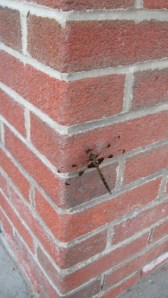
dragonfly
What was this gigantic dragonfly doing there?  It must have lost its way between Main Street and the Bloody Brook.

Read Full Post »

« Newer Posts - Older Posts »