Feeds:
Posts
Comments

Archive for the ‘Vegetables’ Category

Roving is a romantic way of saying moving from place to place.  At one time, the word contained more layers of significance than it does now, including something like “lookin’ for love.”  This sense finds its beautiful epitome in Byron’s love lyric, “We’ll go no more a-roving.” More than a poem of love, this is a poem of eros.  The short, simple poem, which Byron wrote while in Venice, speaks of the sweetness of longing and nostalgia as it relishes ironic double entendre.

Today, I’ve had a decidedly more banal, and boring, experience of roving: I drove all around this spread-out rural center of civilization in the northeast—seemingly just to keep the car capable of more driving.  It was a day of logistics: dropping the boys at camp; driving to White River Junction with my sister to get her tire repaired for $13, which took all day; driving to drop off my sister at my dad’s office so that she could use his car; driving to the library for two hours of 1794 literary journals on microfilm; driving to pick up my boy; driving to CVS and the Hanover Food Co-op; driving back to the back roads of Norwich to drop off the cold food; driving to my dad’s office to pick up my sister; driving to the mechanic’s to pick up her car.  On the way out of there, my automatic transmission problem alert signal came on.  It’s an orange-lighted gear with an exclamation point in the center.  Whoa!  So, then we drove, in caravan, to another mechanic’s, who directed us to another, farther south along route 5 in Vermont.  This will probably cost me quite a bit more than $13.

And then we drove back up route 5, which, happily, leads to Killdeer Farm Stand.  I dropped off my sister and the boys at the UPS warehouse to see the trucks (my nephew’s current obsession) and drove to Killdeer.  After a day of aggravation, this was bliss.

The vegetable baskets are more bountiful every day.  I wanted to make a pasta dish with a classic combination of vegetables.  I bought an eggplant, sweet green pepper, sweet onion, costata romanesca.  I looked at everything, admired everything, knew I’d be back tomorrow.

spring veg

I left, reluctantly, to do more driving.

For dinner we had farfalle with all of the above, and some sweet Italian sausage, flavored with fennel seeds, from Cloudland Farm, which we’d had in the freezer.  It was warm, green, springy, delicious.

Spring Pasta

Get the water boiling for pasta.  Meanwhile, break a half-pound of sweet Italian sausage into chunks, and slice half of a sweet onion, one or two Japanese eggplants (their skin is more tender), one sweet green pepper, and one costata romanesca.  Sauté the sausage until mid-rare and let drain in a bowl lined with paper towel.  Sauté the vegetables, beginning with the onion, followed by the eggplant, pepper, and eggplant.  Cook the pasta.  When the vegetables are lightly caramelized, spoon in a couple of big spoonfuls of pasta-cooking water, and cover for a minute or less.  Put the sausage back in the pan, and then combine pasta and vegetables in a big bowl or pot and toss with grated parmgiano  reggiano.  Serve with extra cheese at the table.

Read Full Post »

romanesca
The Italian heirloom summer squash posing as a fluted Roman column.  Striated and flecked with green on shades of green.  When you slice it crosswise, the shapes are floral in a stylized, modern design kind of way.  It maintains a firm, tender-bite texture unlike its more watery cousins, zucchini or yellow summer squash, and has a sweeter, nuttier flavor.

A bit of pork flavor—in the form of browned pancetta or proscuitto—complements costata romanesca beautifully.

We bought some of these squash at Killdeer Farm stand in Norwich to go with our grilled chicken legs last night, I sautéed the flower-shaped discs with some sliced prosciutto and olive oil.   First over moderately high heat, until they started to brown, and then over medium-low heat until they softened a bit.  Seasoned just with sea salt and black pepper.

Read Full Post »

cukes
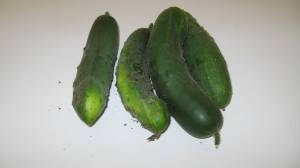
Cucumbers are on that list: the dirty dozen.  These are the fruits and vegetables that, when grown with synthetic fertilizers and pesticides, involve the heaviest use and retain the heaviest residues of these chemicals.  Many of these are the sweetest, most thin-skinned, or most water-dense of our favorite produce.  Remember my posts about peaches and grapes?  Cucumbers are just as bad.  Out of fifty pesticides typically used on cucumber plants, nineteen are PAN “Bad Actors,” which means that they are proven to be highly toxic.  These include several organophosphates, which can damage the functioning of nerves.  I gave a taste of William Cowper’s advice on how to grow an organic cucumber in my last post… which won’t really help you if you’re a novice gardener who’s also impatient with eighteenth-century poetry.  My advice about shopping for cucumbers is much less complex: always buy organic.

Cucumbers are such a versatile vegetable for the cook who likes to play with many different cuisines.  There are old-school British cucumber sandwiches, there’s cucumber dressed simply with sesame oil and sesame seeds, there’s raita (the cooling Indian yogurt sauce made with cucumbers, mint, cumin, and yogurt), there’s cold cucumber soup, there’s tzatziki (yogurt, cucumber, dill, garlic), there’s so much more, all of which is good.  One of our friends served just a dish of thinly sliced salted cucumbers along with his stiff martinis.

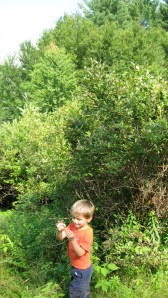
Jack and Peggy spent some time weeding and harvesting in the kitchen garden this morning.  The yield was high!

herbs
J&P

Read Full Post »

cukes
“If you think I am going to make
A sexual joke in this poem, you are mistaken.”

So says Robert Hass, in his playful poem, dryly titled “Poem With a Cucumber In It.”  The poem contains etymological musings on “cumbersome” and “encumber,” musings on the Berkeley sky, memories of travel, and a rough recipe for cucumber salad with dill and yogurt.

Perhaps the most famous poem with a cucumber in it is “The Task,” published in 1775 by William Cowper.  Like Hass’s, this poem contains something of a recipe: for growing a hothouse cucumber.  Cowper meditates for pages on the challenges of growing this sun loving plant in the English winter.  He describes the construction of the greenhouse, the creation of fertile soil out of a “rage of fermentation,” the coddling of seeds and sprouts, the fertilization which in winter requires that “assistant art/ then acts in nature’s office.”

The cucumber takes on social significance as well.  It is the object in a meditation on two main topics of eighteenth century political economy: value (“when rare/ so coveted, else base and disesteemed—/ Food for the vulgar merely”) and labor (“To raise the prickly and green-coated goard/ So grateful to the palate […] is an art” requiring intensive, careful labor unappreciated and unacknowledged by the wealthy purchasers of winter cucumbers).  Cowper advises “ye rich” to “grudge not the cost” because:

Ye little know the cares,
The vigilance, the labor and the skill
That day and night are exercised, and hang
Upon the ticklish balance of suspense,
That ye may garnish your profuse regales
With summer fruits brought forth by wintry suns.

Cowper’s socioeconomically-conscious advice might sound familiar to those of us who write and think and read about our current food culture: learn about how the foods you take for granted are grown; don’t take them for granted; consider the farmer’s labor; grow some food yourself; keep a compost heap; build a cold frame; consider the social and economic costs of unseasonal foods.

To read this eighteenth-century meditation on the economics, culture, and cultivation of cucumbers is to be reminded that our current “good food movement” exists in an historical context.  Skepticism about and moral indignation toward the modernization of food—whether that means hothouse-cultivation, refrigeration, or genetic modification—is as old as modernity itself, and probably older.   Praise for farmers and their ancient art—and injunctions to praise them—are as old as the art itself.

Read Full Post »

beach jack

After a satisfyingly lazy afternoon on the beach, here in Westport, Mass., Peggy and I went to the fish market.  It was a bare bones kind of operation, but all of the fish and shellfish was glisteningly fresh and abundant.  We decided on striped bass.  On the way home, we stopped at the farm stand at Orr’s Farm—an organic vegetable farm run almost single-handedly by Andrew Orr, who is about 20 and is referred to proudly by locals as the town’s youngest farmer—and stocked up on potatoes, garlic, and a few others items.  Dinner was a locavore’s feast: striper grilled mid-rare and topped with fresh, coarse-chopped basil pesto, garlic mashed potatoes (yes, it’s a craze of mine now), and a salad of lettuces from the back yard mixed with local pea greens, tomatoes and radishes.

pesto striper

Yum!

Read Full Post »

Remember what I said about Deborah’s extraordinary vegetarian cooking?  She was gracious enough to send me her recipe for Swiss chard tart.  Here’s what she says:

As for chard tart, tip of the hat to Patricia Wells, from whose recipe this jumps off with a few modifications–it’s actually an olive-oil crust:
The crust is l cup of flour (I use something called white whole-wheat made by King Arthur, but you can use whole-wheat pastry, or some combo of wh wh and white),plus a couple of large pinches of salt, to which you add l/4 cup ice water–mix in–and then l/4 cup olive oil. It can be mixed with the hands, and it will be very moist and soft, like cookie dough sort of. Doesn’t need to be refrigerated–press it into the tart pan with your hands (the recipe fits something like an 8-9 inch pan, but can easily be multiplied to larger vessels). Filling is–well, I don’t know how to describe the amount of chard, but a very big bunch, anyhow–chop it roughly after washing, wilt it in its own water in a saucepan, add to 3 beaten eggs, l/2 to one cup Parmesan or other cheese, salt, pepper. Coat bottom of crust with Dijon mustard, put in filling, and bake at 400 degrees until firm and golden, roughly 30 minutes, depending on your oven.
Doesn’t need to be served absolutely hot from the oven–perhaps more flavorful having cooled off a bit…

Read Full Post »

We’re roving through rural New York this long weekend.  After driving through the Green Mountains of Vermont, over countless hills and through countless valleys, we came into the Catskills with its countless rivers, having passed through the little towns where my mother’s mother and mother’s father were born and raised—Kingston, Callicoon Center—and where they married and started their own family—Liberty.

Our first stop was Kenoza Lake, where we visited our friends Deborah and Jed in their pewter-blue-painted farmhouse, fixed up with many windows, a writing room for him in the attic, a studio for her in the old barn or chicken house or mudroom adjacent the kitchen.  We arrived for a late lunch in the sun: plates of lox and ricotta, sourdough bread, babaganoush, hard-boiled eggs, farmhouse cheeses from around the corner, white wine for some, Coronas for others.  For dessert, we went into the hilly acres of bushes heavy with blueberries and huckleberries.  Because of all of the rain this summer, and the general cloud cover, we picked berry by berry, rather than cluster by cluster.  There were still plenty of berries for Jack.

blueberry picking
Deborah and I went into Jeffersonville to check out the small farmers’ market, where she bought striped Romanesco zucchini and a big head of romaine.

many currants, few zucchini

many currants, few zucchini

Deborah is a wonderful vegetarian cook.  For dinner, after their favorite aperitif—Campari with pulpy orange juice—she served Swiss chard pie (I’ll post a recipe soon…) in a buttery crust, quinoa with pinenuts and golden raisins, and roasted cauliflower with ginger and herbs—out of which she coaxed extraordinary carmelized flavors.

Our next stop will be Margaretville and Roxbury, for Aaron and Kelly’s wedding.  We hope these thunderheads roll on by.

Read Full Post »

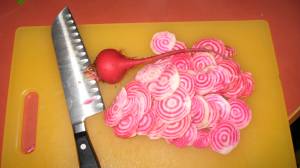
This is a delicious side dish which is also very pretty.  These beets are sweet, as their name implies, and decorative, like Victorian stencilling.  Slice them horizontally to see the concentric pink and cream circles.  These organic beets are from Killdeer Farm.

chioggia

Dolce di Chioggia and Carrots

a small side for 4

Slice 8-10 Dolce di Chioggia beets 2 mm. thin–or even thinner if you have a mandoline.
Slice carrots on the diagonal to the same width.
Melt 1-2 tbs. butter in a large saute pan.
Slide in the beets and carrots and saute on high for a minute, then reduce heat and cover. Season with salt and pepper.  Cook over low-moderate heat until fork-tender.
Toss in a splash of red or white wine vinegar and a handful of chopped parsley.

Serve as a side with grilled chicken.

Read Full Post »

My cousin, Michelle, and I teamed up for this one:

http://theepi-cure.com/2009/07/07/purple-is-the-new-green/

Read Full Post »

Weed Semantics

“I grow some edible weeds,” I was told by my new friend, Diane.   I love the oxymoronic concept of cultivated weeds.  Weeds are, by definition, the enemies of cultivated plants.  They compete, strangle, are overly macho.

Or are they?  Some are delicious.  Toss them in a salad, or do a quick search in the blogosphere for wonderful ways to cook them.

Lamb’s quarters, chickweed, dandelion, lovage, sorrel, ramps, purslane, fiddlehead ferns,  nettles…

These weeds of New England speak to us in the Anglo-Saxon Latinate of foraging colonials with a fervor for naming New World and introducing Old World species.

Natural. Invasive. Cultivated. Edible. (Rediscovered.) Free. Gourmet. Weeds.

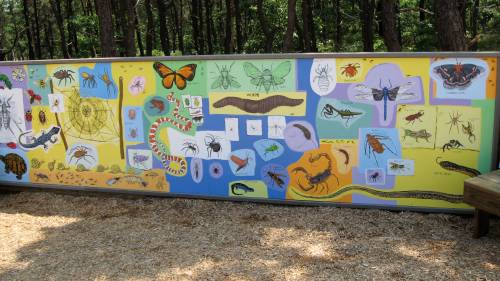
When you first meet someone, you only know three or so things about her, or him.  I like Diane because she plants edible weeds, because she looks natural in red lipstick at the beach, and because she is a painter.  Here is her bug mural, at the playground in Truro:

Diane's wall

Read Full Post »

« Newer Posts - Older Posts »