Feeds:
Posts
Comments

Posts Tagged ‘Vermont local food’

Roving is a romantic way of saying moving from place to place.  At one time, the word contained more layers of significance than it does now, including something like “lookin’ for love.”  This sense finds its beautiful epitome in Byron’s love lyric, “We’ll go no more a-roving.” More than a poem of love, this is a poem of eros.  The short, simple poem, which Byron wrote while in Venice, speaks of the sweetness of longing and nostalgia as it relishes ironic double entendre.

Today, I’ve had a decidedly more banal, and boring, experience of roving: I drove all around this spread-out rural center of civilization in the northeast—seemingly just to keep the car capable of more driving.  It was a day of logistics: dropping the boys at camp; driving to White River Junction with my sister to get her tire repaired for $13, which took all day; driving to drop off my sister at my dad’s office so that she could use his car; driving to the library for two hours of 1794 literary journals on microfilm; driving to pick up my boy; driving to CVS and the Hanover Food Co-op; driving back to the back roads of Norwich to drop off the cold food; driving to my dad’s office to pick up my sister; driving to the mechanic’s to pick up her car.  On the way out of there, my automatic transmission problem alert signal came on.  It’s an orange-lighted gear with an exclamation point in the center.  Whoa!  So, then we drove, in caravan, to another mechanic’s, who directed us to another, farther south along route 5 in Vermont.  This will probably cost me quite a bit more than $13.

And then we drove back up route 5, which, happily, leads to Killdeer Farm Stand.  I dropped off my sister and the boys at the UPS warehouse to see the trucks (my nephew’s current obsession) and drove to Killdeer.  After a day of aggravation, this was bliss.

The vegetable baskets are more bountiful every day.  I wanted to make a pasta dish with a classic combination of vegetables.  I bought an eggplant, sweet green pepper, sweet onion, costata romanesca.  I looked at everything, admired everything, knew I’d be back tomorrow.

spring veg

I left, reluctantly, to do more driving.

For dinner we had farfalle with all of the above, and some sweet Italian sausage, flavored with fennel seeds, from Cloudland Farm, which we’d had in the freezer.  It was warm, green, springy, delicious.

Spring Pasta

Get the water boiling for pasta.  Meanwhile, break a half-pound of sweet Italian sausage into chunks, and slice half of a sweet onion, one or two Japanese eggplants (their skin is more tender), one sweet green pepper, and one costata romanesca.  Sauté the sausage until mid-rare and let drain in a bowl lined with paper towel.  Sauté the vegetables, beginning with the onion, followed by the eggplant, pepper, and eggplant.  Cook the pasta.  When the vegetables are lightly caramelized, spoon in a couple of big spoonfuls of pasta-cooking water, and cover for a minute or less.  Put the sausage back in the pan, and then combine pasta and vegetables in a big bowl or pot and toss with grated parmgiano  reggiano.  Serve with extra cheese at the table.

Read Full Post »

On our way home from the strawberry festival, after driving through the little downtown of Norwich in which all was quiet (it’s Sunday) except for Dan & Whit’s general store (“If we don’t have it, you don’t need it.”), we drove up Turnpike Road, kept going until it turned to dirt, and saw a sign: “eggs.”   We slowed down, and stopped at the table where a young neighbor was selling eggs and chocolate chunk cookies.

eggs 4 sale
We bought a dozen eggs and two cookies.  The eggs came from two breeds of chicken: New Hampshire Reds and Araucana.  The Araucana’s eggs are a pale greenish blue.  I boiled two for lunch, and found when I peeled them that the inner shells are a deeper turquoise.  The yolks were the color of black-eyed Susan petals.

My parents’ house is about a half-mile further on Turnpike Road.  It’s satisfying to eat a lunch so fresh, and in hues I’d love to paint.

Read Full Post »

Saturday morning, Norwich Farmers’ Market.  We got there too late for the golden beets: I saw the last bunch go at 10:15.  Maybe next week….

peas

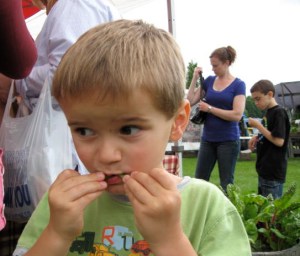
But oh, the potatoes and peas!  The Fairlee, Vermont farm, coyly called “Your Farm,” had baskets upon baskets of sugar snap peas–the kind you can eat right off the vine, pod and all.  Jack was working it like a boiled, salted edamame pod, but was happy finally to eat the whole thing.

eating pea

These peas taste so good raw, they may not last until later, when I’ll make a salad of new potatoes, scapes, herbs and peas.  New potatoes are here in abundance: they are so tender and waxy it’s almost tempting to eat them raw, but lightly boiled will agree with tummies much better. I bought a couple of pounds at the Hurricane Flats farm stand.  (This farm is located on the banks of the beautiful White River, a tributary of the Connecticut, in South Royalton, VT.)

potatoes

New Potato Salad

Potatoes are a blank slate, upon which a thousand personalities can be written.  Bacon is always a good friend to potatoes, as are peas, corn, green beans, and fresh herbs like dill, tarragon, thyme, and parsley.   Caraway seeds are interesting additions to a potato salad dressed generously with a dijon-based vinaigrette.  Here’s what I’ll do with my potatoes, scapes, and maybe peas, today.

Boil potatoes until fork-tender.  Quarter them, and toss with a spoonful of vinegar (red wine, champagne, or cider are good) and two spoonfuls of extra virgin olive oil, salt and pepper. (The quantities depend on how many potatoes you have; they should be dressed but not dripping.)

Then, add some crisped bacon/pancetta/prosciutto bits, and any combination of the above suggested veggies and herbs.  Today, I’m also going to add some lightly sauteed, then smashed, garlic scapes.

Let the salad sit and steep for awhile, and serve warm or chilled.

Read Full Post »

honey

We drove up I89 yesterday to Vermont’s city, Burlington, to have dinner with Peter’s friend, the Irish poet, Greg Delanty, his wife Patti, and their son Dan (who gave Jack his outgrown tractor toys on indefinite loan).  It was rainbow weather.  The sky had been heavy and dark in Norwich—rain for days, all the Vermonters complaining about such an injustice, and on the solstice too!  But as we drove through the Green Mountains and into the Champlain Valley, the sky opened into a shifting patchwork of gray, white, and blue.  Some mountain tops were hidden in dark blurs, some were lit up bright green by shafts of sunlight. Some clouds were white wisps, some were poofy cumulous towers. We saw a rainstorm up ahead over the next valley, we were in it, and back in the hot sun again.

After this beautiful drive, we were welcomed onto a sunny deck by Patti, who is passionate about local food: there was late-afternoon local beer, and asparagus with dinner (to green up the Irish ham and potato plate).  This morning there were jumbo eggs from a nearby farm, toast from a nearby bread baker’s.

But the most delicious element of either meal was also the most local: Patti’s honey.  She keeps a hive in a wooden box in the side yard, the yellow walls of which match the yellow and purple trim on their old New England house, which stands at the corner of the lake-front street packed with other little old houses whose clapboards are whimsically painted other shades of purple, orange, or bright blue.  After breakfast, Jack and I went for a walk and stopped to sniff the roses, peonies, and lilies planted in abundant disorderly patches of overgrown grass in front of the porches along the way.  We saw bees dipping into these polleny perennials as well as into the flowering vines covering the fences and the little nosegays of wildflowers in cracks on the sidewalk and on the edges of driveways and yards.  Patti’s honey has all of the flavors and aromas of this big mixed bouquet.

Because of bees’ omnivorousness when it comes to nectar, and the portion of pollen that ends up in the honeycombs, eating local honey can help us ward off seasonal allergies, and is said to be an immunity booster in general.  But more importantly, honey is a comfort food for me: I associate it with childhood, with the pink and white clovers and buttercups of Vermont, and with Winnie the Pooh’s “little smackerel of something.”  I still enjoy it on toast and in tea, but there are more grown-up ways to eat it too: as a dressing for Mission figs and manchego; drizzled on soft goat cheese; or as a seasoning with braised lamb.

Read Full Post »

« Newer Posts