Feeds:
Posts
Comments

Posts Tagged ‘roving locavore’

Remember what I said about Deborah’s extraordinary vegetarian cooking?  She was gracious enough to send me her recipe for Swiss chard tart.  Here’s what she says:

As for chard tart, tip of the hat to Patricia Wells, from whose recipe this jumps off with a few modifications–it’s actually an olive-oil crust:
The crust is l cup of flour (I use something called white whole-wheat made by King Arthur, but you can use whole-wheat pastry, or some combo of wh wh and white),plus a couple of large pinches of salt, to which you add l/4 cup ice water–mix in–and then l/4 cup olive oil. It can be mixed with the hands, and it will be very moist and soft, like cookie dough sort of. Doesn’t need to be refrigerated–press it into the tart pan with your hands (the recipe fits something like an 8-9 inch pan, but can easily be multiplied to larger vessels). Filling is–well, I don’t know how to describe the amount of chard, but a very big bunch, anyhow–chop it roughly after washing, wilt it in its own water in a saucepan, add to 3 beaten eggs, l/2 to one cup Parmesan or other cheese, salt, pepper. Coat bottom of crust with Dijon mustard, put in filling, and bake at 400 degrees until firm and golden, roughly 30 minutes, depending on your oven.
Doesn’t need to be served absolutely hot from the oven–perhaps more flavorful having cooled off a bit…

Read Full Post »

We’re roving through rural New York this long weekend.  After driving through the Green Mountains of Vermont, over countless hills and through countless valleys, we came into the Catskills with its countless rivers, having passed through the little towns where my mother’s mother and mother’s father were born and raised—Kingston, Callicoon Center—and where they married and started their own family—Liberty.

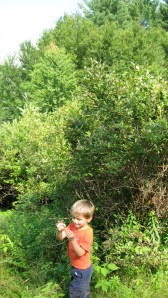
Our first stop was Kenoza Lake, where we visited our friends Deborah and Jed in their pewter-blue-painted farmhouse, fixed up with many windows, a writing room for him in the attic, a studio for her in the old barn or chicken house or mudroom adjacent the kitchen.  We arrived for a late lunch in the sun: plates of lox and ricotta, sourdough bread, babaganoush, hard-boiled eggs, farmhouse cheeses from around the corner, white wine for some, Coronas for others.  For dessert, we went into the hilly acres of bushes heavy with blueberries and huckleberries.  Because of all of the rain this summer, and the general cloud cover, we picked berry by berry, rather than cluster by cluster.  There were still plenty of berries for Jack.

blueberry picking
Deborah and I went into Jeffersonville to check out the small farmers’ market, where she bought striped Romanesco zucchini and a big head of romaine.

many currants, few zucchini

many currants, few zucchini

Deborah is a wonderful vegetarian cook.  For dinner, after their favorite aperitif—Campari with pulpy orange juice—she served Swiss chard pie (I’ll post a recipe soon…) in a buttery crust, quinoa with pinenuts and golden raisins, and roasted cauliflower with ginger and herbs—out of which she coaxed extraordinary carmelized flavors.

Our next stop will be Margaretville and Roxbury, for Aaron and Kelly’s wedding.  We hope these thunderheads roll on by.

Read Full Post »

I spotted a forager at the Farmers’ Market in Hanover.  He was busy behind another farmer’s stand, borrowing the scale to weigh his haul of early chanterelles.   He divvied out the cache of beatifully gouda-colored fungi into straw baskets.  $8 each.  6 hours of foraging had yielded six baskets, he told me.  I’m sure those six baskets were picked up in a flash, after which he probably ducked back into the woods.

chants

When cooking, they smell, and then taste, of nuts and apricots, earth and sunlit woods, fruity wine.

Lacking rabbit, I’ll cook them up and toss them over chicken.  Sauté until they release their juices, in butter, with pancetta, herbs, and minced shallot.  Maybe a few pinenuts.

Rosé…

Read Full Post »

Pork chops, like buttercups, are my Proustian objects.  At the taste of a chop, especially one brined in cider or served with applesauce, I’m back on Old City Falls Road, at the big yellow house in Strafford, Vermont.  Up the steep hill behind the house and barn—a catch-all space housing tools, lumber, a VW bus, my Dad’s darkroom, a sauna—was the pond where I learned to swim and skate, and the pig pen.  My parents, on the run from suburbia back to the land, had set up a small homestead with a vegetable garden, chickens, pigs, a goat, and two little girls running around in Wonder Woman Underoos in January, because the wood stove kept the living room so hot.

The pigs, Gruntly Squatwell and Squatly Gruntwell, were contented animals until that particular date when my uncle and a few other guys would show up in their pickup trucks for the big pig roundup.  Then the pigs ran around and around their pen squealing for their lives, though they didn’t know it.

The result was a freezer full of pork.  For some reason, I remember the chops best of all.  Sweetish and salty, for me the essence of pork—until I tasted pancetta, but that’s a different kind of experience.  The best, more recent, pork chops I’ve had were grilled by our friend Donia, the energetic and lovely Palo Alto chef and writer.  Her cooking—whether in her restaurant or home—is less a performance than an expression of her nurturing nature.  The food is loved and cared for, as are the friends she feeds.

The technique here is so simple, it barely warrants the formalization of a recipe, but here goes:

Donia’s Pork Chops

In the morning, place four thick-cut bone-in pork chops (organic if possible) in a large baking dish, and pour in a fruity red wine—a Beaujolais, or a zinfandel, perhaps—just to cover them.  Turn them over once or twice during the day.  Just before grilling—preferably over charcoal—season them liberally with salt and pepper.  Grill to mid-rare over moderate heat.  Throw some perfectly ripe buttered halved peaches onto the grill too, for a taste sensation.  Donia also served cornbread and salad, outside on the deck.  What a memorable meal!

Read Full Post »

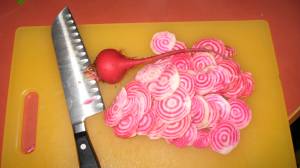
This is a delicious side dish which is also very pretty.  These beets are sweet, as their name implies, and decorative, like Victorian stencilling.  Slice them horizontally to see the concentric pink and cream circles.  These organic beets are from Killdeer Farm.

chioggia

Dolce di Chioggia and Carrots

a small side for 4

Slice 8-10 Dolce di Chioggia beets 2 mm. thin–or even thinner if you have a mandoline.
Slice carrots on the diagonal to the same width.
Melt 1-2 tbs. butter in a large saute pan.
Slide in the beets and carrots and saute on high for a minute, then reduce heat and cover. Season with salt and pepper.  Cook over low-moderate heat until fork-tender.
Toss in a splash of red or white wine vinegar and a handful of chopped parsley.

Serve as a side with grilled chicken.

Read Full Post »

We had the most delicious meal last night.  Sauteed broccoli raab, beet greens, and green garlic from Killdeer, polenta, and spicy grass fed beef sausages.  After our morning with the Jersey cows at Thistle Hill in North Pomfret, Vermont, yesterday, we drove up and down the winding roads and along River Road in search of more cows—this time the black Angus steers of Cloudland Farm.

cloudland steers
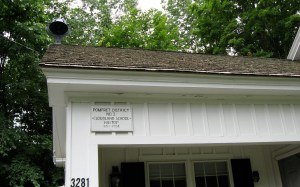
“Cloudland” is an appropriate name for the farm at the top of the mountain road of the same name.  There are some long tunnels of trees along this climb that then break open into gorgeous vistas.  Before the twentieth century, the whole hill was most likely a cloudland—open pastures that seemed to touch the sky, for sheep and cattle and countless stone walls.  New growth forest has filled in some of this land, but Cloudland Farm still maintains a thousand acres of pastureland for its herd of grass fed steers.  (They’ve farmed this land for one hundred years.)  Like the population of grazing animals, that of farming families has thinned over the decades, too.  This empty hilltop school is evidence of a once-thriving community:

cloudland school
(The bigger Pomfret school down in the valley is underenrolled, now.  Old farmhouses are being bought up by wealthy non-farmers whose kids have already grown up and stayed in the cities.)

While I shopped around in their farm store, Jack and his cousin stood in the driveway admiring all of the vehicular activity. There was a big John Deere tractor, a skid steer, two ATVs, and a kid-sized pedal tractor.  The boys were happy.

cloudland sign
So was I.  I bought a whole variety of frozen beef, and started thinking about dinner.  Outside, the sun was streaming down at intervals between the big cumulonimbus clouds that have covered this region for over a month, drenching it again and again.  Bill Emmons, the Cloudland farmer, was talking about how little haying he’s been able to do, because of the constant rain.  He was enjoying the chit-chat, but was also twitching to get away and grab this sunny moment to hay.  “I hope I remember how,” he joked.

Visit their website here.

Read Full Post »

Named for the wily, widespread species of bird, Killdeer Farmstand, on Route 5 in Norwich, is one of my favorite places.  The organic farm of the same name, just a few miles away on the Vermont bank of the Connecticut River, supplies the most dependable abundance of produce.  We stop there almost daily.  Yesterday, it was our first stop after arriving back in VT from Cape Cod.  The first raspberries were in, along with the first green garlic, and there were loads of new potatoes, zucchini, squash, peas, a vast variety of greens.  Scapes will be gone soon, but they still had a big basketful, so I bought a bunch and made more scape mashed potatoes.  Yum!  Sometimes we make an entirely Killdeer meal.  The farmstand also offers Misty Knoll organic chicken, lots of local cheeses and ice creams, some meat, King Arthur bread, and cookies.   Soon, they’ll have sweet corn.

Read Full Post »

It’s a comfort, shaping meatballs.  Only my fingertips touch, shape, nudge, they are so delicate. Unlike the muscle and torque involved in kneading bread, the pressure here has to be slight.  The way you might hold an infant’s foot.

Yes, I know. I’m talking about raw meat.  But I love making these meatballs in part because I use a recipe from a friend I’ve lost touch with, and they remind me of the dinners he cooked for us–at once so scrupulous and so lax.  Jonathan was exact about ingredients, cooking temps and times, the composition of courses.  And relaxed about the way the evening stretched late into the night, about lipstick marks on wine glasses–from previous drinkers–about the terrifying mess in the kitchen.

We had a delicious rivalry.  He would cook us a multi-course meal with wines to match, and we’d follow up the next weekend at our apartment, just up the hill from his, on Euclid Ave. in Berkeley.  It went on, as we attempted amicably to one-up each other.

The meatballs were one of the best meals.  Here is his basic recipe, as I remember it, which came from his Nonna, his Italian grandmother.

Jonathan’s Meatballs

1 lb. ground beef
1 egg
1/2 eggshell water
1/3 c. fresh bread crumbs
small handful chopped parsley
4 cloves garlic, minced
plenty of salt and freshly ground black pepper or some red pepper flakes for spice

Combine all ingredients, and shape gently into meatballs, either large or small.  Cook over moderate heat in an oiled or buttered pan, turning occasionally, until done.  Serve immediately.

Tonight, I had the luxury of local grass fed ground beef, local fresh eggs, and of course local herbs.  I substituted blanched garlic scapes for the garlic cloves.


Read Full Post »

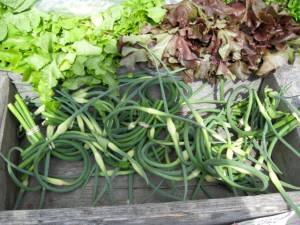
scapes bin at the Norwich Farmers' Market

scapes bin at the Norwich Farmers' Market

I love garlic mashed potatoes.  Possibly even more delicious are mashed potatoes made with garlic scapes.  Last night, I boiled about a pound of new red and gold potatoes (skin on).  I tossed four curlicues of garlic scapes (1 per person) into the boiling water for a minute, just to soften them up a bit.  Then I roughly diced and minced them.  When the potatoes were fork tender, I used a hand-masher to blend in the scapes, milk, 2 tbs. of butter, salt and pepper.  The result was delicious, and as pretty as a pile of potatoes can be: creamy white flecked with green and pink, and tasting of the freshest garlic.  I love whole roasted bulbs of garlic, with that deep nutty caramelized flavor, mashed into potatoes.  This was different.  Garlicky, but greener, grassier, springy.

The only problem was that I made too few.  Everyone wanted more potatoes.

Read Full Post »

wagon

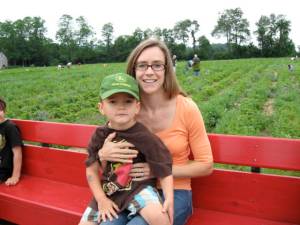
Strawberries were the totems of childhood today, at Cedar Circle Farm’s 7th annual strawberry festival.  Of the milling, stooping, picking, licking population, about two-thirds were fewer than four feet tall.  Many wore the totem on their shirts, hats, or cheeks. The folks at Cedar Circle make this day as much a celebration of childhood as of strawberries and local food in general.  There were three horse-drawn wagons, a mural-drawing section of the barn wall, a coloring station, face-painting teenage girls, a sandbox, strawberry smoothies and shortcake, coffee for the parents, puppetry, kite-making, tractors to sit on, and live music.  And, of course, picking.

tractors

wagon ride

We hit the face-painting table first; the boys both got trucks.

my son, the sceptic

my son, the sceptic

cheek truck

Then we walked around the food stations.  There were local sausages from Hogwash Farm on the grill, organic pizzas cooking in a wood-oven on wheels, and strawberry shortcake with whipped cream or vanilla ice cream from Strafford Organic Creamery.  In honor of this berry, which has been cultivated since medieval times, everything was very forward-looking.  The food was served on compostable dishes with compostable utensils; there was a complex trash station.  Near the coloring table there was a photo-and-text display (a low-tech, stop-time PowerPoint presentation hung with clothespins) about “The Real Costs of Cheap Food”, which included descriptions of chemicals that flow and leach from non-organic farms into ground water, lakes, and rivers, and a definition of food miles (how far a food travels from farm to table, with the fossil fuels required a big consideration), and some charming spelling errors.  There was also a photo-narrative of strawberry growing, from bed preparation during the winter to picking in June.  This display included lots of pictures with hay around the edges, in the middle, and present as a general tone (hay keeps down the weeds) as well as shots of very tan, lightly clad interns happily working the dirt.
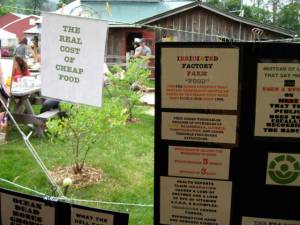
real cost

Cedar Circle grows eight varieties of strawberries, and an array of vegetables—all certified organic.
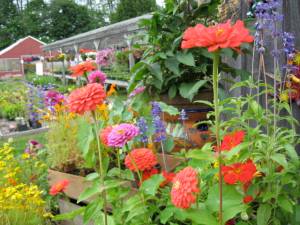
and flowers

and flowers

My mom and I, with the occasional help of Jack and his cousin Jeremiah who preferred sitting on tractors, and my sister, Bridget, who helped them up and down the tractor steps, picked four pounds of berries.  We chose two varieties: Wendy, known by its petite size and light sweetness, and Mesabi, which is bigger, and almost raspberry-like in flavor. The plants were so high that lifting the leaves to look for spots of red was like opening the curtains—in a doll’s house.  The pleasure of discovery became addictive.  It’s hard to stop, even when the basket’s full!

Strawberries fresh off the stem, warmed by the sun, melted into juice in an instant in our mouths.  There were many worshippers.

worshippers

Read Full Post »

« Newer Posts - Older Posts »