Feeds:
Posts
Comments

Posts Tagged ‘Rome sustainable food’

I met my friend Marjorie the other morning at one of the dolci destinations, Desideri, on Via Carini.  While I waited for her, and cooled down from the fast walk from Jack’s school, I checked out the amazing display of gelato and dolci—which refers to sweets of all sorts—in the display cases.  A steady, but meandering, stream of people stopped in to lean on the counter and order their morning treats—all kinds of cornetti, and cappuccino.

Marjorie arrived, and began to tell me all about the different sweets at this famous cafe.  I decided on an almond-covered cornetto, and she asked for un cornetto integrale—one made with whole wheat, and filled with bitter honey.  Wow!

Look at this beautiful cappuccino.

desideri capp

From there, we hurried over to Via Nicolini, to the block-long market, to get the good veggies before they were gone.  Marjorie took me to her favorite farmer-vendor, and we slowly admired everything on the table.  We heard two women exchanging recipe ideas and exclaiming about the first cucumbers and the last melons.

I bought too much, but I have no doubt it will all be cooked and eaten.

10-1 produce

I cooked the broad beans in a Roman style—sauteed with olive oil, tomatoes, and garlic, and dressed with plenty of chopped parsley.  The tastes were surprisingly complementary, and the taste of the beans was that of simple freshness.  It was clear they’d been picked that day.

Read Full Post »

It seems fitting that in such an ancient/modern city as Rome, hunter-gatherers should coexist peacefully with perennial lovers-on-blankets and with i-pod-wired joggers.  The largest public park, Villa Doria Pamphili, exemplifies this shared experience of urban life.

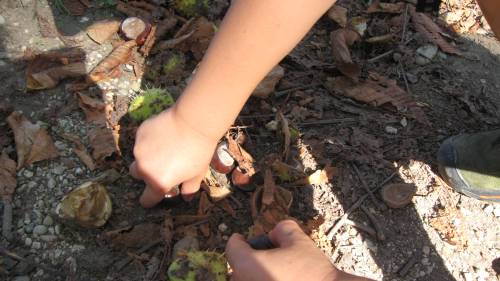
It’s relatively nearby the American Academy, and I’ve been running there on recent mornings.  While I admit I haven’t seen any true hunting, unless you count fit men doing pull-ups eyeing the passing women sweating it up in their requisite black tights, I have seen old men and young boys fishing in the pond, random gatherers of the chestnuts that are falling fast and hard from the trees, and a man with a large sack clipping the last of the dandelion greens, before the mowers arrived.  Free urban harvesting lives on.

We took Jack there today, to ride his bike.  This park is one of the scenes I love about this city, because it blends the ancient with the baroque with the modern—not seamlessly at all, but with the surprise of oddly continuous juxtapositions.  When you take your eyes off of the contemporary Romans, who are surprising for their collective attractiveness and style, you see alongside these modern habits—jogging, doing leg-lifts and push-ups along the “Percorso Salute” (the Health Course) with its exercise stations marked out—the ancient forms of aqueducts and arches, the baroque curlicues of stone leaves and niches.  (Exercise and self-care aren’t modern inventions by far, but that’s another post.)

J aqueduct

gathering chestnuts

Villa Doria Pamphili is the largest public park in Rome.  The baroque villa, built on the prominent hilltop acreage in the early seventeenth century, is now a museum, and the former vineyard and garden—which also played an important strategic role in Garibaldi’s defeat of the French, and so in Italian unification as a nation, with Rome as the capital—is now a park landscaped as if designed to speak one word: leisure.

the villa

the villa

topiary mazes

topiary mazes

J & swans

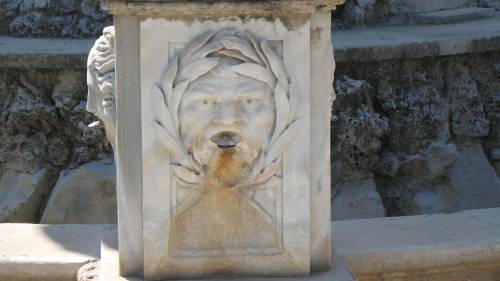
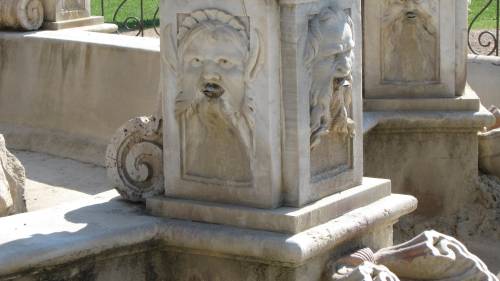
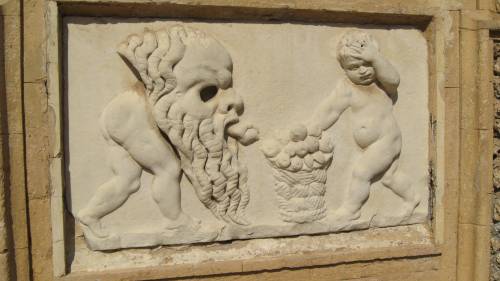
What I love best about the park, though, aside from the people watching, is the baroque interpretation of “pagan stuff”: weird wizardly men as the fountain faces, and funny scenes involving putti.  Here are a few of my favorites.

font face 2

fontana

font. face 3

nice ears

Check out these putti at play:

putti

Filling up, at the wolf’s mouth:

wolf fountain

This is a civilization that knows how to eat well, exercise well (though sometimes stopping for a smoke), drink well, sculpt well, kiss well, relax well.

I sauteed a huge bagful of dandelion greens tonight, which I’d bought at an open market stall a few days ago.  Wonder where those greens were gathered.

I’m not sure what we’ll do with Jack’s collection.  There is a good grill out back….

chestnuts

Read Full Post »

I love the way, in Italian, the word for “bakery” also means “oven.”   It’s a word- and food-lover’s favorite instance of synecdoche.  Jeannie introduced me to the family-run Antico Forno Marco Roscioli a few weeks ago, during our little culinary tour of Trastevere.  When I went back this week, it was because I had two cravings for the two things I bought there last time: fig bread, and the treat Jack and I like to call “secret cookies.”  Next time, I’ll get some of their pizza bianca and one of their famous apple torts.

The fig bread is made with farina integrale—whole wheat flour, which comes from local growers and millers.  Roasted walnuts and dried figs are rolled into the dough as it’s shaped for its last rise, and the interior comes out looking like this:

fig bread

Need I even say that it’s delicious in the morning, toasted and spread with butter or honey, served with a caffé con latte?

These other treats go well with a post-pranza (that’s lunch) espresso:

almond cookies

Made of the most delicate blend of flour and marzipan (I think), they are topped with sliced almonds and dusted with powdered sugar.  The first time I ate one, I was savoring the sweet, tender crumb when—oh my!—I came upon the concealed sugar-soaked sour cherry.  What a delight!  Jack is crazy for these cookies, and loves boastfully to tell his friends he knows their secret.  They are so rich, though, that these will be special treats.

For more on Forno Roscioli, and for some entertaining translations—such as “biological jam” for confettura biologica, by which they mean “organic jam”—check out their website here.

Read Full Post »

This past Saturday, we hosted our first dinner party here at our Rome apartment.  The guests were six parents and five children under age six.  It was a swirling whirl of activity, with chair and table shortages, and yet we broke only one wine glass.

I had planned the menu around several types of abundance and constraint: the produce that is in season at the markets, the number of guests who were omnivores, vegetarians, or plain-pasta-preferring children, and the odd assortment of cookery tools available to me in this lightly furnished apartment. Planning a meal like this has something in common with other types of composition—blank verse or water color, perhaps—in which there are particular forms and materials available, with particular possibilities and limitations.

Is this too cerebral an introduction to something as sensuous as a good meal?  The pleasures in cooking go both ways for me.  But let’s get down to what we had.

Id’ been wanting to cook that Roman cauliflower cousin, variously named broccoflower and broccolo romanesca.  I decided it in the meal for its strange, fractal, architectural beauty.

brocoflower

I had bunches of carrots, which I decided to braise:

carrots

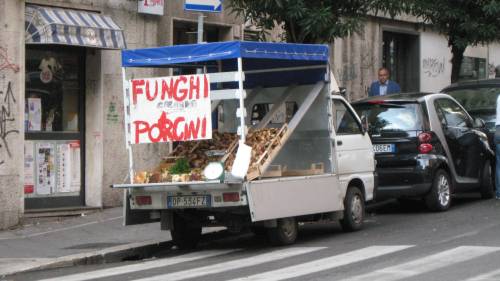
I’d also been passing “the funghi guy” with his mini-truck full of chanterelles and porcini, every day.  The meal would have to include these things.

sizzling porcini

The menu came together, with a few more shopping trips:

For snacking and sipping, we had the following: wine-brined black olives, Jeannie’s treats—mozzarella wrapped in prosciutto on toothpicks with prugne (yes, prunes, or, dried plums, if you prefer)—and a deliciously crisp local organic white wine that Marjorie brought.

Next, came the kids’ meal: pasta with red sauce.  Really, why fancy it up with any other name?  They did have freshly grated parmigiano-reggiano, those lucky little blondies.  (Don’t worry—they’re drinking water, not that prosecco, which we drank):

kids meal

After clearing the kids’ dishes, I served up the main meal:  chicken legs braised in Sardinian white wine with porcini, polenta, braised carrots tossed with parm, and broccolo romanesco roasted with bread crumbs and fennel.  The only contorni (vegetable side dish) I managed to photograph was the cauliflower.  (It was delicious! I had some for lunch today, with some of the leftover chicken.  Maybe even better as a leftover.)

roast romanesca

There were so many conversations going on, many of which I barely dipped into, because I was busy talking with Jeannie and Marjorie about food and Rome.  Both of these new friends are passionate devotees of good, whole, local, organic food.  Jeannie is a journalist currently working on a book about food, and Marjorie owns a tourism business—called Insider’s Italy—that focuses on sustainable travel and food-related adventures in Italy.  Her newly created trip, “Farm to Fork,” is absolutely inspired.  Not only does the tour take families to the best markets in Rome for sustainably produced Italian specialties, but it also takes them back in history to the Roman markets of 2000 years ago, and is carbon-conscientious.  (You must check out their website.)

We had set the kids up with a movie, before we started eating.  They entered an instant collective trance:
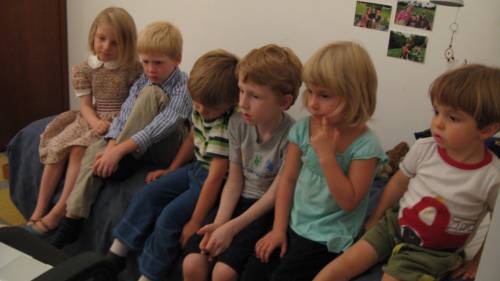
movie

We grown-ups were happily eating and talking, and almost didn’t notice that the silence behind the closed bedroom door had ballooned into a hurricane level of noise.  Uh oh.

Cookie time.  I’d bought thirty of those chewy/crunchy amaretti from the bread place on Quattro Venti. It was a fun night.

Roasted Broccolo Romanesca

2 heads broccolo romanesca, broken into its “trees”
3 cloves garlic, smashed
2 shallots, broken up
assorted dried or fresh herbs
1 fennel bulb, sliced
home-made rough-crushed breadcrumbs
plenty of olive oil, salt, and pepper

Combine these ingredients—reserving the breadcrumbs until later—on a pan.  Roast in a preheated oven (400-450) for 15-20 minutes.  Sprinkle with the olive-oil tossed breadcrumbs, and roast for another 10-15 minutes.  Serve warm or room temp.

Braised Carrots
based on Marcella Hazan’s recipe

8-10 large carrots
salt & pepper
1 tbs. sugar
2 tbs. butter
1/2 c. grated parmigiano-reggiano

Slice carrots into thin discs and spread in an even layer in your largest skillet. Just cover with water, sprinkle in the salt, pepper, sugar, and butter. Bring to a boil, then simmer until the carrots are wrinkly and almost browning.  If the water runs out, add a bit more, tiny bit by tiny bit.  Take off the heat and stir in the parm.  Serve immediately.

Chicken Legs Braised with Porcini

4-6 chicken legs
plenty of stock and white wine
3 garlic cloves
3 shallots
dried or fresh porcini
dried or fresh thyme
butter & olive oil

Brown the chicken legs in butter and olive oil over moderate heat until skin is crispy on both sides.  Add the smashed garlic and sliced shallot to the pan to brown a bit.  Pour in a combination of half wine/half stock just to cover the chicken.  Add porcini and thyme, salt and pepper.  Simmer for 30-45 minutes, until chicken is tender and almost falling off the bone.  If you want to, reduce some of the braising liquid with some butter for a richer sauce.

Read Full Post »

quail spigot

So, yes, there are bananas from Ecuador at all of the markets here, and much of the beef comes from Brazil.  But this is also the land of plenty when it comes to local foods.  When my new friend Anna and I were walking with our little ones around the Bass Garden here at the American Academy the other day, we just kept saying, “wow, isn’t this paradise?”  Here’s a sampling of what we saw—in this over-the-top edible yard (and this is after much of the summer vegetable garden has been tilled under).

One last lonely cherry tomato:

a little tomato

Plum trees so heavy with clusters, the fruit is dropping to the ground:

plum cluster

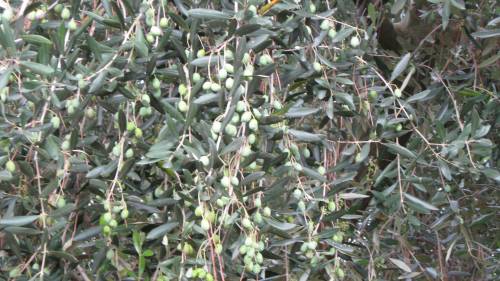
Olive trees dripping with thousands of olives:

olives

Fig trees, not with fruit this late, but still with a beautiful canopy:

fig canopy

Grapes:

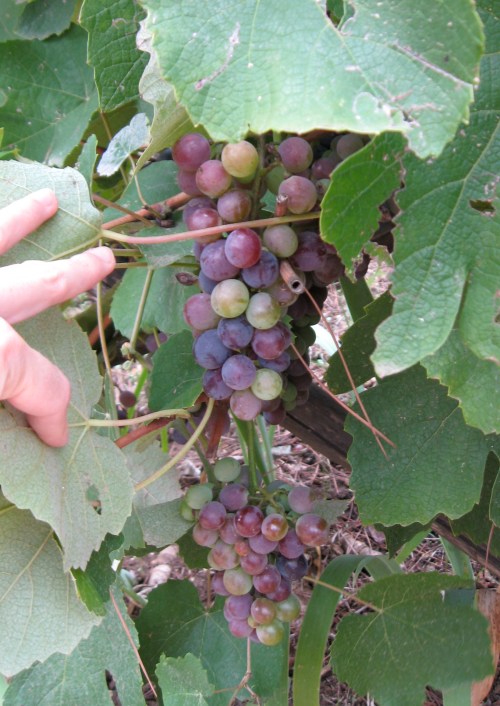
grapes

Also growing in plentiful patches here are hot peppers, sage, and persimmons.

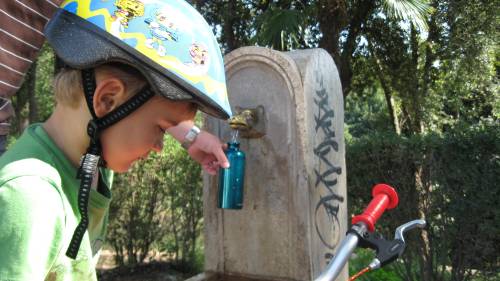
Anna and I, along with Lulu and Jack (4) and Jesse (2), took a leisurely tour of the garden, stopping to admire and sample all of the fruit, and to take a drink from the gurgling fountain:

water fountain

Jack and Lulu also floated things down the irrigation canal—something of a mini Roman aqueduct for their world of miniature boats and barges:

waiting for boats

The water flows into a basin with a drain and a spigot.  To turn on the water at this end, you twist the little quail pictured above.

Our tour concluded when we saw a thunderhead approaching, above the umbrella pines:

thunderhead

This post is just an appreciation of beauty….   Soon, though, I’d like to address some questions—hinted at above—that I’ve been looking into about what local eating means in Rome, about pesticides and organics in Italy, and about farm sizes and types.  Stay tuned.

Read Full Post »

I just happened upon a new, exciting flavor combination.  With a still-heavy bag of chanterelles in the bottom of my fridge, and a ball of mozzarella needing to be pulled, I decided to make pizza.

For the crust, check out this post.  For the topping, I sauteed green onions, garlic, 1 sliced sage leaf and a small sprig of rosemary, and a big pile of chanterelle chunks in butter and olive oil.  I brushed the crust with olive oil, spread the veg, sprinkled on the mozzarella strings and some grated parmesan and salt, and baked it for about 15 minutes.

We opened a bottle of one of the staggeringly cheap, good local wines, a rosato frizzante (is just what it sounds like).

The combo was the best kind of thrilling comfort food that I love so much.

For dessert, we each had a little amaretto cookie I’d picked up this morning at the bakery on Quattro Venti.  These cookies—I tell no lies—are perfect.  The outside can be tapped with a fingernail, but is chewy, not crisp.  The inside is a moist, chewy crumb that pulls apart with delicate resistance.  The flavor is pure essence of almonds, sugar, butter.

Read Full Post »

porcini cart

I’ve seen this truck full of gorgeous mushrooms on successive mornings for the past week.  I hadn’t stopped to buy any though, because we’ve had so many dinners there and everywhere, but not here, in our own dining room.  Yesterday, though, after bringing Jack to school, I walked back by a route that would take me past the fungi guy.

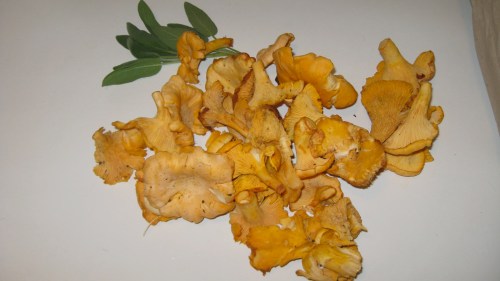
I asked for “some of those”—in Italian—and pointed.  That was enough.  He started loading up a small bag, and when I said, “basta, grazie,” he put it on the scale and mumbled something about “dieci.”  In other words, let’s make it an even ten. Euros that is.  He heaped some more in the bag, and I was too sheepish to say no.  Despite the cost, too, a part of me was thrilled to be walking away with such a mound of perfect chanterelles.

chanterelle pile

I’m not just trying to justify my spree by saying this, but this picture really doesn’t do justice to their size.  The biggest ones are as broad as my palm.

These mushrooms are so flavorful—with such a delicate combination of earthiness, sweetness, and nuttiness—that they’re best served by simple cooking.  Tonight, I’ll be making a pasta dish in which every ingredient is there only to stage and spotlight these graceful plants.

I don’t have hand-cut papardelle, but here’s a version of the dish I had at Pane e Salute, in Woodstock, Vermont.

Chanterelles with Fresh Papardelle

enough pasta to serve four as a first or main course
1 small shallot, minced
1 sage leaf, sliced, or some fresh thyme leaves
1/2 c. dry, light-bodied white wine
freshly shredded parmesan
a pile of chanterelles, sliced into nice, bite-sized pieces

Sauté chanterelles and shallot in butter over medium heat, seasoned with salt and pepper.  Remove them to a plate, and deglaze pan with wine.  Reduce it a bit.  Meanwhile, boil pasta until al dente.  Add the chanterelles back into the pan to warm.  Toss the pasta with olive oil and parmesan, and serve topped with chanterelles and more cheese.

Read Full Post »
There are certain food items my family would be unhappy to do without: eggs, milk, peanut butter, and basil.  Only one of these items is not a regular part of the Italian diet.

I had heard that the big, fancy gourmet food store near the Vatican, Castroni, was the place to find peanut butter.  This store is amazing for its glittering array of precious victuals.  The pleasure is in gazing at the novelties, and not in purchasing.  There is one high shelf in particular that had me staring in dumbstruck awe.  Call it a shrine to American cravings.

Castroni

For the sorry traveler who feels deprived and disappointed by what Rome has to offer in the edible realm, here is his Skippy, her Betty Crocker.  See the size of the Skippy jar? See the price tag, in euros, above it (3.90)?  The cravings must be strong, indeed.  This was not the place for me to buy peanut butter.

I asked my friend Jeannie where to get it.  She told me about Canestra, a health food store in Trastevere, not far from the cheese shop where I got the ricotta.  This is what I’ve been looking for:

peanut butter

It’s organic (biologico) but not local; it’s made in Germany.

The other items on my list of essentials are very local.  The milk and eggs are from the immediate region of Rome.  We buy them from the Rome Sustainable Food Project.  The milk is whole, unpasteurized, and delicious—especially frothed up in the form of a cappuccino made by Alessandro at the Academy bar.

milk & capp

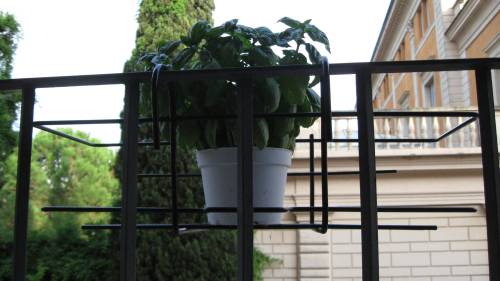
The basil, in a picture here by Jack, is in our window basket.

basil

Read Full Post »

Yesterday, I had my first Rome Sustainable Food Project lunch, put together by Mona Talbott and her crew of cooks and interns.  The choices of different delicious tidbits with which to pile one’s plate was almost overwhelming.  I took teeny portions so that I could have some of everything.  There was pasta with lentils, a green bean and fennel salad with chopped roasted almonds, warm zucchini with tomatoes, pâté topped with pickled onions on toasted whole grain bread, big leaves of Boston lettuce (which I’m sure has another name here), and pizza bianca.  Everything was delicious, but the one item I couldn’t resist getting more of was another crostini—this one a slice of whole grain bread topped with the most delicate, moist ricotta, a drizzle of flavorful olive oil, and a few tiny shreds of basil.  The elements are all utterly simple in themselves, but together they made one of those morsels that cause you to close your eyes and focus on the flavor that is sadly, thrillingly, fleeting.

One of the inspiring thing about the kitchen here is that they source as many ingredients as they can locally.  Mona has spent a good part of her three years here getting to know the dairy farmers, vegetable and livestock farmers and purveyors, and cheese makers, in order to find the best ingredients.  The ricotta served yesterday comes from Tuscany, and is sold at what Mona describes as the best cheese shop in Rome, La Tradizione, near the Vatican.  I’ll have to find that one….

ricotta

The ricotta pictured here is the piece I bought the other day at Antica Caciara in Trastevere.  I thought I’d make some pasta with ricotta, peas, and prosciutto, based on Marcella Hazan’s recipe in Essentials of Classic Italian Cooking, a favorite of mine.  But after yesterday’s lunch, I think I’ll have to make crostini.  Anyone want to come over for aperitivi?

Ricotta Crostini
(based on my experience and not Mona’s recipe; serves 4 or so)

1 c. ricotta (the best you can find!)
1/4 c. basil chiffonade
2-4 tbs. evoo (again, the best you can find)
salt to taste
1/2 round loaf whole wheat bread, cut into 1/2-inch thick half-slices

Toast the bread slices until crisp.  Spread a large dollop of ricotta on top of each, sprinkle on a smidgen of salt, sprinkle on the basil, drizzle with olive oil.  Serve with wine and olives!

Read Full Post »

I find that what I cook for dinner here in Rome is similar to what I cooked in Vermont or Alabama.  The only difference is that the ingredients are generally better or cheaper.  For example, last night I made bucatini (long, skinny tube pasta) with the ingredients I had in the fridge from previous days at the markets: chanterelles, dandelion greens, prosciutto, fresh onion, garlic, parmaggiano reggiano I’d grated with a hand-grater.

greens

It was delicious.   And made with ingredients that would have been much more expensive in the States and would have been seen with a halo, or rather a tiara, above them, which spelled out “e-l-i-t-e f-o-o-d.”  Ingredients like dandelion greens, for instance, are perversely seen as unusual, elitist, and foodie-fetishized by the general public.  This is unfortunate, because they are so delicious and easy (to grow and to cook).

Here in Rome, everyone buys and cooks huge bunches of dandelion greens, varieties of chicory, treviso, radicchio, and countless kinds of beans.  Everyone buys multiple varieties of tomatoes that actually taste like tomatoes and not like paper towels injected with citric acid.  I was talking to Mona, the chef at the American Academy, about this observation a few days ago.  She had a few explanations.  One is that Italian cuisine is based on greens, grains, and beans.  To Americans, this sounds like “health food,” but think about what an amazingly varied pyramid-foundation these food groups provide.  Everyone in every socio-economic group here eats greens, grains, and beans.  Another reason has to do with land ownership.  Historically, land has been owned by the church and leased to small-scale farmers.  The “get big or die” dictum doesn’t really work here.  Agricultural land and the regional cuisines are seen as part of a national heritage, too, and so there are social, cultural, and economic motives for preserving the status quo when it comes to food.

I don’t need to rehearse for my readers the problems with the farm bills of recent history or the problematic ramifications of agricultural subsidies in the U.S.  Everyone knows that large-scale monocultures of commodity crops like corn and soybeans end up being favored over diversified smaller farms that might grow dandelion greens alongside sweet onions, tomatoes, and melons.  The consequences of this kind of agribusiness are a dumbed-down or simply wiped-out cuisine, a boring selection of cheap food that must be jazzed up with corn-derived substances and packaging to sell, diet-related diseases, a general lack of cooking skills, and a silly politicization of good, real food, whereby fresh fava beans are seen as chi chi.

I’m learning things here that could be taken home.  (OK, get out your corn-tassel pom-poms for this): C’mon, America, let’s get real!

Read Full Post »
« Newer Posts - Older Posts »