Feeds:
Posts
Comments

Posts Tagged ‘Rome sustainable food’

As we rode the train north-east, from Rome to Venice, we passed through Italian regions famous for their food and wine.  And really, which ones aren’t?  One sight that struck me again and again was the smallness and odd shapedness of, and variety of growth on the fields.  They reminded me of Vermont.

Why is this interesting?  There is a correlation between the size and shape of the agricultural fields, the omnipresence of them over all kinds of landscape, and the presence of produce like this in the markets:

IMG_2502

treviso

I’ve been interested in the fact that there’s so much great variety at these street markets which are all over the city.  Why are people in many different economic situations able to buy a variety of leafy greens or tomatoes, for example, when in the U.S. the less well-off are stuck with processed food at their local markets?  One explanation is that Italy has a culture that values food, and that the rituals and culture based on food are stronger than the modern urge for convenience.  Another explanation is that lots of agricultural land has been owned by the church for a very long time, and is leased to people who farm relatively small plots.  This means they don’t pay a premium for land, and therefore don’t have big profits as their only care; the small scale also encourages crop diversity.  And I guess there’s the geography of the place—no great plains to cover with corn; mountains; and a strong sense of regional identity. Wine culture has something to do with it too; food and wine are seen as something special and are historically connected to national and regional identity.

The economics of food in the U.S. is a real problem.  Because of the perversity of the farm subsidies, which go toward commodity crops and wealthy farmers, non-nutritious processed food ends up being a lot cheaper than good, whole food.  Because organic food and “unusual” produce is more expensive and less available, it is seen as elitist food.  There are changes that could be made: government support for small farms growing diverse crops, and for the creation of farmers’ markets in many more places; revamping the farm subsidy programs to provide more help for small food producers and less help for the factory farms.  I really think there’s hope, if the government can ever break the power of the strongest lobbies.  But the other problem, which relates to the comparison with Italy, is that the U.S. doesn’t have a food culture.  Food isn’t really valued for itself, doesn’t have a lot of history or ritual attached to it (except on holidays, when the tradition is to overeat), and isn’t passed down through the generations as a set of rules, knowledge, and values.

Convenience encroaches here, too, though.  I see people in the park where I run gathering wild edible greens and mushrooms.  They are all over 70, as is, I think, the farmer-couple I like to buy from at the market.

Read Full Post »

Tomorrow morning, transit workers are striking across Italy, but we have 9:50 tickets to Venice.  Word on the street is that we’ll be fine.  Eight of us from the Academy are renting an apartment for the weekend.  I won’t be bringing my computer, and will probably not be blogging.  But not to worry!  I’ll be keeping a food diary—and not one in the style of a dieter.

Other tidbits of interest?  I just cooked a simple dinner for myself and Jack made of mostly local things purchased around the neighborhood.  I sauteed peppers, onion, rosemary, and proscuitto.  I scrambled local organic eggs.  We ate warm pizza bianca from Panificio Beti.  I like that they put coarse salt on top. I opened some Lazio wine, but it was corked.

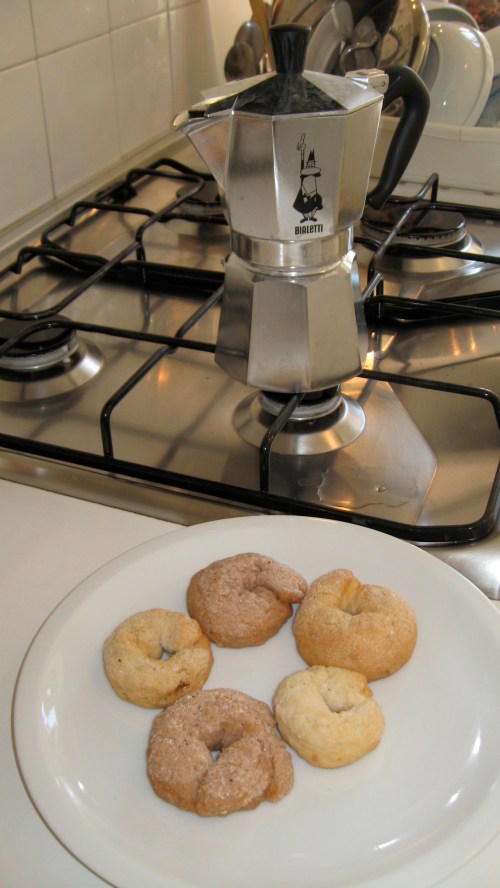
For dessert, Jack ate Greek yogurt with honey, and I ate a ciambellina vino rosso.

ciamb

I also started working on a new project today, as a volunteer for the Diversity for Life campaign.  In order to promote knowledge of the importance of agricultural biodiversity for the health of people, cultures, and the planet, they are launching an oral history project in Kenya and Italy this year.  (Other places will follow.)  For these oral history archives, school children will record interviews with their grandparents about what foods they used to grow, cook, and eat.  The aims are to foster an interest in old food traditions and in the foods themselves, to help the kind of agricultural biodiversity that’s been almost lost to monocultures and convenience food continue to thrive, and to encourage a reliance on varied diets which are more nutritious and can be grown in ways that are healthier for the planet.  I’ll be writing the pamphlet that will be distributed to school children in rural and urban Kenya, and which explains the project and the value of maintaining both agricultural biodiversity and continuity in the regional culture as it relates to food.  A lot of American school children could benefit from a similar campaign!

This weekend, though, I’ll be walking around beautiful Venice, taking notes about a very different kind of food culture.

Ciao!

Read Full Post »

ciambelline

These are complex subjects in Italian life.

There are many tacit rules that guide coffee culture (observance of which would be to the benefit of American coffee drinkers).  One rule, which I just broke—knowingly, so does that make it ok?—is that no milk should be consumed after lunch.  A cappuccino, or a caffe con latte, is an appropriate breakfast or late morning drink.  One should drink it standing at a marble bar, or sitting briefly while eating a small pastry and talking a lot.  (Addendum: what we call a “latte” contains an amount of milk Italians would think obscene.  A twenty-ounce cup of hot milk with a bit of esspresso served in a paper cup and called a “venti”?  Horrors!)  After lunch, the only acceptable coffee behavior is to drink a caffe (espresso) or a machiato (espresso dabbed with milk foam).

Today, it’s about fifty degrees outside, and I’m wearing a long-sleeved but thin cotton dress.  I was cold, and I just didn’t think an espresso would do the trick of warming and comforting me while also giving me the jolt to go on with my dissertation-writing (or blogging, as it may be).  I asked Gabriel, the Academy bartender, for a cappuccino, and received a look that combined raised and furrowed brows.  Ah, well.  I’m a barbarian.  (Addendum #2: I bought the dress in Vermont, and it has a Vermont theme: deer.)

dress

self-portrait in deer dress

Alright, on to the cookies.  Again, a comparison with cookie culture in the U.S. is instructive.  A sugar-heavy blob the size of your palm receives the name of “cookie” at home, and might more properly be called “unhealthy meal-replacement item” because why eat a meal when you have a quarter-pound cookie with your venti latte?  Here in Italy, cookies are called biscotti, and they are more like delicately sweetened, tiny, crunchy biscuits.  With my misguided cappuccino after lunch, I nibbled a pistachio biscotto that tasted like lightly sweetened crushed pistachios, with a hint of butter.  It was just perfect.

The biscotti above are of a particular species of cookie called ciambelline.  They’ve been catching my eye here and there for awhile, because they are usually labeled ciambelline al vino rosso, and they look like little doughnuts.  I finally bought some the other day, at a nearby family-run forno (bakery/oven) called Panificio Beti.  (Addendum #3: the breads are all displayed on a low counter behind the glass, and beneath each type is a list of the ingredients, which are few and of the best quality.  I like this kind of proud transparency.)  They had on display five different kinds of ciambelline: vino rosso, limoncello, walnut, anise, and one other which I think was just a savory version of vino rosso (no sugar).  I asked for uno per tipo.

Back at home, I brewed some coffee in my beloved Bialetti, and broke off a bite of each.  Not having had them before, I was pleasantly surprised.  They were hard, not chewy, and they had just a trace of sweetness.  Traditionally, they are made with olive oil in place of butter, and are served after dinner with sweet wine, in the regions of Tuscany, Umbria, and Lazio, where Rome is.  These are cookies I’d like to have around at all times.

Read Full Post »

What a Saturday!  Jack and I started the day with Harry and Ramie at Dolci Desideri: cappucini and cornetti (one with marmalata, one whole wheat with bitter honey) for the moms, frutti di bosca (wild berry) muffins for the boys.  Then, in the 39-degree-Fahrenheit chill, we walked around the block to the outdoor market on Via Nicolini.  First, we went to one of the small organic farmers’ stands.  What’s in season at this farm near the airport?  Dandelion greens, chicories, peppers, eggplants, potatoes, various hard-skinned squashes.  I bought some of almost everything, and she stuffed some fresh herbs in my bag for free.  At the next stand, we bought apples, plums, pears, and broad beans.

Back at the Academy, we stopped in at the bar, and Alessandro made Jack some hot cocoa.  He doesn’t know how lucky he is.  The ingredients were whole unpasteurized organic milk, house-made chocolate ganache, and house-made marshmallows.  While he worked, Alessandro told Jack, in Italian, about his pet turtle.

Lunch at the Academy, served at one, was phenomenal as usual.  The dessert was an incredible taste sensations.  “Outrageous,” according to one diner.  There was a sweet crumbly shortbread style tart crust, in which was a warm custard flavored with—or really just subtly evoking the flavors of—honey, lemon, pinenuts, a few raisins, and something else more evanescent.  What was it?

Unbelievably, we did more eating as the day went on.  Some of our next door neighbors with young kids came over for dinner.  I roasted a bunch of the veggies I’d bought, and tossed them with pasta, rosemary, olive oil, and grated pecorino romano.

Nick and Rena brought dessert: a Dolci Desideri cherry-infused chocolate cake that seemed to be half crumb, half ganache.  Jack and Lulu licked all of the plates clean:

licking1

I’m not sure what the goggles were for.

licking

Read Full Post »

Everyone says it’s impossible to get a bad meal in Italy.  That’s not true.

After spending a wonderful morning in the galleries of the Museo Borghese, feasting our eyes on the Caravaggios, like his “Self Portrait as Bacchus,” and on the sculptures Bernini carved—improbably rendering marble as smooth and pliant as flesh—we took the bus back to Trastevere in search of a good lunch.  You can’t tell by the facade of authenticity, or by the menu, or the prices, or the aromas coming out of the kitchen.  But some meals are disappointing.  The pasta was greasy, the porcini were soggy, the stew was bland, the antipasti boring.

But we did see some other interesting sights.  An ivy covered house:

ivied house

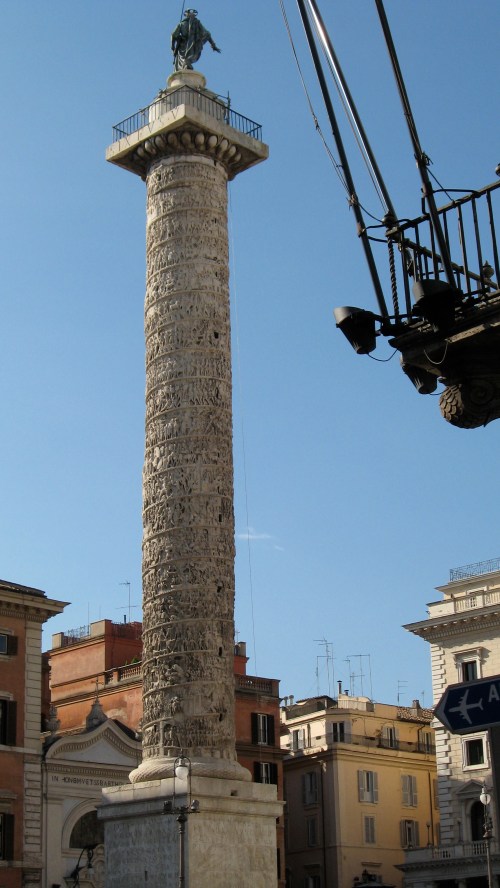
Marcus Aurelius’s copycat version of Trajan’s triumphal column:

marcus aurelius

and some black laundry items hanging out:

laundry

Today is Saturday.  We have big plans.  We’ll start at Dolci Desideri with Ramie and Harry, and then go to the market around the corner to buy some veggies for tonight’s dinner.  Then, I’m getting together with my new friend Ruth, who works for the non-profit Diversity for Life, an organization that promotes education in agricultural biodiversity (mainly in the U.S. and Africa, where it’s most needed).  After that, Jack and I will meet up with his friend Dylan for some play date fun.  Then dinner… what will I cook?

The day started off with a beautiful sunrise:

sunrise

we went

wewe

we

Read Full Post »

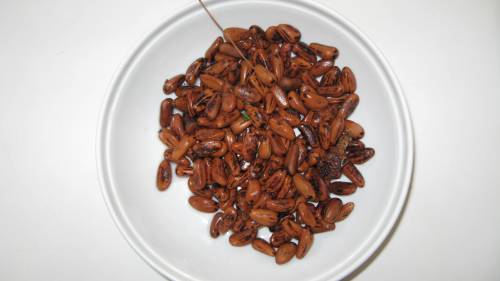
The other day, Jack and I went to a corner of the Bass Garden far away from the windows of the library.  We sat down beneath the olive trees and umbrella pines, and started to pick through the grass for pine nuts.  They kept falling from the trees as we foraged.  There were so many, but they were tricky to find by sight alone, because their black striations make them blend in with the shadows of the grass blades.  We found more by feel than by sight.

Jack decided to plant one, excited about the (far off) possibility of growing a tree.

planting a tree

We gathered a big bowlful, but they’re not easy to eat.  The shell is so hard, and the nut so small and soft, that we often end up crushing the whole thing with out nut cracker.  Oh well. The novelty of it is fun.  And when we do get a whole nut, the taste is so nutty, with no bitterness.  There’s a touch of astringency at the end, but mainly the taste is of a toasty oil.  That’s not something you notice in a handful of frozen pine nuts thrown into a Cuisinart for pesto.

pignoli

Read Full Post »

Maybe it’s the weather.  (This morning, when Jack and I walked to the bus stop next to the Aurelian Wall, it was 41 degrees (F).)

It’s also the food.  The (nice) problem is that the food at the Academy is too good.  Sometimes, I just want to hole up in the apartment and eat a humble dinner that a kid can like.  I’m lucky enough to have a kid who likes some interesting foods, though he also loves pasta with olive oil, parmesan, and nothing else.

soup

One thing I’ve learned from Mona is that the traditional Italian diet is a peasant diet, and is based on the lowly triumvirate of greens, grains, and beans.  My soup takes two of those categories, in the form of farro, red lentils, and split peas, and swaps the greens for carrots and onions.  I also threw in some chunks of fatty pork belly (i.e. bacon) for flavor.  This is the easiest comfort food to make, and is good for locavores in the winter (I’m jumping the gun, here) because it involves dry and long-lived root ingredients.

Start by sauteing bacon, carrots, shallots or onions, and garlic.  Bring broth to a simmer, and pour in a cup of farro combined with split peas and red lentils.  Dump in the veggies, after they caramelize, and simmer until it’s all tooth-tender.  You can add more water or broth if it gets too low.  And you can season to your pleasure.  Tonight, because it was mainly for Jack, I just used a parmesan rind, salt, and pepper.  Other nights, I might have used a combination of lemon and marjoram or thyme; or cumin, cayenne, and coriander.  In any case, it will benefit from a drizzle of flavorful olive oil (my bottle says “gusto forte”) and a sprinkling of grated cheese.  Yum.

A chunk of bread and a glass of hearty red helps too.

Read Full Post »

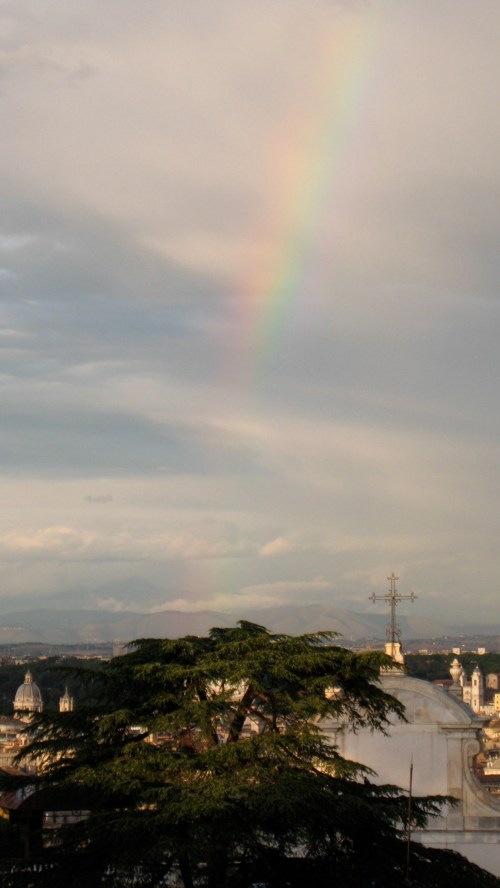
Fall fell in a swirl of branches, leaves, and whole trees.  Yesterday afternoon, we watched the pines and bamboo swaying in circles as the wind picked up.  Rain fell hard, and stopped quickly.  And then, the most magnificent double rainbow I’ve ever seen arched across the Rome skyline, and the mountains, free from the haze after a long hot summer, seemed etched into the sky.  This morning, the air was crisp, about 15 degrees cooler than yesterday’s, and smoke from burning piles of brush signaled the arrival of autumn.  We rode the bus to our usual stop, just past Piazza Ottavilla, where we saw a huge pile of downed trees and branches.  Later, I ran through the park at Villa Pamphili, and saw huge old pines and palms lying broken on the grass.

I had spent the morning on a long market circuit in Trastevere, stopping at my favorite shops: Antica Caciari for fresh ricotta, Canestro for organic cereals, grains, lentils, and peanut butter, and Antico Forno Roscioli for delicious bread and un cornetto integrale–a whole wheat croissant with bitter honey inside.  I knew I’d found an amazing baker when I saw the impossible combination of whole wheat flecks and buttery thin flaky pastry.  How do they do it?

I love walking around Trastevere because of its spider web of narrow off-angle streets that open onto beautiful architectural surprises.

Trast. arch

Rena sent me on a hunt for this place, which carries organic milk in a little fridge near the door.

checco

nut tart

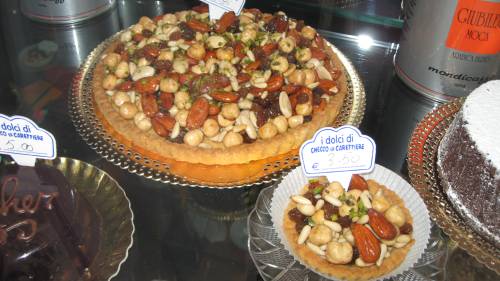
Wow!  It looks pretty, but what would it be like actually to eat this nutty tart?

The Fontana d’Acqua Paolo, seen from the pedestrian bridge, Ponte Sisto, jutting up at the top of the hill, marked the line I’d need to walk to find the steep set of stairs that would lead me up the hill back home.

Ponte sisto

And now, the pictures we’ve all been waiting for…

Il Arcobaleno!

arcobaleno 1

arc 2

I’d been cooking dinner, when Jack, sitting at the high counter in the kitchen, said, “there’s a huge rainbow in the sky.” Uh huh.  I was busy.  But then, I decided to look, and couldn’t believe it.  We ran down the stairs, but not before Jack resourcefully thought to pull on his puddle boots.  We buzzed Lulu and Jesse’s apartment, and ran outside with them to stand in the street.  The rainbow made a full half-circle.  And then we realized it was doubled by a fainter, inverted rainbow above:

double bow

Peter called down from the terrace, where everyone else was watching it.

Peter on terrace

The view from up there was even more amazing.

arc from terrace

arc terr 2

Jack

Read Full Post »

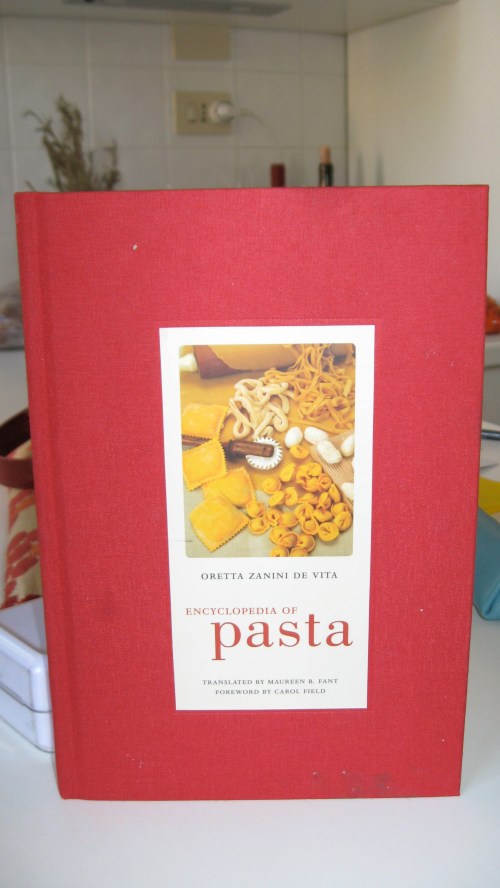
Yesterday, I attended a panel discussion celebrating the publication of the Encyclopedia of Pasta, by Oretta Zanini de Vita and translated into English by Maureen Fant. Also in attendance were Sheila Levine, the editor from UC Press, who co-founded that wonderful magazine, Gastronomica, which features stories about the intersection of food and culture; and Chris Boswell, the sous chef here at the American Academy, a former Chez Panisse chef who is passionate about things like heirloom wheat varietals, and who cooks us amazing dinners here five nights a week.  He co-founded the Rome Sustainable Food Project with Mona Talbott.

pasta book

The highlights of the discussion were the humorous bits.  The hundreds (or more?) of pasta shapes which have evolved over the past few centuries have names which carry stories—many of them humorous, and sometimes with political overtones, such as strangulapreti (priest stranglers), and sometimes simply naughtily ridiculous, such as cazzetti d’angelo (little angel’s balls).  Oretta’s book combines the lore and history of all of Italy’s known varieties of pasta, which she learned mainly through personal conversation and perusal of personal recipe collections.  Part of the value of the book, then, is that it captures in text an oral and manual tradition that is beginning to be lost to convenience foods.  There are also instructions for making all kinds of pasta, and descriptions of how they are traditionally served.

Oretta also has some strong opinions about historical chronology.  She said that not only were Italians making pasta two hundred years before Marco Polo was born, but that when Marco Polo got back from China, his mother probably served him a big bowl of pasta—an assertion she delivered with her characteristic exclamatory tone and gestures.

Then, we ate five or so takes on pasta for lunch.  My favorite was the lasagna—made with incredibly few ingredients: house-made lasagna noodles separated by thinly sliced, narrow zucchini and pulled smoked scamorza, a spun cheese like mozzarella but more flavorful.  It was a taste sensation to remember.

Read Full Post »

File:Rosetti02.jpg

Here is Dante Gabriel Rossetti’s luxuriant post-Romantic Persephone, holding the fruit that completed her curse and imposed the season of winter on the world.   Abducted by Hades, and held in his realm, she was tricked into eating four seeds of the pomegranate.  Every year thereafter, she was forced to spend four months in the Underworld.  During these months, her mother, Demeter, the goddess of fertility, who mourned the loss of her daughter, neglected her duties and let the fruitfulness of the world die away.

This fruit has incredible baggage.  It is associated with fruitfulness in many traditions, and carries the whiff of the forbidden in Greek myth and Hebrew tradition (some believe Eve ate not an apple but a pomegranate).  In a contemporary version of myth and the mysteries of the body—nutrition science—the pomegranate is again a hallowed fruit, worshiped for its antioxidants, the free radicals (a great phrase) that may help to reduce the likelihood of everything from heart disease to breast cancer from developing.  Many Americans spend as much on a bottle of pomegranate juice as they do on a bottle of wine, and feel just as cultured and more virtuous for doing so.

poms

The other afternoon, I thought I might be in paradise.  The sun was warm and the breeze was cool in the garden at the American Academy.  I lay down in the long grass beneath the long, bowed, branches of the pomegranate tree, which were heavy with fruit. I heard the happy voices of Jack and his friends, as they ran around, frolicking and gamboling.  (Here’s an opportunity to use that word unironically–almost.)  I reached up to pick the biggest fruit, and later on enjoyed seeing Jack discover all of the secret chambers full of sweet-tart drippy seeds.

open pom

eat pom

We seem to have avoided any curses, unless that thunder storm that woke us up this morning counts.

Read Full Post »

« Newer Posts - Older Posts »