Feeds:
Posts
Comments

Posts Tagged ‘locavore’

I am in wholehearted agreement with the motivation behind the New York Times editorial of a few days ago, “Farms and Antibiotics,” and with the legislation it promotes, which aims to drastically reduce the amount of antibiotics used in raising meat.   The figures in this editorial are staggering.  There are so many good reasons to pass this legislation: the overuse of antibiotics leads to super-resistant bugs that can affect human and animal health; the animals are given antibiotics not because they are sick, but to prevent them from getting sick, which surely would happen because of the crowded and confined conditions in which they are raised, and because of the unnatural diet they are fed to fatten them up faster than their bodies can handle; antibiotics in farm run-off (i.e. manure) leach into ground- and open water.

But the problem will not be easy to solve.  It would be simplisitic to think that it’s just a bunch of bad-boy capitalist farmers injecting their animals with too many drugs in the name of profit.   Those farmers are stoking, yes, but are also feeding an insatiable appetite for meat.  The change won’t come with legislation alone but with massive shifts in the American (and first world in general) diet–away from cheap meat–and toward more easy access to healthy, whole foods.  Legislation to limit antibiotic use on factory farms will need to be accompanied by some consciousness raising about the unsustainable scale of the meat industries, and with many more legislative actions. (Michael Pollan had some great suggestions for what these might be, in his pre-election open letter, “Farmer In Chief.”)

The road blocks to changing the first world diet might better be described as an intricate and incredibly strong mesh, made up of socioeconomic inequalities, socioeconomic history, and the history of the food industry and of the first world diet.  A century and a half ago, fresh beef was a specialty food of the wealthy.  That all changed with the invention of refrigeration in the late nineteenth-century.  First came the icebox in upper-class homes; then came ice-cooled warehouses, both of which were unreliable but which led to greater changes .  Then came compressed-air, and electric refrigeration–in homes, in warehouses, on trains, in steamers.  The growth of the refrigeration industry, which was directly related to that of beef, completely changed the culture of meat consumption.  Large-scale cattle farms, slaughter-houses, and warehouses, and the increasing demand they were set up to meet, displaced small-scale businesses of all sorts, and introduced the factory-farming of cattle.  This was when grain-fed beef and the first CAFOs (Confined Animal Feeding Operation) were implemented.  As supply increased, demand increased, and prices fell.  And now here we are, habituated to a diet of cheap, abundant beef that we are finally recognizing to be unsustainable.  (A compelling and carefully researched description of this history can be found in the new book by Susanne Freidberg, Fresh: A Perishable History.)

The reduction of antibiotic use in cattle will have to go along with a reduction in beef consumption, but because of the socioeconomic realities of beef consumption, this won’t change easily.  We all know that highly processed, “fast food” is cheaper and easier for many to get than fresh, whole foods.  This socioeconomic disparity will have to be addressed as well. (Salmon and shrimp are fast becoming the new beef: the prices are dropping and the antibiotic use is going up.  The Times had a chilling article the other day about antibiotic use by salmon farms in South America.)

If you have the means, switching to grass fed beef is a good idea, but it will only help to keep beef production sustainable if the beef is local and eaten infrequently.  Speaking of which… it’s been a few weeks since I’ve been to Cloudland Farm….
Read Full Post »

The other day, I went back to visit friends from high school, whom I hadn’t seen in about fourteen years, in the town I haven’t visited much since then.  Why not, I can’t really explain.

It was one of the strongest experiences of sense-memory: watching the curve of the off-ramp come into view; feeling the curve in the tilt of my car; knowing when to slow down.  Driving from the Putney Road strip into the little downtown: they’ve redirected traffic, one way past the Common now, so where I expected the stop sign I’d failed to stop at during driver’s ed.—with the bulldog-owning bulldog of a teacher jamming on the breaks—there was none.  Past the library on the right, where I’d spent so many after-school afternoons.  Down the slope.

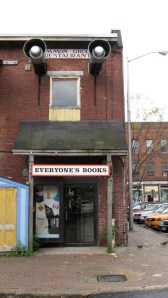
I can’t believe how much has stayed the same over the decades. The same businesses with the same awnings, not updated in twenty years. (The sign remains for the Common Ground, though the restaurant is no more.  It was a true hippy spot: a cooperatively run restaurant, on the second floor, with creaky floorboards, a bottomless bowl of salad with great tahini dressing, and dense, buttery cornbread.)
common ground

Over other storefronts, new signs : shiny, with spiffy, computer-designed lettering, but keeping in the spirit of the town–a store selling natural body products, another new-age bookstore.  I parked on Main Street, across from The Shoe Tree—there for as long as I can remember.  Above those buildings to the left (east) I see the top of Wantastiquet, that huge hump of a mountain I’d walked up and down with these friends so many times, (and remember parking in its secluded parking lot at night), rising up abruptly from its foot in the Connecticut River.
wantastiquet

I looked up Elliot St. and saw that familiar block between Main Street and the Harmony Lot, where we’d always circled slowly a few times before finding a spot.  There was McNeill’s Brewery on the left, Maple Leaf Music on the right, where I had my first real job (lots of dusting and re-alphabetizing of sheet music).  Just across Elliot Street, down the beginning of the steep hill to Flat Street, was the slanted storefront of Mocha Joe’s coffee shop, where I had my second, and probably favorite, job.  Everything inside was exactly the same.  Four steps down to the counter, display of Bodum pots, tea things, and tee shirts on shelves on the left, a little round table to the right, and the milk-sugar station, the high counter straight ahead.  They were playing The Smiths.  That sounds familiar.

I saw Shannon first at a table at the center of the same ancient-stylized floor painting of a bird’s head in a circular design.  She looked like Shannon.  She said, “you walked right past Ham.”  He was at the counter.  We gave each other a big hug.  I was shaking!  Shannon said she’d reached Amy, who had said she’d be here.  We waited just a few minutes and saw her coming down the stairs, looking exactly like herself.  She said, “I saw you on the street, and thought, yup, that looks like her.” It’s hard to express the feelings in all of our looks and hugs.  We’d known each other so well, and then had been so far apart.  We all felt as if we couldn’t explain why we’d lost touch. We stayed there for a few minutes and then walked down the hill toward the bridge to New Hampshire to the Riverview Café.  We sat on the deck above the river, looking over at Wantastiquet—that mountain that figures so prominently in my memories of high school.
wantastiquet bridge
Our personalities were the same, though we were all more comfortable in our own skin, and talked more like adults, less like self-conscious teenagers.  I remember all of their voices so well. And their laughs, mannerisms, bodies.  It was like seeing distant cousins you used to know well, but more complicated.  We didn’t do much reminiscing in part, I think, because our group memories weren’t always happy.  There was also the feeling that we didn’t need to repeat old stories: the stories were in the air around us.  We had so many shared memories, they were there in our looks more than our words.  We had a decade and a half to catch up on.  The fourteen years when we became “grown-ups” and made our lives what they are now.

One has traveled all over the world and lives in New York City, where he writes headlines for The New York Times; another lives in her childhood house, farms the land of Circle Mountain farm, and sells her organic eggs and produce to the locals; a third is a scientist studying the impact of climate change on different species, and on humans.  I’m working on a Ph.D. in literature and writing a blog about local food, living in Alabama, and moving to Rome.  All of these endpoints, and the paths that took us there, make perfect sense for who we were and at the same time seem paradoxically outlandish.  When I told Amy my dissertation was about eighteenth-century British literature, we both started laughing.  Shannon laughed at herself for knowing so much about the different beetles that are killing off the trees of New England.  Hamilton laughed about having a job that feels like professional ADD, and Amy said, “I’m a farmer,” and we all laughed.

Walking with them, back up to Mocha Joe’s, where Ham went in for another coffee, and then up Elliot St. and around the corner into the Harmony lot, felt so familiar.  My feet, legs, body, eyes remembered all of the little details: even the concrete sidewalks haven’t been updated. There was the little triangle of grass at the corner of the lot and the street that always gets trodden down to mud. The lot, and the back doors of old buildings leading to the same shops (The Book Cellar, Galanes’) were exactly the same.

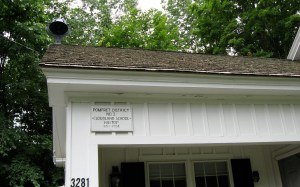
As I drove up the hill, I remembered—in a deep mind/body memory—the little y intersections and nineteenth-century houses along the streets that led up to Western Ave.  I took a right onto the interstate, but if I’d gone straight, the third right would have been Orchard Street, the hill I walked up and rode my bike up so many times, to Meetinghouse Lane, and home.

Incidentally, the food we had was mostly local: goat cheese salads, grass fed cheddar-bacon burger, pulled pork.  We ate and talked.   The hours went by, and we barely noticed.

Read Full Post »

Roving is a romantic way of saying moving from place to place.  At one time, the word contained more layers of significance than it does now, including something like “lookin’ for love.”  This sense finds its beautiful epitome in Byron’s love lyric, “We’ll go no more a-roving.” More than a poem of love, this is a poem of eros.  The short, simple poem, which Byron wrote while in Venice, speaks of the sweetness of longing and nostalgia as it relishes ironic double entendre.

Today, I’ve had a decidedly more banal, and boring, experience of roving: I drove all around this spread-out rural center of civilization in the northeast—seemingly just to keep the car capable of more driving.  It was a day of logistics: dropping the boys at camp; driving to White River Junction with my sister to get her tire repaired for $13, which took all day; driving to drop off my sister at my dad’s office so that she could use his car; driving to the library for two hours of 1794 literary journals on microfilm; driving to pick up my boy; driving to CVS and the Hanover Food Co-op; driving back to the back roads of Norwich to drop off the cold food; driving to my dad’s office to pick up my sister; driving to the mechanic’s to pick up her car.  On the way out of there, my automatic transmission problem alert signal came on.  It’s an orange-lighted gear with an exclamation point in the center.  Whoa!  So, then we drove, in caravan, to another mechanic’s, who directed us to another, farther south along route 5 in Vermont.  This will probably cost me quite a bit more than $13.

And then we drove back up route 5, which, happily, leads to Killdeer Farm Stand.  I dropped off my sister and the boys at the UPS warehouse to see the trucks (my nephew’s current obsession) and drove to Killdeer.  After a day of aggravation, this was bliss.

The vegetable baskets are more bountiful every day.  I wanted to make a pasta dish with a classic combination of vegetables.  I bought an eggplant, sweet green pepper, sweet onion, costata romanesca.  I looked at everything, admired everything, knew I’d be back tomorrow.

spring veg

I left, reluctantly, to do more driving.

For dinner we had farfalle with all of the above, and some sweet Italian sausage, flavored with fennel seeds, from Cloudland Farm, which we’d had in the freezer.  It was warm, green, springy, delicious.

Spring Pasta

Get the water boiling for pasta.  Meanwhile, break a half-pound of sweet Italian sausage into chunks, and slice half of a sweet onion, one or two Japanese eggplants (their skin is more tender), one sweet green pepper, and one costata romanesca.  Sauté the sausage until mid-rare and let drain in a bowl lined with paper towel.  Sauté the vegetables, beginning with the onion, followed by the eggplant, pepper, and eggplant.  Cook the pasta.  When the vegetables are lightly caramelized, spoon in a couple of big spoonfuls of pasta-cooking water, and cover for a minute or less.  Put the sausage back in the pan, and then combine pasta and vegetables in a big bowl or pot and toss with grated parmgiano  reggiano.  Serve with extra cheese at the table.

Read Full Post »

romanesca
The Italian heirloom summer squash posing as a fluted Roman column.  Striated and flecked with green on shades of green.  When you slice it crosswise, the shapes are floral in a stylized, modern design kind of way.  It maintains a firm, tender-bite texture unlike its more watery cousins, zucchini or yellow summer squash, and has a sweeter, nuttier flavor.

A bit of pork flavor—in the form of browned pancetta or proscuitto—complements costata romanesca beautifully.

We bought some of these squash at Killdeer Farm stand in Norwich to go with our grilled chicken legs last night, I sautéed the flower-shaped discs with some sliced prosciutto and olive oil.   First over moderately high heat, until they started to brown, and then over medium-low heat until they softened a bit.  Seasoned just with sea salt and black pepper.

Read Full Post »

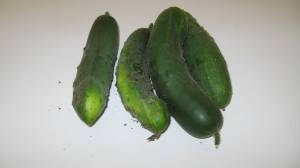
cukes
“If you think I am going to make
A sexual joke in this poem, you are mistaken.”

So says Robert Hass, in his playful poem, dryly titled “Poem With a Cucumber In It.”  The poem contains etymological musings on “cumbersome” and “encumber,” musings on the Berkeley sky, memories of travel, and a rough recipe for cucumber salad with dill and yogurt.

Perhaps the most famous poem with a cucumber in it is “The Task,” published in 1775 by William Cowper.  Like Hass’s, this poem contains something of a recipe: for growing a hothouse cucumber.  Cowper meditates for pages on the challenges of growing this sun loving plant in the English winter.  He describes the construction of the greenhouse, the creation of fertile soil out of a “rage of fermentation,” the coddling of seeds and sprouts, the fertilization which in winter requires that “assistant art/ then acts in nature’s office.”

The cucumber takes on social significance as well.  It is the object in a meditation on two main topics of eighteenth century political economy: value (“when rare/ so coveted, else base and disesteemed—/ Food for the vulgar merely”) and labor (“To raise the prickly and green-coated goard/ So grateful to the palate […] is an art” requiring intensive, careful labor unappreciated and unacknowledged by the wealthy purchasers of winter cucumbers).  Cowper advises “ye rich” to “grudge not the cost” because:

Ye little know the cares,
The vigilance, the labor and the skill
That day and night are exercised, and hang
Upon the ticklish balance of suspense,
That ye may garnish your profuse regales
With summer fruits brought forth by wintry suns.

Cowper’s socioeconomically-conscious advice might sound familiar to those of us who write and think and read about our current food culture: learn about how the foods you take for granted are grown; don’t take them for granted; consider the farmer’s labor; grow some food yourself; keep a compost heap; build a cold frame; consider the social and economic costs of unseasonal foods.

To read this eighteenth-century meditation on the economics, culture, and cultivation of cucumbers is to be reminded that our current “good food movement” exists in an historical context.  Skepticism about and moral indignation toward the modernization of food—whether that means hothouse-cultivation, refrigeration, or genetic modification—is as old as modernity itself, and probably older.   Praise for farmers and their ancient art—and injunctions to praise them—are as old as the art itself.

Read Full Post »

beach jack

After a satisfyingly lazy afternoon on the beach, here in Westport, Mass., Peggy and I went to the fish market.  It was a bare bones kind of operation, but all of the fish and shellfish was glisteningly fresh and abundant.  We decided on striped bass.  On the way home, we stopped at the farm stand at Orr’s Farm—an organic vegetable farm run almost single-handedly by Andrew Orr, who is about 20 and is referred to proudly by locals as the town’s youngest farmer—and stocked up on potatoes, garlic, and a few others items.  Dinner was a locavore’s feast: striper grilled mid-rare and topped with fresh, coarse-chopped basil pesto, garlic mashed potatoes (yes, it’s a craze of mine now), and a salad of lettuces from the back yard mixed with local pea greens, tomatoes and radishes.

pesto striper

Yum!

Read Full Post »

I spotted a forager at the Farmers’ Market in Hanover.  He was busy behind another farmer’s stand, borrowing the scale to weigh his haul of early chanterelles.   He divvied out the cache of beatifully gouda-colored fungi into straw baskets.  $8 each.  6 hours of foraging had yielded six baskets, he told me.  I’m sure those six baskets were picked up in a flash, after which he probably ducked back into the woods.

chants

When cooking, they smell, and then taste, of nuts and apricots, earth and sunlit woods, fruity wine.

Lacking rabbit, I’ll cook them up and toss them over chicken.  Sauté until they release their juices, in butter, with pancetta, herbs, and minced shallot.  Maybe a few pinenuts.

Rosé…

Read Full Post »

Pork chops, like buttercups, are my Proustian objects.  At the taste of a chop, especially one brined in cider or served with applesauce, I’m back on Old City Falls Road, at the big yellow house in Strafford, Vermont.  Up the steep hill behind the house and barn—a catch-all space housing tools, lumber, a VW bus, my Dad’s darkroom, a sauna—was the pond where I learned to swim and skate, and the pig pen.  My parents, on the run from suburbia back to the land, had set up a small homestead with a vegetable garden, chickens, pigs, a goat, and two little girls running around in Wonder Woman Underoos in January, because the wood stove kept the living room so hot.

The pigs, Gruntly Squatwell and Squatly Gruntwell, were contented animals until that particular date when my uncle and a few other guys would show up in their pickup trucks for the big pig roundup.  Then the pigs ran around and around their pen squealing for their lives, though they didn’t know it.

The result was a freezer full of pork.  For some reason, I remember the chops best of all.  Sweetish and salty, for me the essence of pork—until I tasted pancetta, but that’s a different kind of experience.  The best, more recent, pork chops I’ve had were grilled by our friend Donia, the energetic and lovely Palo Alto chef and writer.  Her cooking—whether in her restaurant or home—is less a performance than an expression of her nurturing nature.  The food is loved and cared for, as are the friends she feeds.

The technique here is so simple, it barely warrants the formalization of a recipe, but here goes:

Donia’s Pork Chops

In the morning, place four thick-cut bone-in pork chops (organic if possible) in a large baking dish, and pour in a fruity red wine—a Beaujolais, or a zinfandel, perhaps—just to cover them.  Turn them over once or twice during the day.  Just before grilling—preferably over charcoal—season them liberally with salt and pepper.  Grill to mid-rare over moderate heat.  Throw some perfectly ripe buttered halved peaches onto the grill too, for a taste sensation.  Donia also served cornbread and salad, outside on the deck.  What a memorable meal!

Read Full Post »

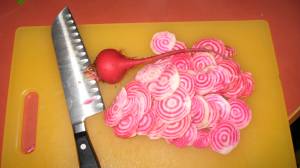
This is a delicious side dish which is also very pretty.  These beets are sweet, as their name implies, and decorative, like Victorian stencilling.  Slice them horizontally to see the concentric pink and cream circles.  These organic beets are from Killdeer Farm.

chioggia

Dolce di Chioggia and Carrots

a small side for 4

Slice 8-10 Dolce di Chioggia beets 2 mm. thin–or even thinner if you have a mandoline.
Slice carrots on the diagonal to the same width.
Melt 1-2 tbs. butter in a large saute pan.
Slide in the beets and carrots and saute on high for a minute, then reduce heat and cover. Season with salt and pepper.  Cook over low-moderate heat until fork-tender.
Toss in a splash of red or white wine vinegar and a handful of chopped parsley.

Serve as a side with grilled chicken.

Read Full Post »

We had the most delicious meal last night.  Sauteed broccoli raab, beet greens, and green garlic from Killdeer, polenta, and spicy grass fed beef sausages.  After our morning with the Jersey cows at Thistle Hill in North Pomfret, Vermont, yesterday, we drove up and down the winding roads and along River Road in search of more cows—this time the black Angus steers of Cloudland Farm.

cloudland steers
“Cloudland” is an appropriate name for the farm at the top of the mountain road of the same name.  There are some long tunnels of trees along this climb that then break open into gorgeous vistas.  Before the twentieth century, the whole hill was most likely a cloudland—open pastures that seemed to touch the sky, for sheep and cattle and countless stone walls.  New growth forest has filled in some of this land, but Cloudland Farm still maintains a thousand acres of pastureland for its herd of grass fed steers.  (They’ve farmed this land for one hundred years.)  Like the population of grazing animals, that of farming families has thinned over the decades, too.  This empty hilltop school is evidence of a once-thriving community:

cloudland school
(The bigger Pomfret school down in the valley is underenrolled, now.  Old farmhouses are being bought up by wealthy non-farmers whose kids have already grown up and stayed in the cities.)

While I shopped around in their farm store, Jack and his cousin stood in the driveway admiring all of the vehicular activity. There was a big John Deere tractor, a skid steer, two ATVs, and a kid-sized pedal tractor.  The boys were happy.

cloudland sign
So was I.  I bought a whole variety of frozen beef, and started thinking about dinner.  Outside, the sun was streaming down at intervals between the big cumulonimbus clouds that have covered this region for over a month, drenching it again and again.  Bill Emmons, the Cloudland farmer, was talking about how little haying he’s been able to do, because of the constant rain.  He was enjoying the chit-chat, but was also twitching to get away and grab this sunny moment to hay.  “I hope I remember how,” he joked.

Visit their website here.

Read Full Post »

« Newer Posts - Older Posts »