Feeds:
Posts
Comments

Posts Tagged ‘locavore Rome’

I find that what I cook for dinner here in Rome is similar to what I cooked in Vermont or Alabama.  The only difference is that the ingredients are generally better or cheaper.  For example, last night I made bucatini (long, skinny tube pasta) with the ingredients I had in the fridge from previous days at the markets: chanterelles, dandelion greens, prosciutto, fresh onion, garlic, parmaggiano reggiano I’d grated with a hand-grater.

greens

It was delicious.   And made with ingredients that would have been much more expensive in the States and would have been seen with a halo, or rather a tiara, above them, which spelled out “e-l-i-t-e f-o-o-d.”  Ingredients like dandelion greens, for instance, are perversely seen as unusual, elitist, and foodie-fetishized by the general public.  This is unfortunate, because they are so delicious and easy (to grow and to cook).

Here in Rome, everyone buys and cooks huge bunches of dandelion greens, varieties of chicory, treviso, radicchio, and countless kinds of beans.  Everyone buys multiple varieties of tomatoes that actually taste like tomatoes and not like paper towels injected with citric acid.  I was talking to Mona, the chef at the American Academy, about this observation a few days ago.  She had a few explanations.  One is that Italian cuisine is based on greens, grains, and beans.  To Americans, this sounds like “health food,” but think about what an amazingly varied pyramid-foundation these food groups provide.  Everyone in every socio-economic group here eats greens, grains, and beans.  Another reason has to do with land ownership.  Historically, land has been owned by the church and leased to small-scale farmers.  The “get big or die” dictum doesn’t really work here.  Agricultural land and the regional cuisines are seen as part of a national heritage, too, and so there are social, cultural, and economic motives for preserving the status quo when it comes to food.

I don’t need to rehearse for my readers the problems with the farm bills of recent history or the problematic ramifications of agricultural subsidies in the U.S.  Everyone knows that large-scale monocultures of commodity crops like corn and soybeans end up being favored over diversified smaller farms that might grow dandelion greens alongside sweet onions, tomatoes, and melons.  The consequences of this kind of agribusiness are a dumbed-down or simply wiped-out cuisine, a boring selection of cheap food that must be jazzed up with corn-derived substances and packaging to sell, diet-related diseases, a general lack of cooking skills, and a silly politicization of good, real food, whereby fresh fava beans are seen as chi chi.

I’m learning things here that could be taken home.  (OK, get out your corn-tassel pom-poms for this): C’mon, America, let’s get real!

Read Full Post »

wall

wall 2

just wide enough to look or shoot through

I had an interesting personal-historical palimpsestic experience this morning on my way home from dropping Jack at school.  I wound my way to the market street, and went to the last stall, where there is a sign saying “Vendita Directa,” meaning that the fruits and vegetables are sold directly from farmer to consumer.  I don’t know how to explain the presence of bananas from Ecuador on the table, but oh well.

On my way home, I decided to take a little staircase I hadn’t seen before, which seemed to lead in the general direction of the American Academy.  It led to a sidewalk that ran along La Mura—the gigantic wall built around the ancient city.  I knew that the Academy was situated just over the wall, in a sort of nook near the wall’s highest point.  If I just walked along the wall, I’d find a way in.  I kept walking and walking along the wall, as it started to wind down the steep hillside.  Cars rushed by me on one side, and the high wall reflected hot sunlight on the other.  I kept thinking, there has to be a way through this wall!  And then I realized the historical and ironic nature of this walk—about a mile out of my way.  My position on the outside, and my desire to get in, put me in the place of the barbarians the wall was constructed to keep out.  I may be an American, and wearing jeans from the Gap, I thought, but I’m carrying a bag of figs, and I’m trying to learn Italian!

Finally, I decided to turn around, and this time, I spotted a woman pushing a stroller through a narrow doorway in the wall.  This passageway led to the park and playground right near the Academy.  I was in.

Now for some pictures.  Last night, a bunch of us at the Academy did our best to eat as Romans do.  We had a pot-luck barbecue, but there were no barbarian-style hot dogs or burgers on the menu.

I made pizza:

my pizza

Lars and Eva brought sausages to grill:

grill

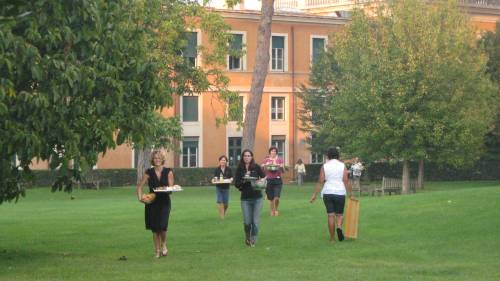
When the rain let up, we carried all of the food outside to a table under the trees:

carrying

The fire kept burning, and more meat came out.  This was the butterflied leg of lamb Russel and Annie bought at Testaccio on Saturday, along with some sweet cippolline:

lamb

It was a good spread:

the table

Read Full Post »

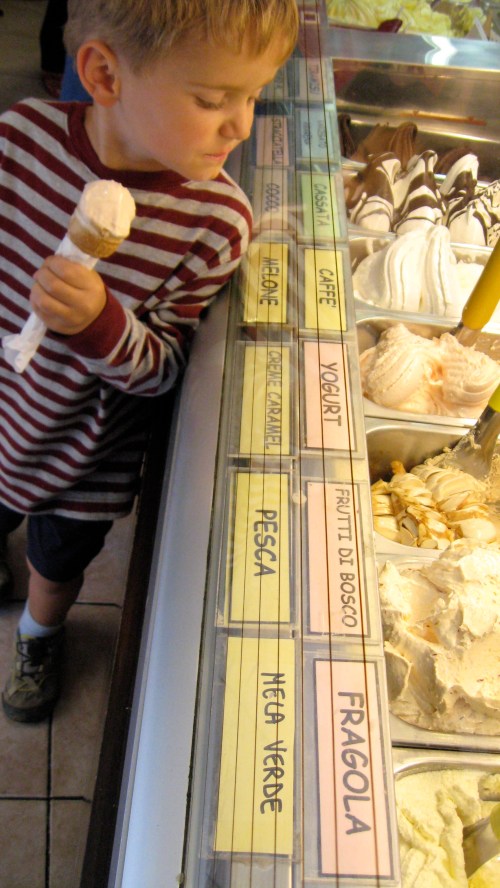
We made our first gelato-destination-trek yesterday, after asking around about the best shops in the neighborhood.  Miami Gelateria, conveniently located about halfway between our apartment and Jack’s school, makes theirs in-house, and offers an array of flavors, from the tangiest limone to the densest chocolate, with everything nutty and fruity in between.

gelateria

They serve typical cones or cups with large, melty scoops, and they also make mini, dipped cones.  The minis are about 6 centimeters (trying to think metrically, here) high, are dipped in dark chocolate, then a bowl of chopped nuts, then served, to eager little hands.  You can eat one in two or three bites.

After contemplating the selection, and learning new words in the process, Jack chose melone and Peter and I shared a creme caramel.

gelato

The texture is airy and fluffy, compared to the hard ice cream at home, and the flavors were undiluted essences.

Read Full Post »

On Jack’s first day of school, I stayed there with him for a couple of hours, to ease him into the experience of a new school in a new language.  We left just before lunch, and took a looping, indirect way home, stopping at market stalls and shops along the way.  One of my destinations was a half-block of street closed to cars, where vendors were selling fruits, vegetables, meat and cheese, and household odds and ends.

mkt st

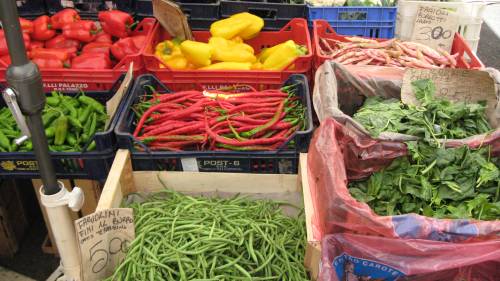
We bought bags of the pink-and-white-swirled fagioli borlotti, and of blackberries that taste as sweet and meaty as pears.  Not a trace of tartness, which is a surprising sensation!  To be honest, I only bought the pricey 3-Euro basket because Jack fondled them.  The unspoken rule of etiquette at the markets is: you touch it, you buy it.

veg mkt

Next time, I think I’ll get some of these elegant peppers:

peppers

The most delicious item we bought, though, was the melon.  Sweet as honey and juicy as, well, juice:

melon

Next, we went to the bread shop, which is the most nondescript shop I think I’ve ever seen.  What you have to do is follow the scent of baking bread with your nose, and look for a bunch of people standing around chatting happily, and moving in a constant stream in and out of a narrow door.  That’s the line for bread.

bread store

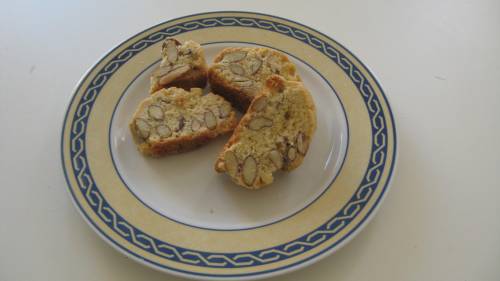
Once inside, I was crammed shoulder to shoulder with people buying multiple bags of bread, biscotti, pizza, and cornetti (croissants).  Jack stood in a corner, with his backpack and sunglasses on, eating an apple.  He looked as nonchalent as a true Italian.  The only proper name of a bread I knew was pizza bianca (what we call focaccia), so I asked for that and used gestures and alternate “grazie”s and “per favore”s to indicate how much I wanted.  Then I asked for quattro biscotti, and pointed at these cute little lemony-almondy cookies:

biscotti

Oh, boy, were they good.

Read Full Post »

This is one of the aspects of living in Italy I’ve been looking forward to.  There is such an onslaught of brightly packaged processed food at kids-eye level, (ok, and grown-up eye level) in American supermarkets, that it’s difficult to avoid loading your cart with boxes of convenience food.  The array of breakfast cereal is astounding, and hard to resist.  Breakfast cereal, to follow this example, is also very expensive, considering the ingredients, and is loaded with sugar and sodium—even the “healthy” varieties.

I was thinking about these things as I walked through the aisles of the GS—the big supermarket near Jack’s school here in Rome.  There are a lot of crackers and bread products that are far from “fresh,” but in general, there is a dearth of processed foods in an Italian supermarket, compared to those in the U.S.  You certainly won’t find any large jars of pre-made tomato sauce (loaded with high fructose corn syrup and sodium).  And breakfast cereal?  Instead of a gazillion choices, there were just a few.  And if you want to spend 7 Euros, you can get a small bag of honey-coated puffed farro.  Farro!?  That would only go over in a natural food store of some sort, in the U.S.  Also, note the price (don’t forget the exchange rate).  My conclusion is that Romans don’t eat much cereal for breakfast.

I was also thinking about these observations when I read this article in today’s Times, about a new green checkmark label that is supposed to lead consumers to healthier food choices.  Froot Loops apparently received the checkmark.  The idea that consumers are so stupid as to need a green checkmark to tell the difference between a Froot Loop and an apple in the first place, and that they are too stupid to know that Froot Loops actually aren’t a healthy choice, is astonishing, and really depressing.

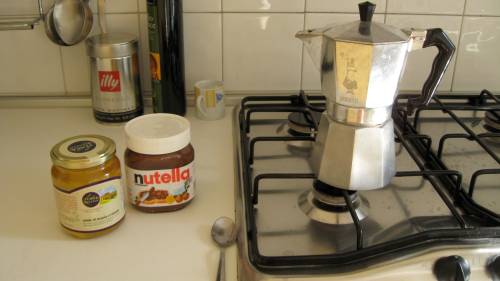
So, what did we have for breakfast here in Rome?  Whole-grain toast with honey (or, ok, I admit, a bit of Nutella), coffee, and milk.  Good food.

breakfast

Read Full Post »

« Newer Posts