Feeds:
Posts
Comments

Posts Tagged ‘eating locally’

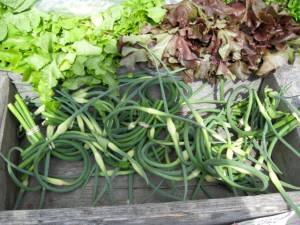
scapes bin at the Norwich Farmers' Market

scapes bin at the Norwich Farmers' Market

I love garlic mashed potatoes.  Possibly even more delicious are mashed potatoes made with garlic scapes.  Last night, I boiled about a pound of new red and gold potatoes (skin on).  I tossed four curlicues of garlic scapes (1 per person) into the boiling water for a minute, just to soften them up a bit.  Then I roughly diced and minced them.  When the potatoes were fork tender, I used a hand-masher to blend in the scapes, milk, 2 tbs. of butter, salt and pepper.  The result was delicious, and as pretty as a pile of potatoes can be: creamy white flecked with green and pink, and tasting of the freshest garlic.  I love whole roasted bulbs of garlic, with that deep nutty caramelized flavor, mashed into potatoes.  This was different.  Garlicky, but greener, grassier, springy.

The only problem was that I made too few.  Everyone wanted more potatoes.

Read Full Post »

On our way home from the strawberry festival, after driving through the little downtown of Norwich in which all was quiet (it’s Sunday) except for Dan & Whit’s general store (“If we don’t have it, you don’t need it.”), we drove up Turnpike Road, kept going until it turned to dirt, and saw a sign: “eggs.”   We slowed down, and stopped at the table where a young neighbor was selling eggs and chocolate chunk cookies.

eggs 4 sale
We bought a dozen eggs and two cookies.  The eggs came from two breeds of chicken: New Hampshire Reds and Araucana.  The Araucana’s eggs are a pale greenish blue.  I boiled two for lunch, and found when I peeled them that the inner shells are a deeper turquoise.  The yolks were the color of black-eyed Susan petals.

My parents’ house is about a half-mile further on Turnpike Road.  It’s satisfying to eat a lunch so fresh, and in hues I’d love to paint.

Read Full Post »

honey

We drove up I89 yesterday to Vermont’s city, Burlington, to have dinner with Peter’s friend, the Irish poet, Greg Delanty, his wife Patti, and their son Dan (who gave Jack his outgrown tractor toys on indefinite loan).  It was rainbow weather.  The sky had been heavy and dark in Norwich—rain for days, all the Vermonters complaining about such an injustice, and on the solstice too!  But as we drove through the Green Mountains and into the Champlain Valley, the sky opened into a shifting patchwork of gray, white, and blue.  Some mountain tops were hidden in dark blurs, some were lit up bright green by shafts of sunlight. Some clouds were white wisps, some were poofy cumulous towers. We saw a rainstorm up ahead over the next valley, we were in it, and back in the hot sun again.

After this beautiful drive, we were welcomed onto a sunny deck by Patti, who is passionate about local food: there was late-afternoon local beer, and asparagus with dinner (to green up the Irish ham and potato plate).  This morning there were jumbo eggs from a nearby farm, toast from a nearby bread baker’s.

But the most delicious element of either meal was also the most local: Patti’s honey.  She keeps a hive in a wooden box in the side yard, the yellow walls of which match the yellow and purple trim on their old New England house, which stands at the corner of the lake-front street packed with other little old houses whose clapboards are whimsically painted other shades of purple, orange, or bright blue.  After breakfast, Jack and I went for a walk and stopped to sniff the roses, peonies, and lilies planted in abundant disorderly patches of overgrown grass in front of the porches along the way.  We saw bees dipping into these polleny perennials as well as into the flowering vines covering the fences and the little nosegays of wildflowers in cracks on the sidewalk and on the edges of driveways and yards.  Patti’s honey has all of the flavors and aromas of this big mixed bouquet.

Because of bees’ omnivorousness when it comes to nectar, and the portion of pollen that ends up in the honeycombs, eating local honey can help us ward off seasonal allergies, and is said to be an immunity booster in general.  But more importantly, honey is a comfort food for me: I associate it with childhood, with the pink and white clovers and buttercups of Vermont, and with Winnie the Pooh’s “little smackerel of something.”  I still enjoy it on toast and in tea, but there are more grown-up ways to eat it too: as a dressing for Mission figs and manchego; drizzled on soft goat cheese; or as a seasoning with braised lamb.

Read Full Post »

cheese sample

Vermont is, of course, known for its dairy farms, along with its maple syrup.    The two events I went to today, the Norwich Farmers’ Market and the Co-op’s annual Dairy Day, are really celebrations of the richness, variety, and history of Vermont’s dairies, which stretches back to the seventeenth century. While stories of small dairies going out of business or being bought out by large conglomerates are common these days, some of the most successful operations now are small.  They have simply shifted their market focus and serve the (expanding) niche markets defined by the desire for food that is of a high quality, is local, and is artisanal in some way.  The desire for these traits goes along with a conservationist ethos that looks both forward and back.  Heirloom seeds and techniques are prized for their history as well as for the continuity and contribution to biodiversity they offer to the future.

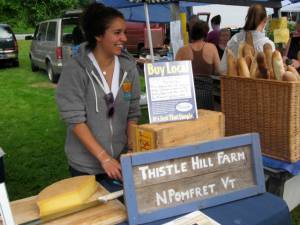
Today, I settled on a cheese from Thistle Hill Farm, in North Pomfret, Vermont, a dairy which epitomizes this cultural and environmental ethos in their cheesemaking.

pomfret cheese

They specialize in a semi-hard cheese named Tarentaise, after the Tarentaise Valley in the Savoie region of the French Alps.  The organic milk from their Jersey cows is combined with imported French cultures and their own rennet in a custom-made copper vat like those used in the Savoie.  The Putnams write on their website:

From its humble beginnings as organic raw milk to its natural aging and rind development, Thistle Hill Farm Tarentaise is as unadulterated a cheese as you will find. The imported French cultures impart flavor and texture. The traditional rennet provides structure and further complexity to the flavor of the cheese. Thistle Hill Farm Tarentaise has no added preservatives, synthetic flavors or additives. No herbs are used to hide its flavor; no waxes or plastics simplify its aging process.

Tarentaise is unique to North Pomfret Vermont’s terrior – its soil, geography, climate and flora – which gives Tarentaise its characteristic smooth, subtle nut flavor and complex finish. http://www.thistlehillfarm.com/default.htm

We sampled little cubes, and then bought a big slab.

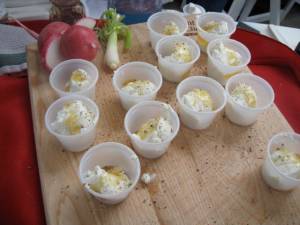
Just before lunch, we migrated to the Lebanon Food Co-op’s Dairy Day, where everything from root beer floats to Greek yogurt could make a mid-morning snack.  While Jack and his cousin went for the root beer and balloons, I sampled the Vermont Butter & Cheese Company’s creamy goat cheese dressed with honey and black pepper, and an assortment of other cheeses, including more Tarentaise.

VT B&C goat
But I was also on the hunt for a sweeter evocation of fields, forages, and herbs.  Some of you might recall my daydreams about the ice creams of Strafford Organic Creamery, the small Guernsey dairy in my first hometown (and the town where Peter and I got married in the meeting house).

Strafford

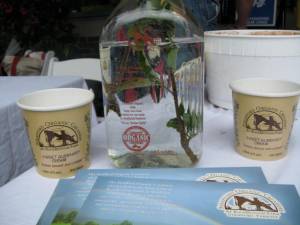
At last, I found their table, where melting ice cream in plastic buckets was being scooped into a constant stream of drippy cones.  I ordered fresh mint, and could taste the herb garden.  Bridget ordered coconut, and my mom got coffee, with its milk-brewed grounds.  Our favorites? It was a toss-up between fresh mint and coffee.  (Strafford Organic Creamery)

the kind of shot you get from a 4-year-old portraitist

the kind of shot you get from a 4-year-old portraitist

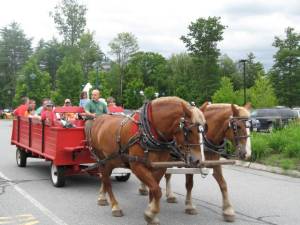
Since it was an event aimed mainly at children and their families, there were the requisite horse-drawn wagon rides around the parking lot.
horsesAnd, of course, Ben and Jerry’s:

B & J's

Read Full Post »

How to cook kale?  There are many theories which involve long cooking and lots of water, but I prefer to saute it fairly quickly in a hot pan with a bit of olive oil.

Last night, I cooked purple kale.  I pulled large bite-sized pieces off of the stalk, and washed them in cold water.   Sometimes, as with spinach, I’ll grease the pan by cooking some small pieces of bacon or pancetta, then throw the kale in just before the pork gets crunchy.  I always use garlic, and have found that the kale gets most garlicky when several crushed cloves of garlic have been simmered in the oil for a few minutes, so that its skin is slightly caramelized.  After putting in the kale, you can put the lid on for a few minutes to steam it a bit, and when it gets wilty, leave the lid off and toss it with tongs.   I strongly recommend tongs, so that you can squeeze out the excess water before plating it.

Kale is also delicious when it’s tossed together in the pan with mustard greens and spinach.  Red pepper flakes are a nice addition at the end.

Read Full Post »

Last night we had a last, leisurely, late-afternoon-into-late-evening dinner with Jim, Sharyn, and the adorable Mimi.  Jack and Mimi played continuously and tirelessly for five solid hours, pausing only for dinner—spicy local pork sausages with spicy mustard, shalloty crispy green beans, and grilled eggplant dressed with saffron-yogurt sauce—and dessert: lemon custard tart topped bountifully with berries.
Sharyn's tart
Sharyn is the picture of effortless elegance.  The wine was served in little Moroccan tea glasses that complemented the votives arranged asymmetrically here and there.  The tapenade was lemony, the pita toasts just bite sized, the dishes bistro-white.  And then there was the tart: aristocratic and earthy at once on its crystal cake-stand.  The crust edges were perfectly tapered and golden, the vanilla-lemon custard softly peaked, the berries tart-sweet and juicy.  The farmers’ market blackberries were as big as small plums, and satisfyingly, sun-ripened sweet.  My adjectival powers are stretched to the limit!

Let’s end with some happy faces.
J & M

J & M 2

J & M 3

interpretive dance?

interpretive dance?

Read Full Post »

Beef Cattle in Pasture

If you like meat, you’d enjoy a trip to the Lambert-Powell Meats Lab store at Auburn University.  They carry eggs, all kinds of cuts of beef and pork, fat packs of ground beef, and sausage in many varieties of traditional spice combinations, including chorizo and fennel-seed-dotted sweet Italian.  (The smoked sausage is delicious grilled and smothered in spicy mustard.) They also occasionally offer grass fed beef, which I prefer to buy because it’s produced more sustainably than its conventional, grain fed counterpart.

The distinction between grass fed and grain fed beef is pretty simple to explain, but the differences in the effects of these two production methods on the environment and human health are drastic.  Here’s how Heidi Finegan, the Research Associate in the Department of Animal Sciences at Auburn, describes the differences in the production methods:

Grass fed beef is just that, beef that is grown only on forages (the term “forage” encompasses many grasses and legumes).  Most beef you buy in the grocery store is finished on grain and considered “regular beef” by many consumers.  Generally, beef cattle are raised alongside their mothers in a pasture until they are weaned at 6-8 months of age, weighing around 500-550 pounds.   After weaning, they will remain on grass until they reach about 800 pounds.  At this point, they will be shipped to the mid-west to enter a commercial feedlot where they will be “finished” on a grain diet until reaching harvest weight at 1000-1200 pounds.  This usually takes around 100 days and the average age of harvest beef is 18-22 months.  So, the main distinction lies in the fact that some cattle never have grain and are marketed as “Grass fed” while feedlot cattle are grain fed.

Even though the grain-finished method is preferred by the beef industry and many consumers, because it takes less time and results in the flavorful white-fat marbling familiar to meat-eaters, it entails many problems.  I won’t go deeply into them, but let me offer a brief list to get your imagination going on some consequences of raising beef on an industrial scale: e. coli, antibiotics, manure “lagoons,” mass-production-style slaughter (or would that be destruction?), fossil fuels, fossil fuels, and more fossil fuels.  This week, Jane Brody wrote about beef in her weekly column for the New York Times, and proposed that “a reduced dependence on livestock for food could help to save the planet from the ravaging effects of environmental pollution, global warming and the depletion of potable water.”  She quotes Dr. Barry Popkin, an epidemiologist at the University of North Carolina, who says that, “in the United States, livestock production accounts for 55 percent of the erosion process, 37 percent of pesticides applied, 50 percent of antibiotics consumed, and a third of total discharge of nitrogen and phosphorus to surface water.”

And we all know that meat consumption contributes to the high rates of heart disease in the U.S.

Grass fed beef offers many advantages.  Heidi says that:

Grass fed cattle are easier to manage, are more cost effective to the producer, and play a key role in sustainable agriculture.  Properly managed grazing patterns can help maintain soil productivity and keep forages in healthy conditions where they can protect soil from erosion and fix nitrogen.  Local producers can also cut out shipping and delivery costs by keeping cattle on their own property and not sending them to Kansas or Texas.  Some negatives to grass fed productions are that it will take a longer amount of time for cattle to reach optimal harvest weight and as the animal ages the tenderness and quality of meat declines.

Some would dispute the point about quality.  Many foodies claim that there is a terroire aspect to grass fed beef—that the particular qualities of the forage and soil come through in the meat, and that the flavors of California- and Vermont-raised grass fed beef are different.  The distinctness of the flavor of grass fed beef may also be a result of contrast.  If you’re used to the water-bloated mass-produced steak from the big chain supermarkets, this beef will be a new experience.  Perhaps nutritional content affects flavor too: grass fed beef contains less saturated fat, and more antioxidants and omega-3 fatty acids than grain fed beef.  Heidi also pointed out that beef is high in zinc, vitamin B, and iron.

If you love a juicy steak, it seems that the best way to go is to buy grass fed, and only on occasion. But grass fed beef is not widely available yet, so when we just need to celebrate with steak and red wine, I’ll buy grain fed New York steaks from the Auburn meats lab.  At least I know it’s local and raised with education in mind. My favorite toppings for salt-and-pepper seasoned burgers are Colemans mustard, a tomato slice, and fresh basil leaves.  For steaks, simplest is best: I rub them all over with a fresh rosemary sprig (then stick some leaves in the fat-crevices), sprinkle them with salt and pepper, and grill to mid-rare.

Read Full Post »
« Newer Posts