Feeds:
Posts
Comments

Posts Tagged ‘eat locally’

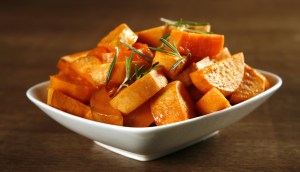
unsweetened. My favorite seasonings for sweet potatoes are salt and spices. During the fall season of the Randle Farm CSA, we got a ton of organic, honey-sweet sweet potatoes. We experimented with different preparations. On Thanksgiving, my brother-in-law, Ned, spent a lot of time grating a pound or two with my hand-held, flea-market Wonder Shredder, then threw them into a skillet warmed with some sage brown butter. They stuck. Badly. Something about the starch.

iStock_000004120135Medium

So, my stand-by preparation is to roast spears. First, Jack peels them meticulously, avoiding his precious digits. Then I cut them into thick “fry”-shaped spears. I grind up some coriander seeds, fennel seeds, cumin seeds, and salt with a mortar and pestle, and toss the spears with the spices and either olive or sesame oil. So good!

Oh, and if you still have sweet potatoes in May, and they start to sprout, you can make them into interesting creatures:

sweet potato creature

Read Full Post »

https://i0.wp.com/randlefarms.com/bberry/sheepinclover.jpg
Randle Farms is one of the CSA possibilities in the Auburn area.  They grow a wide variety of produce, and also offer eggs, beef, pork, and lamb, all of which is organic. When we joined in the fall, our first pick-up included two frozen lamb shoulders.  I had to do some research before cooking these hunks, and then had to turn my knife in all directions to carve the meat off the oddly shaped bone and make relatively uniform-sized chunks.  Because braising is the best way to cook this sinuous cut, I tried two variations on stew—one classic French, and the other Moroccan. Both were delicious, but the Moroccan spices and the mystery ingredient—honey—really brought out the distintiveness of the lamb.

Ras el hanoutThe dish is a variation on Mrouzia, traditionally made after the celebration of the slaughter of the lambs, and characterized by its sweet-spiciness.  The main spices are in the blend called Ras el hanout, which is popular across North Africa and the Middle East.  The blend includes cumin, coriander, cardamom, clove, paprika, cinnamon, nutmeg, peppercorn, turmeric, and mace.

First, in a dutch oven or heavy pot, whisk together the 2 tsp. Ras el hanout, 2tsp. salt, ½ tsp. black pepper, ¾ tsp. ground ginger, a pinch of crumbled saffron threads, and 1 cup of water.  Stir in 3 pounds of lamb chunks with 2 more cups water, 1 chopped onion, 2 minced garlic cloves, 2 cinnamon sticks, and ¼ cup butter.  Simmer, covered, for about 1½ hours.

Then add the sweets: stir in 1¼  cups raisins (I prefer goldens), 1¼ cups whole blanched almonds, ½ cup honey (which you can get locally), and 1 tsp. cinnamon.  Simmer, covered, for another 30 minutes.

Finally, uncover the pot and cook over moderate heat, stirring occasionally, until stew is thicker (about 15 minutes).  Serve with bowls of moist, fluffy cous cous.

Here’s a link to Randle Farms (randlefarms.com) where you can see the lambs munching clover.  (The photo at the top is theirs.)

Read Full Post »

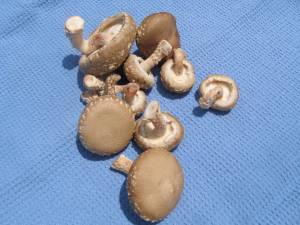
shiitake1
Umami.  It’s the earthy, meaty taste that mushrooms, meat, and long-simmered stocks have.  Aged and fermented foods have it too: hard cheeses, Thai fish sauce.

I bought a few handfuls of local shiitakes at Dayspring Natural Foods, sautéed them in olive oil, and tossed them in a salad with romaine, spinach and a vinaigrette made with Dijon, sherry vinegar, and olive oil.  The dark tang of the sherry vinegar was a perfect match with the umami of the shiitakes.  It’s my mushroom of choice.  In comparison, so-called “buttons” taste like dirt.

Read Full Post »

sign2

Shrimp might be called a staple for many Americans.  It’s often the seafood—or just plain protein—of choice for lunch, dinner, or cocktail snack because it’s sweet, nutritious, low in fat, and goes well with anything from mango salsa to garlicky oil.  What’s not to love?

A few things.  First of all, do you have any idea where most shrimp in supermarkets and restaurants comes from?  Probably Thailand, from which the U.S. imported 182,371 metric tons of shrimp in 2008 (and where intensive shrimp cultivation is endangering the mangrove forests and everything that lives in them).  Or maybe it’s from Indonesia, Ecuador, Vietnam, China, Mexico, or Malaysia.  We import anywhere from 84,000 to 30,000 metric tons of shrimp from these countries annually.  The energy demands of this shipping distance is one problem.  Another is the environmental degradation that results from such intensive farming in these places.  Then there is the problem of contamination.  Mega shrimp farms are constantly fighting off bacteria and fungi with antibiotics—including those that are banned in the U.S.   Heavy metals and other pollutants are also common contaminants.  And do you recall the contamination scandals of recent years, when thousands of pets and Chinese babies died from ingesting melamine?  The New York Times reported not too long ago that melamine is commonly used as a binding agent in the food pellets given to shrimp in China (and probably other places as well).   During the occasional inspection of shrimp imports by the FDA, contamination is almost sure to be found.  In another recent Times article about seafood from China, the reporter summed up the FDA report with these words: “Of the seafood that was refused at the border, filth was the top reason and salmonella was second, with shrimp accounting for about half of those.”  And did you know that the FDA inspects less than 2% of food imports?

These are some of the reasons I’m so excited about the shrimp I can get at Auburn University’s fish market.  The shrimp is raised in Gulf Shores, Alabama by the University’s Aquaculture department, whose programs focus on maintaining and restoring healthy ecosystems and running their businesses sustainably.  (Another project of theirs I’m interested in is the restoration of the oyster beds around Dauphin Island, in the Gulf of Mexico.)  Gulf shrimp are the only domestic shrimp available.

fish-mkt

The fish market, just outside of town, is open on Saturday mornings, and often sells out of catfish by 8:30.   This past Saturday, it already felt like summer: the air was heavy, hot, and humid, and the sun was just burning off the haze around 10:00.  We pulled up to the little shack with $27 in cash.  The shrimp are frozen, and sold in huge bags.  Jack wanted to prove his strength by lugging the bag to the car:

Who are you calling shrimp?

Who are you calling shrimp?

I like to cook these shrimp in all kinds of combinations.  Last night we had it with cous cous and a mango-jalapeño and fresh herb salsa (with, yes, many non-local ingredients).  I also like to sauté it with the local shiitake mushrooms now in season, which lace the sweet shrimp an earthy umami yumminess.
shiitake

Often, the simplest preparation is the best.  Shrimp needs little more than to be sizzled in hot olive oil with crushed garlic and a dried chili for punch.  Salad, crusty bread, and some light wine are the only other things you need for this savory meal.

Some links and other points of interest regarding shrimp:

Green Prairie Aquafarms, which delights in its oxymoronic name, and which I heard about from my friend Jim McKelly, who is working on a film about sustainability projects in Alabama, is an inland shrimp-farming business in the salt ponds of west central Alabama.

Auburn’s Aquaculture Department: http://www.ag.auburn.edu/fish/facilities/index.php

Times article: http://www.nytimes.com/2007/06/29/business/29fish-web.html?scp=10&sq=shrimp%20contamination&st=cse

Read Full Post »
Over the next few months, I’ll be lucky enough to follow strawberry season north, as we go from Alabama, through New York and Massachusetts, to Vermont, where we’ll look forward to going to the strawberry festival at Cedar Circle Farm in Thetford.  Here in Auburn, we had our first local organic strawberries yesterday, from Miles Berry Farm, in Baxley, Georgia.  Jack found a Siamese twin:

img_0810

Kids love strawberries, and for that reason, it’s particularly important to buy the organic ones.  Strawberries are at the top of the list of “the dirty dozen”—the fruits and vegetables most likely to be contaminated with pesticide, herbicide, and fungicide residues.  Here’s what Cindy Burke writes, in her meticulously researched book To Buy or Not to Buy Organic:

Some organic growers joke that conventionally grown strawberries are so full of chemicals, you could grind them up and use them as pesticide.  But pesticides are no laughing matter.  Sixty-five different pesticides, fungicides, and herbicides are registered for use on strawberries.
Strawberries are the most chemically intensive crop in California. Most commercial strawberry growers use methyl bromide, a toxic, ozone-depleting chemical, to eradicate all fungus, nematodes, microorganisms, and weeds, effectively killing every living thing in the soil where strawberry plants are grown.  For the remaining growth cycle, the berry plants are drip-fed chemical fertilizers.  Because methyl bromide can cause poisoning, neurological damage, and reproductive harm, the EPA classifies it as a Toxicity Category I compound, which is a classification reserved for the most deadly substances it regulates.
Nonorganic strawberries are highly likely to contain pesticide residue after harvest.  When the Pesticide Data Program releases its annual list of produce samples with residues that exceed tolerance levels, strawberries appear more often than any other fruit or vegetable. (84-5)

Wow!

Perhaps the best way to enjoy (organic!) strawberries is just to bite into them and slurp up the juice.  During rhubarb season, clearly, it’s pie time.  When I visited Spain in high school, the three sisters in my host family ate strawberries and cream for dessert every day.

But strawberries can be delicious additions to savory fare as well.  A classic salad consists of arugula tossed with goat cheese, strawberries, and a tangy vinaigrette.  A surprising appetizer can be made with a variation on this theme.  Here’s a little recipe:

Toast thin slices of baguette and drizzle a few drops of olive oil on them.
Spread goat cheese on the slices.
Top with thin slices of strawberry and a few leaves of rosemary.

When I make this later today, aside from the bread and olive oil, everything will be local. I’ll use my Georgia berries, goat cheese from Fromagerie Belle Chèvre in Elkmont, Alabama (217 miles away), and the rosemary Jack and I planted out back.

img_0815

Read Full Post »

The Locavores of the San Francisco Bay area (www.locavores.com) define locavorism as eating food that comes from within a one-hundred-mile radius of home.  Having lived there, I know the bounty and variety of sustainably raised food that can be procured within that radius—including everything from lamb to Tomales Bay Sweetwater oysters, and from goat cheese to Meyer lemons.  Many locales are much more limited when it comes to locally-produced food, so I prefer to think of the radius as more of an ellipse that can wobble this way and that, embracing the cherries or chicken from a bit farther afield.

Here’s an example of the ellipse philosophy in practice.  When we lived in Chestertown, Maryland, I belonged to a food co-op.  Once a month, we’d unload cases of food in Jenn Hicks’ garage, and divide it up.  One item I always purchased was chicken.  This was not just any chicken, but the most chickeny tasting chicken, which was sustainably raised by the Amish community in the region.  I dream about the taste of that chicken.  Here in Auburn, I haven’t been able to find local chicken, so I stretch my locavore-ellipse to reach Springer Mountain Farms in Georgia, 190 miles away. Their chicken is delicious and sustainably raised; the farm is also the first chicken farm in the world to be certified by the American Humane Association.  It is worth those extra food-miles.

Another kind of stretch, or trade-off, can be made for local food that isn’t certified organic.  For example, Auburn University’s meat sciences program runs a shop, behind which is a sloping green hill where black steers stand around munching grass and swishing their tails.  The shop sells grassfed beef, pork and student-made spicy pork sausage, and eggs.  None of these products are certified organic by the USDA, but they couldn’t get much more local.  My house is about a mile away.
img_0818
It’s strawberry season in southern Georgia, so I stretched my ellipse yesterday when I bought a pint of organic berries at my local natural food store, Dayspring.  The strawberries came from Miles Berry Farm, in Baxley, Georgia, about 240 miles away from Auburn.  To hear more about these berries check out my strawberry post.

Read Full Post »

« Newer Posts