Feeds:
Posts
Comments

Posts Tagged ‘Amy Campion’

My big old aluminum flea market colander is bursting with berries in the fridge, and I’ve already had strawberries with lunch yesterday, for dessert last night, breakfast this morning, and lunch today.  What will we do with all of these berries?

Any other time, it wouldn’t be a challenge, but our rental house is in a strange state. We’re leaving for New England in a week, and for Rome in about two months, so we’ve been packing.  Some of the boxes already in storage contain all of my baking dishes and appliances.  But I had to do something with these berries!  I hadn’t packed a few things, including a bit of flour and sugar, and an odd-sized round Pyrex, so the task became obvious: galette!
galette

Strawberry Galette

The sweet pastry recipe I like best is Nancy Silverton’s, from her wonderful Pastry from La Brea Bakery.  Since I’ve already packed the cookbooks, I dredged it out of my memory, and cut it in half.  Roughly, it goes like this:

Combine in a food processor or in a bowl with a pastry cutter:
1 ¼ cup flour
2 tbs. sugar
¼ tsp. salt
7 tbs. butter
Mix together in a small bowl:
1 large egg yolk
½ tsp. vanilla
2-3 tsp. milk
Then mix the wets into the dries until just combined, working the dough lightly with the pastry cutter.  Turn it out onto the counter and fold it and push it to flatten the butter bits, then shape it into a disc, roll it out to the right size, and chill it.

While it chills, let the berries steep in sugar for awhile.  Jack and I cut berries (he used a little cheese knife) and tossed them in a bowl with ¼ cup of sugar and ¼ cup of flour, a few gratings of nutmeg, and a splash of almond extract.

Normally, a galette would be made on a sheet, but we had only this casserole, and it worked out well since the berries were so juicy.  Now I have to go get some cream!

Read Full Post »

ready to pick

ready to pick

A month or so ago, I made a big deal about buying only organic strawberries.  Today, though, my friend Sharyn and I took Mimi and Jack strawberry picking at a little farm in Lafayette (pronounced, defiantly, La-FIE-et), where the only sign is a big slab of particle board with “U-Pick” and a big strawberry painted on it.  In other words, there are no visible declarations of their farming practices, but you can tell right away that this is not a “Green Chem-Lawn” type of operation.  It smelled like grass and mud and strawberries. One of the owners told Sharyn, “we try not to put too much stuff on them”—meaning chemicals. Compared to the berry farm on the Eastern Shore of Maryland, where we went last year because it was on the way home from Jack’s school, and which appeared to be a perfect paradise of spotless leaves and giant berries, but where you could smell the chemicals, this farm today was a paradise of “imperfection.”  They use black plastic to control weeds, and insects to control insects.  Bugs and slugs and buzzing things were busy throughout the rows.  When a tiny local farm produces sweet juicy berries with the help of ladybugs, I don’t quibble about minimal chemical counts.
berries
Jack would wander far down the rows, and then run back triumphantly when he found a ripe berry.  He also found some “ticklers”—tall grasses with tufts on top—and put them to use:
tickling
Then Jack and Mimi found a little Jeep and decided to drive “to California… or maybe just a short trip to Kroger’s.”

see ya!

see ya!

Read Full Post »

Aside from the closets of home-brewing friends, where can we get good local ale around here?  (Home-brewing friends? Shhh!  It’s illegal(!) to brew beer in Alabama.)

Visit Fine Wine and Beer by Gus, next to the UPS store, for semi-local Southern Pecan Nut Brown Ale on tap, which you can buy in a freshly poured half-gallon jug.  This is the nuttiest of brown ales because it is actually made with roasted pecans.  Brewed by Lazy Magnolia Brewery, in Bay Saint Louis, Mississippi, this ale is best just off the tap—not too chilly, not too fizzy—with salty snacks and pickles.

Here’s how the Lazy Magnolians describe Southern Pecan:

Southern Pecan Nut Brown Ale is the first beer in the world, to our knowledge, made with whole roasted pecans.  The pecans are used just like grain and provide a nutty characteristic and a delightful depth to the flavor profile. This beer is very lightly hopped to allow the malty, caramel, and nutty flavors shine through.  The color is dark mahogany.  Southern Pecan won a Bronze Medal in the 2006 World Beer Cup in the Specialty Beer category.

Another semi-local brewery I like is Terrapin, in Athens, Georgia.  I like all the ales I’ve tried, and would love to taste the one they call “Oak Aged Big Hoppy Monster.”  About their coziness with their city they say, “both Athens and Terrapin have a great love of music, are committed to the environment, and practice living life to the fullest.”  OK, I’ll buy it, because the beer is good.

Terrapin Logo
(By the way, Gus also sells local wine, but despite my love of wine, I haven’t…well, dared to try it.)

Read Full Post »

water

Sorry, but this post is just about the kitchen tap.  When we eat locally, let’s not neglect to drink locally as well.  There are many good reasons to open the tap rather than the clicking “contamination seal” of a plastic water bottle.  For one thing, the promise of that seal is an illusion.  According to the Natural Resources Defense Council:

Even when bottled waters are covered by the FDA’s rules, they are subject to less rigorous testing and purity standards than those which apply to city tap water. For example, bottled water is required to be tested less frequently than city tap water for bacteria and chemical contaminants. In addition, bottled water rules allow for some contamination by E. coli or fecal coliform (which indicate possible contamination with fecal matter), contrary to tap water rules, which prohibit any confirmed contamination with these bacteria. Similarly, there are no requirements for bottled water to be disinfected or tested for parasites such as cryptosporidium or giardia, unlike the rules for big city tap water systems that use surface water sources. This leaves open the possibility that some bottled water may present a health threat to people with weakened immune systems, such as the frail elderly, some infants, transplant or cancer patients, or people with HIV/AIDS.

Oh, and carbonated waters are exempted from even these regulations.  Yuck!  But the cap is also powerless against other sources of contamination.  I’m sure you’ve heard of Bisphenol A (BPA), which leaches from polycarbonate plastic bottles into the liquid inside—whether it’s water, iced tea, or breastmilk. There’s been a lot of news about this recently, and Nalgene and Avent, the baby bottle maker, grabbed the spotlight when they announced their phase-outs of BPA-containing plastics.  (For the problems caused by BPA, check out my cousin-in-law, Michelle Grey Campion’s blog, “The Epi-Cure” at http://www.theepi-cure.com.)

We also know that plastic bottles are pollutants, because only a small percentage of the 2 million plastic bottles Americans throw away every five minutes are recycled.  For a shocking visual representation of this number, take a look at Chris Jordan’s photographs, at:  http://www.chrisjordan.com/current_set2.php

I’d been using my portable bottles for years, like a good little environmentalist, but I didn’t know a thing about the water coming from my tap until I spent an interesting half hour surfing the web to find out about my watershed, the Lower Tallapoosa.  (It’s a pleasure just learning the names, but I highly recommend clicking around on the EPA website.)  It turns out that the muddy little strand of Chewacla Creek I run along ends up in my water glass—after it flows into Ogletree Lake and is joined in the treatment plant by water from Saugahatchee Lake, Halawakee Creek, and Lake Harding, and is chlorinated.

Does drinking a bit of chlorine and the byproducts of its oxidizing process sound unappetizing?  (Actually, I think the drops that end up in my mouth when I swim help ward off the coughs and sniffles of the preschoolers and undergrads I’m constantly in the midst of.)  Chlorine has been used to kill  the microbes in public drinking water since 1970, and since then, there has been a lot of debate about its safety, but nothing better has come along.  A report by Auburn University’s Agronomy and Soils Department on chlorination persuades with a touch of scary irony:

Although there seems to be a growing public fear of drinking water with a small residual level of chlorine in it, this small residual elemental chlorine level at the tap is the single best indicator that the water is free of microbial contamination. If all the chlorine has been used up in oxidation processes before the end of the pipeline—your faucet—you do not know whether your water is safe to drink or not.

And you can always pop a Brita filter on your faucet.

Read Full Post »

grapes
No, they’re not local.  But I was recently seduced by the glistening display of fresh, perfectly ripe, organic, (and highly expensive) grapes in the Kroger near our neighborhood.  I got two heavy bunches—one in each color—because organic grapes are a rare find, and because children love popping the bouncy-ball-sized fruit in their mouths, and holding them, chipmunk like, for an anticipatory second before bursting the juicy bubbles.

And even though these grapes rode in from California on the wave of petroleum necessary for such a trip, I bought them because I think that tradeoffs between local and organic are sometimes called for.  For us eaters in human civilization, food will always be linked to an appetite which might best be described by Freud’s phrase for infantile sexuality: “polymorphously perverse.”  (Or you could describe our relation to food with Michael Pollan’s more down-to-earth phrase: “the omnivore’s dilemma.”)  Because of the contradictory character of this appetite, we buy foods with different objects in mind (nutrition, variety, flavor, politics, environmentalism, nostalgia, ideology, aroma, convenience, craving), and different reasons will have a different sway at different times.  We can be conscientious consumers and still look the other way on occasion.  (For example, when Jack’s class took a “field” trip across the street to Checkers for milkshakes, I just looked the other way and cringed.  Better that than single him out among his friends and deprive him of a special thrill.  Though I admit I felt a perverse thrill when he told me “we walked to Checkers and had milkshakes but then my tummy hurt.”) So, my reasoning about the grapes went like this: We don’t have much organic fruit around here right now.  It’s almost high peach season, but I have my reasons for not eating local peaches.  We do have a lot of other local food options, and have eaten some wonderful mainly local meals lately: grass fed beef with local organic green beans; local shrimp with local basil and summer squash; braised local lamb with carrots and brussels sprouts.

But what’s wrong with conventionally raised grapes from California?  Forty-nine pesticides, seventeen of which the Pesticide Action Network (PAN) describes as “Bad Actors,” and the residues of all of which settle in our bodies.  The bunches of grapes banked invitingly in the supermarket often are not even domestic, however.  Except during California’s grape season, they are probably from Chile, where it’s still legal to spray them with the ozone-depleting, farm-worker-poisoning, developmental and neurological toxin, methyl bromide.  Here’s what the PAN says about this stuff:

* Methyl bromide is a toxic pesticide that is injected into soil before planting strawberries, grapes, almonds and other crops. It is also used to kill pests in stored commodities, in agricultural shipments and in buildings.
* Because of its ability to cause poisonings, neurological damage and reproductive harm, EPA classifies methyl bromide as a Toxicity Category I compound, the most deadly category of substances.
* Methyl bromide is also a powerful ozone depleter and was banned in industrialized countries (including the U.S.) in 2005 under the international Montreal Protocol treaty. (www.panna.org)

Another source, http://www.scorecard.org, “the pollution information site” says that methyl bromide is a “recognized” developmental toxicant and is a “suspected” cardiovascular and blood toxicant, gastrointestinal and liver toxicant, kidney toxicant, neurotoxicant, reproductive toxicant, respiratory toxicant, and skin or sense organ toxicant.  That covers all the bases, I think.

Only because it was depleting the ozone layer, though, was it seen as a serious enough threat to phase out its use over twelve years.  However, the Bush administration left us another pleasant legacy: so-called “critical-use exemptions”:

Whereas the Montreal Protocol has severely restricted the use of bromomethane internationally, the United States has successfully lobbied for critical-use exemptions of the chemical. In 2004, [the final year before the complete phase-out], over 7 million pounds of bromomethane were applied to California fields, according to pesticide use statistics compiled by the California Department of Pesticide Regulation. The most recent set of ‘critical use’ exemptions in the US include use of Bromomethane for tomato, strawberry, and ornamental shrub growers, and fumigation of ham/pork products. (Wikipedia)

Luckily for us, large-scale California growers began growing table grapes organically in 1989, and their production has only grown since them.  I can watch Jack do his chipmunk cheeks in good conscience.

chipmunk cheeks

Read Full Post »

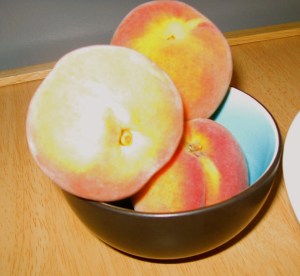
Sometimes eating locally does not benefit the health of our bodies or of the planet.  Take one of the southeast’s most famous crops, for example: peaches.  The official state fruit of Georgia, and state tree of Alabama, peaches are strongly associated with Dixie and with the triumphant guitar riffs of a great band formed in 1969 in Macon, Georgia.  The sweet juice of a Georgia peach dripping down the chin becomes a vivid childhood memory of summer, even for a Vermonter.  However, with all due respect to the Allman Brothers, my advice is: don’t eat a peach.  Along with those happy images in their aura, peaches are also strongly associated with chemicals such as organophosphorous, a neurotoxin, and dichloropropene, a reproductive and developmental toxin—to name just two of the forty-nine chemicals typically sprayed on peaches to ward off everything from nematodes and fungi to large mammals.  Needless to say, peaches regularly top the “Dirty Dozen” list of foods most contaminated with pesticide residues.

Legions of living things are attracted to the sweet, juicy, bright orange peachiness of the peach, as we humans are, but it is possible to grow them without heavy applications of synthetic nastiness.  Unfortunately for me here in Auburn, however, typing “organic peaches Alabama” or “Georgia” into Google yields no sources.  Should I make an exception, in order to support local agriculture?  Well, not this time.  Because the news gets worse.

Are these peaches glowing?

The Pesticide Action Network, which promotes pesticide reduction and elimination, as well as consumer awareness, and is based in California, came up with a list of what they call “Bad Actor Pesticides.”  Here’s how they define the baddest of the bad guys:

* Known or probable carcinogens, as designated by the International Agency for Research on Cancer (IARC), U.S. EPA, U.S. National Toxicology Program, and the state of California’s Proposition 65 list.
* Reproductive or developmental toxicants, as designated by the state of California’s Proposition 65 list.
* Neurotoxic cholinesterase inhibitors, as designated by California Department of Pesticide Regulation, the Materials Safety Data Sheet for the particular chemical, or PAN staff evaluation of chemical structure (for organophosphorus compounds).
* Known groundwater contaminants, as designated by the state of California (for actively registered pesticides) or from historic groundwater monitoring records (for banned pesticides).
* Pesticides with high acute toxicity, as designated by the World Health Organization (WHO), the U.S. EPA, or the U.S. National Toxicology Program.

Seventeen out of the forty-nine pesticides typically used on peaches are PAN Bad Actors.  (This information is from pesticideinfo.org.)

What’s a mommy with a fruit-loving four-year-old to do?  When shopping for food, I think in terms of trade-offs among the qualifications important to me: if we’re having a dinner made with local shrimp, organic green beans and basil, I won’t feel too bad about giving Jack those organic California grapes for dessert.  (For the tradeoffs involved in grape-buying, read my next post.)

Read Full Post »

We went to the first farmers’ market of the year at “Ag Heritage Park” today in the drizzle.  I and everyone else there seemed to be wondering the same thing: why aren’t there more farmers around here?  The line for the most varied vegetable selection was almost thirty minutes long. The berry farm stand ran out of strawberries at ten past the opening hour.  Peaches were gone by the time Jack and I made it out of the veggie line.   Hundreds of people arrived in the first hour and stood around in the rain, beaming at each other as they hefted canvas bags full of local lettuce, peaches, cucumbers, honey, cheese, and eggs—if they were lucky enough to get some before it all sold out. There’s so much pent up demand for fresh local food, and too few CSAs and small farmers to meet it with their supply. This may be because the market is young in relation to the agricultural history of the state, in which commodity crops like cotton and lumber dominated.

The exciting thing, though, is that small farms are popping up or remaking themselves to meet this demand.  And if you ask around enough you find out about other producers who have been in the area, quietly serving up their grass fed beef or organic greens for decades. (For example, the Ritches of Goose Pond Farm, one of whose scrumptious chickens we enjoyed with friends the other night.)
fm haul
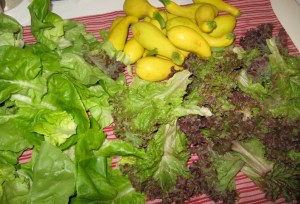
Jack and I took home a small haul: red leaf and butter lettuces, an armful of baby summer squashes, veggie goat cheese from Bulger Creek Farm in Notasulga, and some honey.

Eggs were available, but we already had a dozen of the local “Frank’s Famous Eggs” in the fridge.  (Their yolks are molten orange! And if you happen to eat a supermarket egg when you’re used to the density and flavor of these, you’ll say: what’s this tasteless rubber?)
frank'sThe lettuces made a crisp bed for some eight-minute eggs.
salad

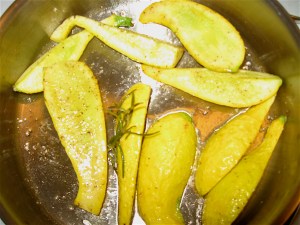
I roasted the summer squash in a skillet with olive oil, salt and pepper, and a sprig of backyard rosemary.  Jack insisted he didn’t like “fwash” but he ate every sweet and salty morsel.

squash

Read Full Post »

unsweetened. My favorite seasonings for sweet potatoes are salt and spices. During the fall season of the Randle Farm CSA, we got a ton of organic, honey-sweet sweet potatoes. We experimented with different preparations. On Thanksgiving, my brother-in-law, Ned, spent a lot of time grating a pound or two with my hand-held, flea-market Wonder Shredder, then threw them into a skillet warmed with some sage brown butter. They stuck. Badly. Something about the starch.

iStock_000004120135Medium

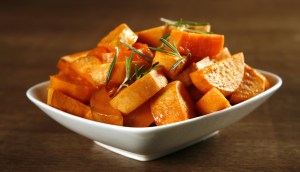
So, my stand-by preparation is to roast spears. First, Jack peels them meticulously, avoiding his precious digits. Then I cut them into thick “fry”-shaped spears. I grind up some coriander seeds, fennel seeds, cumin seeds, and salt with a mortar and pestle, and toss the spears with the spices and either olive or sesame oil. So good!

Oh, and if you still have sweet potatoes in May, and they start to sprout, you can make them into interesting creatures:

sweet potato creature

Read Full Post »

https://i0.wp.com/randlefarms.com/bberry/sheepinclover.jpg
Randle Farms is one of the CSA possibilities in the Auburn area.  They grow a wide variety of produce, and also offer eggs, beef, pork, and lamb, all of which is organic. When we joined in the fall, our first pick-up included two frozen lamb shoulders.  I had to do some research before cooking these hunks, and then had to turn my knife in all directions to carve the meat off the oddly shaped bone and make relatively uniform-sized chunks.  Because braising is the best way to cook this sinuous cut, I tried two variations on stew—one classic French, and the other Moroccan. Both were delicious, but the Moroccan spices and the mystery ingredient—honey—really brought out the distintiveness of the lamb.

Ras el hanoutThe dish is a variation on Mrouzia, traditionally made after the celebration of the slaughter of the lambs, and characterized by its sweet-spiciness.  The main spices are in the blend called Ras el hanout, which is popular across North Africa and the Middle East.  The blend includes cumin, coriander, cardamom, clove, paprika, cinnamon, nutmeg, peppercorn, turmeric, and mace.

First, in a dutch oven or heavy pot, whisk together the 2 tsp. Ras el hanout, 2tsp. salt, ½ tsp. black pepper, ¾ tsp. ground ginger, a pinch of crumbled saffron threads, and 1 cup of water.  Stir in 3 pounds of lamb chunks with 2 more cups water, 1 chopped onion, 2 minced garlic cloves, 2 cinnamon sticks, and ¼ cup butter.  Simmer, covered, for about 1½ hours.

Then add the sweets: stir in 1¼  cups raisins (I prefer goldens), 1¼ cups whole blanched almonds, ½ cup honey (which you can get locally), and 1 tsp. cinnamon.  Simmer, covered, for another 30 minutes.

Finally, uncover the pot and cook over moderate heat, stirring occasionally, until stew is thicker (about 15 minutes).  Serve with bowls of moist, fluffy cous cous.

Here’s a link to Randle Farms (randlefarms.com) where you can see the lambs munching clover.  (The photo at the top is theirs.)

Read Full Post »

shiitake1
Umami.  It’s the earthy, meaty taste that mushrooms, meat, and long-simmered stocks have.  Aged and fermented foods have it too: hard cheeses, Thai fish sauce.

I bought a few handfuls of local shiitakes at Dayspring Natural Foods, sautéed them in olive oil, and tossed them in a salad with romaine, spinach and a vinaigrette made with Dijon, sherry vinegar, and olive oil.  The dark tang of the sherry vinegar was a perfect match with the umami of the shiitakes.  It’s my mushroom of choice.  In comparison, so-called “buttons” taste like dirt.

Read Full Post »

« Newer Posts - Older Posts »