Feeds:
Posts
Comments

Posts Tagged ‘Amy Campion’

We had the most delicious meal last night.  Sauteed broccoli raab, beet greens, and green garlic from Killdeer, polenta, and spicy grass fed beef sausages.  After our morning with the Jersey cows at Thistle Hill in North Pomfret, Vermont, yesterday, we drove up and down the winding roads and along River Road in search of more cows—this time the black Angus steers of Cloudland Farm.

cloudland steers
“Cloudland” is an appropriate name for the farm at the top of the mountain road of the same name.  There are some long tunnels of trees along this climb that then break open into gorgeous vistas.  Before the twentieth century, the whole hill was most likely a cloudland—open pastures that seemed to touch the sky, for sheep and cattle and countless stone walls.  New growth forest has filled in some of this land, but Cloudland Farm still maintains a thousand acres of pastureland for its herd of grass fed steers.  (They’ve farmed this land for one hundred years.)  Like the population of grazing animals, that of farming families has thinned over the decades, too.  This empty hilltop school is evidence of a once-thriving community:
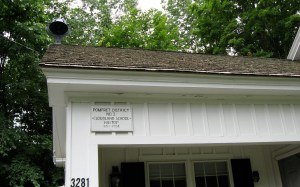
cloudland school
(The bigger Pomfret school down in the valley is underenrolled, now.  Old farmhouses are being bought up by wealthy non-farmers whose kids have already grown up and stayed in the cities.)

While I shopped around in their farm store, Jack and his cousin stood in the driveway admiring all of the vehicular activity. There was a big John Deere tractor, a skid steer, two ATVs, and a kid-sized pedal tractor.  The boys were happy.

cloudland sign
So was I.  I bought a whole variety of frozen beef, and started thinking about dinner.  Outside, the sun was streaming down at intervals between the big cumulonimbus clouds that have covered this region for over a month, drenching it again and again.  Bill Emmons, the Cloudland farmer, was talking about how little haying he’s been able to do, because of the constant rain.  He was enjoying the chit-chat, but was also twitching to get away and grab this sunny moment to hay.  “I hope I remember how,” he joked.

Visit their website here.
Read Full Post »

Named for the wily, widespread species of bird, Killdeer Farmstand, on Route 5 in Norwich, is one of my favorite places.  The organic farm of the same name, just a few miles away on the Vermont bank of the Connecticut River, supplies the most dependable abundance of produce.  We stop there almost daily.  Yesterday, it was our first stop after arriving back in VT from Cape Cod.  The first raspberries were in, along with the first green garlic, and there were loads of new potatoes, zucchini, squash, peas, a vast variety of greens.  Scapes will be gone soon, but they still had a big basketful, so I bought a bunch and made more scape mashed potatoes.  Yum!  Sometimes we make an entirely Killdeer meal.  The farmstand also offers Misty Knoll organic chicken, lots of local cheeses and ice creams, some meat, King Arthur bread, and cookies.   Soon, they’ll have sweet corn.

Read Full Post »

It’s a comfort, shaping meatballs.  Only my fingertips touch, shape, nudge, they are so delicate. Unlike the muscle and torque involved in kneading bread, the pressure here has to be slight.  The way you might hold an infant’s foot.

Yes, I know. I’m talking about raw meat.  But I love making these meatballs in part because I use a recipe from a friend I’ve lost touch with, and they remind me of the dinners he cooked for us–at once so scrupulous and so lax.  Jonathan was exact about ingredients, cooking temps and times, the composition of courses.  And relaxed about the way the evening stretched late into the night, about lipstick marks on wine glasses–from previous drinkers–about the terrifying mess in the kitchen.

We had a delicious rivalry.  He would cook us a multi-course meal with wines to match, and we’d follow up the next weekend at our apartment, just up the hill from his, on Euclid Ave. in Berkeley.  It went on, as we attempted amicably to one-up each other.

The meatballs were one of the best meals.  Here is his basic recipe, as I remember it, which came from his Nonna, his Italian grandmother.

Jonathan’s Meatballs

1 lb. ground beef
1 egg
1/2 eggshell water
1/3 c. fresh bread crumbs
small handful chopped parsley
4 cloves garlic, minced
plenty of salt and freshly ground black pepper or some red pepper flakes for spice

Combine all ingredients, and shape gently into meatballs, either large or small.  Cook over moderate heat in an oiled or buttered pan, turning occasionally, until done.  Serve immediately.

Tonight, I had the luxury of local grass fed ground beef, local fresh eggs, and of course local herbs.  I substituted blanched garlic scapes for the garlic cloves.


Read Full Post »

scapes bin at the Norwich Farmers' Market

scapes bin at the Norwich Farmers' Market

I love garlic mashed potatoes.  Possibly even more delicious are mashed potatoes made with garlic scapes.  Last night, I boiled about a pound of new red and gold potatoes (skin on).  I tossed four curlicues of garlic scapes (1 per person) into the boiling water for a minute, just to soften them up a bit.  Then I roughly diced and minced them.  When the potatoes were fork tender, I used a hand-masher to blend in the scapes, milk, 2 tbs. of butter, salt and pepper.  The result was delicious, and as pretty as a pile of potatoes can be: creamy white flecked with green and pink, and tasting of the freshest garlic.  I love whole roasted bulbs of garlic, with that deep nutty caramelized flavor, mashed into potatoes.  This was different.  Garlicky, but greener, grassier, springy.

The only problem was that I made too few.  Everyone wanted more potatoes.

Read Full Post »

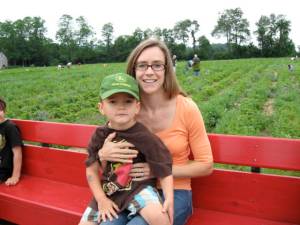
wagon

Strawberries were the totems of childhood today, at Cedar Circle Farm’s 7th annual strawberry festival.  Of the milling, stooping, picking, licking population, about two-thirds were fewer than four feet tall.  Many wore the totem on their shirts, hats, or cheeks. The folks at Cedar Circle make this day as much a celebration of childhood as of strawberries and local food in general.  There were three horse-drawn wagons, a mural-drawing section of the barn wall, a coloring station, face-painting teenage girls, a sandbox, strawberry smoothies and shortcake, coffee for the parents, puppetry, kite-making, tractors to sit on, and live music.  And, of course, picking.

tractors

wagon ride

We hit the face-painting table first; the boys both got trucks.

my son, the sceptic

my son, the sceptic

cheek truck

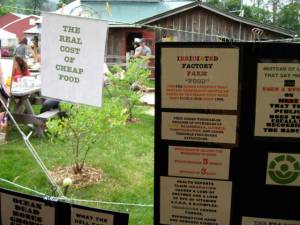
Then we walked around the food stations.  There were local sausages from Hogwash Farm on the grill, organic pizzas cooking in a wood-oven on wheels, and strawberry shortcake with whipped cream or vanilla ice cream from Strafford Organic Creamery.  In honor of this berry, which has been cultivated since medieval times, everything was very forward-looking.  The food was served on compostable dishes with compostable utensils; there was a complex trash station.  Near the coloring table there was a photo-and-text display (a low-tech, stop-time PowerPoint presentation hung with clothespins) about “The Real Costs of Cheap Food”, which included descriptions of chemicals that flow and leach from non-organic farms into ground water, lakes, and rivers, and a definition of food miles (how far a food travels from farm to table, with the fossil fuels required a big consideration), and some charming spelling errors.  There was also a photo-narrative of strawberry growing, from bed preparation during the winter to picking in June.  This display included lots of pictures with hay around the edges, in the middle, and present as a general tone (hay keeps down the weeds) as well as shots of very tan, lightly clad interns happily working the dirt.

real cost

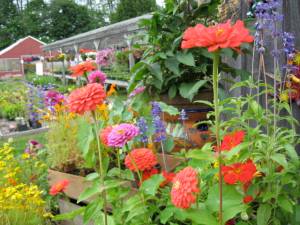
Cedar Circle grows eight varieties of strawberries, and an array of vegetables—all certified organic.

and flowers

and flowers

My mom and I, with the occasional help of Jack and his cousin Jeremiah who preferred sitting on tractors, and my sister, Bridget, who helped them up and down the tractor steps, picked four pounds of berries.  We chose two varieties: Wendy, known by its petite size and light sweetness, and Mesabi, which is bigger, and almost raspberry-like in flavor. The plants were so high that lifting the leaves to look for spots of red was like opening the curtains—in a doll’s house.  The pleasure of discovery became addictive.  It’s hard to stop, even when the basket’s full!

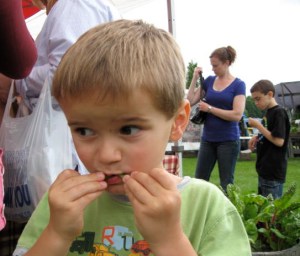
Strawberries fresh off the stem, warmed by the sun, melted into juice in an instant in our mouths.  There were many worshippers.

worshippers

Read Full Post »

On our way home from the strawberry festival, after driving through the little downtown of Norwich in which all was quiet (it’s Sunday) except for Dan & Whit’s general store (“If we don’t have it, you don’t need it.”), we drove up Turnpike Road, kept going until it turned to dirt, and saw a sign: “eggs.”   We slowed down, and stopped at the table where a young neighbor was selling eggs and chocolate chunk cookies.

eggs 4 sale
We bought a dozen eggs and two cookies.  The eggs came from two breeds of chicken: New Hampshire Reds and Araucana.  The Araucana’s eggs are a pale greenish blue.  I boiled two for lunch, and found when I peeled them that the inner shells are a deeper turquoise.  The yolks were the color of black-eyed Susan petals.

My parents’ house is about a half-mile further on Turnpike Road.  It’s satisfying to eat a lunch so fresh, and in hues I’d love to paint.

Read Full Post »

Saturday morning, Norwich Farmers’ Market.  We got there too late for the golden beets: I saw the last bunch go at 10:15.  Maybe next week….

peas

But oh, the potatoes and peas!  The Fairlee, Vermont farm, coyly called “Your Farm,” had baskets upon baskets of sugar snap peas–the kind you can eat right off the vine, pod and all.  Jack was working it like a boiled, salted edamame pod, but was happy finally to eat the whole thing.

eating pea

These peas taste so good raw, they may not last until later, when I’ll make a salad of new potatoes, scapes, herbs and peas.  New potatoes are here in abundance: they are so tender and waxy it’s almost tempting to eat them raw, but lightly boiled will agree with tummies much better. I bought a couple of pounds at the Hurricane Flats farm stand.  (This farm is located on the banks of the beautiful White River, a tributary of the Connecticut, in South Royalton, VT.)

potatoes

New Potato Salad

Potatoes are a blank slate, upon which a thousand personalities can be written.  Bacon is always a good friend to potatoes, as are peas, corn, green beans, and fresh herbs like dill, tarragon, thyme, and parsley.   Caraway seeds are interesting additions to a potato salad dressed generously with a dijon-based vinaigrette.  Here’s what I’ll do with my potatoes, scapes, and maybe peas, today.

Boil potatoes until fork-tender.  Quarter them, and toss with a spoonful of vinegar (red wine, champagne, or cider are good) and two spoonfuls of extra virgin olive oil, salt and pepper. (The quantities depend on how many potatoes you have; they should be dressed but not dripping.)

Then, add some crisped bacon/pancetta/prosciutto bits, and any combination of the above suggested veggies and herbs.  Today, I’m also going to add some lightly sauteed, then smashed, garlic scapes.

Let the salad sit and steep for awhile, and serve warm or chilled.

Read Full Post »

Gorgeous green curlicues, Watteauesque arabesques…

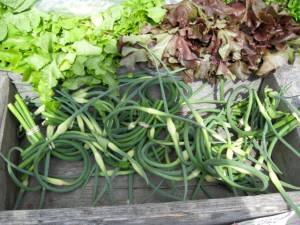
scapes
Not to be confused with green garlic (long spring stalks with the bulbs attached) or ramps (wild leeks, whose season is earlier), scapes are the seed pod portion of the garlic plant that must be culled before they harden and pale from green to beige.  Snipping them helps the garlic bulb below fatten up.  Scapes’ season is fleeting, their flavor mere essence, evanescence.

Unlike the stronger-tasting bulbs, mild scapes can stand alone: blanched and tossed on a salad or ground into a pesto; sautéed with baby bok choy and thrown together with noodles; mixed in sneakily with green beans for an added dimension of flavor.

At the Hanover farmers’ market on Wednesday afternoon, I bought a small bunch.  Last night, my mom diced scapes and added them to her summery corn and edamame salad.  The night before, I sautéed them with local greens in a dish I make frequently, which is based on yaki-soba.  Here’s the recipe:

Garlicky Noodles and Greens
Serves 4

1 package soba (buckwheat) noodles
1 lb. fresh spinach, washed and torn up
2 heads baby bok choy, roughly chopped
5 garlic scapes, chopped
1 lb. flank steak or chicken breast, sliced
2 tbs. sesame oil
2 tbs. mirin
2 tbs. soy sauce
Thai hot sauce
Lime slices

In a small bowl, combine oil, mirin, and soy sauce; set aside. Sauté the meat until mid-rare, and set aside.  In the same pan, with a bit more oil, cook the greens and scapes, covered, over moderate heat.  After a few minutes, remove the lid, to let the water evaporate.  Meanwhile, bring a large pot of water to a boil, add the soba noodles, and cook for 5 minutes.  Drain, and pour into a warmed serving bowl.  Just before serving, put the meat back in the pan with the greens to re-warm.  Combine greens & meat with noodles, pour the sauce over, and toss to coat.  Add hot sauce and lime juice individually to taste.

Read Full Post »

Since this is a locavore blog, in some ways, I have to admit, I misrepresent myself.  For example: beer versus wine.  I’ve written more about beer, and expressed a lot of enthusiasm about local ales, but I’m really much more of a wine drinker.  Lately it’s been Spanish reds, and vinho verde.  I love the different tones of garnacha, and the refreshing effervescence of that Portuguese “green wine.”  I also love the whites of Alsace.  And the infinite varieties of rosé! From the elegant Tavel to the earthy South African pinotage rosé, I love them all.  If I still lived in Berkeley, there wouldn’t be the whiff of hypocrisy in calling myself a locavore eater and drinker, because I’d still be drinking those great Sonoma, Paso Robles, Santa Cruz, and Mendocino wines we could get in the grocery store.  I miss you, Bonny Doon.  Wish I could be there in the tasting room to try your new, more restrained bottlings, which I’ve now only read about, wistfully, in the New York Times. (Not to mention all the great things I could be eating: mission figs and meyer lemons from neglected trees on my block of Euclid Ave., for example….)

Enough gushing, now.  The reason I started writing this post has to do more with ale and my country-girl nostalgia.  In Burlington, at Greg and Patti’s, we started the evening with Otter Creek Copper Ale, which I love, and which brought back memories (not all pleasant) of my stint as an “environmental educator” at a school-trip camp near Middlebury, Vermont.  We slept in cabins so rustic, the frosty mid-March air gusted in the cracks between the aged two-by-fours during the night.  I slept in my -40 down “mummy” sleeping bag in long underwear, a sweater, and a wool cap.  The kids arrived on full school buses on Monday, we introduced them to things like recycling, organic carrots, and sphagnum moss, and they were gone by Friday.  And then, if it was sunny, we’d drag all of the Adirondack chairs out to the middle of the lawn at the camp’s center overlooking the lake, set a bunch of six-packs of all of the Otter Creek brews here and there, and sample them all afternoon.  Copper Ale, Pale Ale, Stovepipe Porter, Spring Ale, Mud Bock!  We were single, outdoorsy, and glad to be free.

Otter Creek Brewery is a family owned business in Middlebury, Vermont, which also makes certified organic beers under the Wolaver’s label.  They host a regular beer and cheese tasting, which at first glance smacks of wine-culture-imitation opportunism, but then I remember how good I think the sharp Vermont cheeses taste with beer.  Here’s how they advertise it:

Not only is Vermont home to 19 craft brewers (at last count), the most breweries per capita in the country, we also are lucky enough to have 35+ artisanal cheesemakers here, too!  This makes us arguably the best state for cheese and beer pairings in the country!

You know what else is good with beer?  Peanut butter.

Read Full Post »

honey

We drove up I89 yesterday to Vermont’s city, Burlington, to have dinner with Peter’s friend, the Irish poet, Greg Delanty, his wife Patti, and their son Dan (who gave Jack his outgrown tractor toys on indefinite loan).  It was rainbow weather.  The sky had been heavy and dark in Norwich—rain for days, all the Vermonters complaining about such an injustice, and on the solstice too!  But as we drove through the Green Mountains and into the Champlain Valley, the sky opened into a shifting patchwork of gray, white, and blue.  Some mountain tops were hidden in dark blurs, some were lit up bright green by shafts of sunlight. Some clouds were white wisps, some were poofy cumulous towers. We saw a rainstorm up ahead over the next valley, we were in it, and back in the hot sun again.

After this beautiful drive, we were welcomed onto a sunny deck by Patti, who is passionate about local food: there was late-afternoon local beer, and asparagus with dinner (to green up the Irish ham and potato plate).  This morning there were jumbo eggs from a nearby farm, toast from a nearby bread baker’s.

But the most delicious element of either meal was also the most local: Patti’s honey.  She keeps a hive in a wooden box in the side yard, the yellow walls of which match the yellow and purple trim on their old New England house, which stands at the corner of the lake-front street packed with other little old houses whose clapboards are whimsically painted other shades of purple, orange, or bright blue.  After breakfast, Jack and I went for a walk and stopped to sniff the roses, peonies, and lilies planted in abundant disorderly patches of overgrown grass in front of the porches along the way.  We saw bees dipping into these polleny perennials as well as into the flowering vines covering the fences and the little nosegays of wildflowers in cracks on the sidewalk and on the edges of driveways and yards.  Patti’s honey has all of the flavors and aromas of this big mixed bouquet.

Because of bees’ omnivorousness when it comes to nectar, and the portion of pollen that ends up in the honeycombs, eating local honey can help us ward off seasonal allergies, and is said to be an immunity booster in general.  But more importantly, honey is a comfort food for me: I associate it with childhood, with the pink and white clovers and buttercups of Vermont, and with Winnie the Pooh’s “little smackerel of something.”  I still enjoy it on toast and in tea, but there are more grown-up ways to eat it too: as a dressing for Mission figs and manchego; drizzled on soft goat cheese; or as a seasoning with braised lamb.

Read Full Post »

« Newer Posts - Older Posts »