Feeds:
Posts
Comments

Posts Tagged ‘Amy Campion food’

How to cook kale?  There are many theories which involve long cooking and lots of water, but I prefer to saute it fairly quickly in a hot pan with a bit of olive oil.

Last night, I cooked purple kale.  I pulled large bite-sized pieces off of the stalk, and washed them in cold water.   Sometimes, as with spinach, I’ll grease the pan by cooking some small pieces of bacon or pancetta, then throw the kale in just before the pork gets crunchy.  I always use garlic, and have found that the kale gets most garlicky when several crushed cloves of garlic have been simmered in the oil for a few minutes, so that its skin is slightly caramelized.  After putting in the kale, you can put the lid on for a few minutes to steam it a bit, and when it gets wilty, leave the lid off and toss it with tongs.   I strongly recommend tongs, so that you can squeeze out the excess water before plating it.

Kale is also delicious when it’s tossed together in the pan with mustard greens and spinach.  Red pepper flakes are a nice addition at the end.

Read Full Post »

My favorite way to cook asparagus is to roast it.  The caramelization that happens in the oven brings out the natural sweetness of this grassy green, and the dry heat softens the stalks without turning them to mush.

Preheat oven to 425. Roll asparagus on a cookie sheet in olive oil, salt, and pepper.  Roast for about 10 minutes, until lightly browned but not shriveled.

Asparagus goes particularly well with the breakfasty flavors of eggs and bacon.  For a substantial side or light meal, you could roast the asparagus with bacon, pancetta, or proscuitto pieces sprinkled around, then dress it with a chopped eight-minute egg.

Asparagus is also great with a bit of lemon zest.

Read Full Post »

Whew—I can finally relax.  I’m sitting on the deck in Vermont. The sun is shining, the Bloody Brook is rushing, Jack is loading a dump truck in the sand box, and a hummingbird is buzzing by.  This is nice.  Yesterday, Tuesday, was spent in buses, planes, cars, and waiting areas.  Monday, the moving van came, the house was emptied and then scrubbed from baseboards to ceiling vents.  I’ve never cleaned so hard!

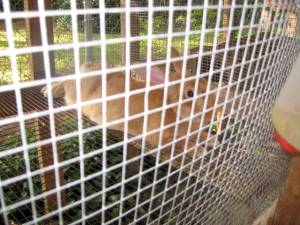
But the real event I’ve been itching to address was Sunday night: the great picnic party at Matt and Christina’s which included a power outage, ice cream churned by hand, newborn rabbits, homebrew, a tree climb, and two antique MGs, to name just a few of the highlights.
tree

J & P

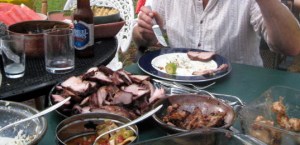
This was a real homegrown meal.   To begin with, there were simmered shell-on peanuts, along with a plateful of carrots and radishes from Red Root Farm for dipping in hummus.  We were standing around the table talking, eating these small bits, and sampling Matt’s dark, hoppy ale, when he brought in a bowl full of sliced, spice-rubbed local pork that he’d just grilled over a heap of smoking hickory coals.
Matt

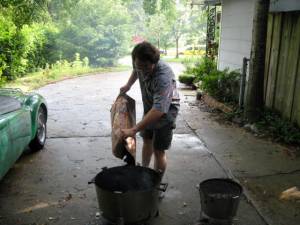
And that wasn’t the only hunk of pork or the only grill.  There were two other steel buckets serving for grills, on which Matt was cooking long skewers of zucchini and summer squash slathered with olive oil and herbs, and rabbit—the most local of the items in this dinner, since it came from the back yard, where its kin still lolled in their cages, and where one of them had just given birth to her first litter.  He mentioned something about venison sausage too, but I don’t think I saw that….
Emma

rabbitThis was a great dinner not just for the company and its easy, rolling-along tempo, but also for the simplicity and bounty of the food that Matt and Christina spread on the table.  While he manned the grills, she was in the kitchen (where there was no electricity, Auburn having just been whipped up in an hysterical thunderstorm) stuffing poblano peppers with chipotle-spiced ground beef and its alternative for the poco picante palates, cheesy black beans.  She also mixed a quick peanut sauce so that one rabbit option was satay.  Others brought cornbread, salad, and the always idiosyncratic no-knead bread.  I brought wine from Spain.  It can’t all be local!
food

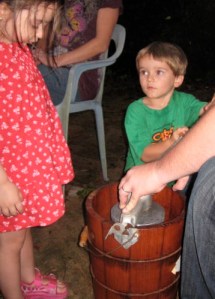
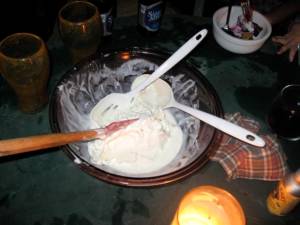
The kids started churning the lemon-almond ice cream as the sun went down.

round and round

round and round

getting sweaty

getting sweaty

Daddy's taking over

Daddy's taking over

Eventually, after some serious help from the grown-ups, we could spoon big, soft dollops on top of Emma’s blueberry tart.  It went too fast for me to take a representative picture…
i c

Read Full Post »

Last night we had a last, leisurely, late-afternoon-into-late-evening dinner with Jim, Sharyn, and the adorable Mimi.  Jack and Mimi played continuously and tirelessly for five solid hours, pausing only for dinner—spicy local pork sausages with spicy mustard, shalloty crispy green beans, and grilled eggplant dressed with saffron-yogurt sauce—and dessert: lemon custard tart topped bountifully with berries.
Sharyn's tart
Sharyn is the picture of effortless elegance.  The wine was served in little Moroccan tea glasses that complemented the votives arranged asymmetrically here and there.  The tapenade was lemony, the pita toasts just bite sized, the dishes bistro-white.  And then there was the tart: aristocratic and earthy at once on its crystal cake-stand.  The crust edges were perfectly tapered and golden, the vanilla-lemon custard softly peaked, the berries tart-sweet and juicy.  The farmers’ market blackberries were as big as small plums, and satisfyingly, sun-ripened sweet.  My adjectival powers are stretched to the limit!

Let’s end with some happy faces.
J & M

J & M 2

J & M 3

interpretive dance?

interpretive dance?

Read Full Post »

We’re moving out in a few days, and have no more dinners at home, thanks to friends.  Peter and I packed all day, off and on, while listening to a random college-vintage shuffle.  All but the dinner dishes, cereal bowls, silverware, and a few other things from the kitchen were packed by 5.  And yet.  We had one last dinner party at 220 Cove Court!  Chantel brought the salad, but it was an impressive performance, I have to say.

I went to the meats lab soon after opening time, at 2 p.m., and it was really difficult not to stock up.  I knew I only needed two steaks at most, to supplement the ones Reuben was bringing.  But the eggs were so cheap and abundant!  The pork sausage so spicy! The steaks so beautifully thick and red.  I held back though, and went on to Kroger, where I got olives, some Toad Hollow Paso Robles “proprietary”—i.e. mystery—blend, which turned out to be delicious (I’m still sipping it now), some Terrapin India-style brown ale, a shallot, and pistachios.

Earlier in the day, I’d contemplated the pantry.  What would I do with these random bulk baggies?  The answer came in with style.  Arborio rice, dried porcinis, just a few sundried tomatoes.  Risotto.  Midway through the day, I threw together some brownies.  The menu was set: steaks—both rib eye and strip, which Reuben and I rubbed enthusiastically while in enthusiastic conversation about meat, with crushed garlic cloves—a little dried out—freshly snipped rosemary, olive oil, salt, and pepper; porcini-spiked risotto (as if it weren’t hot enough already); Chantel’s green bean salad; brownies; red wine, after a thirst quenching beer.

The occasion originated with the grill giveaway.  There’s no way that gas grill, which I bought on special last fall at K-mart for $65 and Peter assembled, was going to fit into our storage unit.  So we called Reuben, who said he’d take it, but only after bringing over some steaks to throw on it.  It was also a great pantry- and freezer-emptying event. (We gave Reuben the frozen ground beef.) Most of the time, my pantry is so full of stuff, it doesn’t set off any sparks in my mind.  So there’s something nice about thinning, weeding, giving away.  I haven’t made risotto for ages, and have had those porcinis for just as long.  There’s also something nice about uncomplicated cooking.  The only things I used for cooking were a knife for the shallot, a little bamboo cheese board, a wooden spoon (for both brownies and rice), a pot, a glass baking dish, tongs, and the tea kettle.  And, of course, the grill. Simplicity.  The pleasure of a pantry.

Porcini Risotto

Soak porcini in a bowl of hot hot water until they soften.  Slice porcini into bits and save water to use in risotto.

Pour 1 c. Arborio rice into a moderately hot saucepan with a melted nob of butter in it.  Stir the rice until it gains translucence around the edges of the grains.  Reduce heat to medium low.  Gradually stir in 1/2 c. white wine until absorbed.  Pour in mushroom soaking liquid. Add a bit of minced fresh thyme. Keep stirring as you gradually pour in about 3 cups of warm stock, over the course of 25 minutes or so.  Keep stirring and pouring until it has that silky soft risotto feel in your mouth.  Add 2 more tbs. or so of butter and 1/2 c. grated parmesan.  Serve immediately.

Read Full Post »

I was listening to “John Wesley Harding” this morning and thinking that Bob Dylan is someone who cultivates oddness—in a way that seems oddly genuine.  (But what is authenticity in a celebrity?  One of the subjects of my British lit. dissertation….)  Anyway, that got me thinking about what an encompassing, useful word “cultivate” is.  We cultivate land, relationships, our intellects, our tastes, even our eccentricities.  Or if you’re a four-year-old boy who loves tractors, you’ll cultivate just about any surface.

cultivator

There are no surprises in its etymology: since its entrance into English, by way of medieval Latin, it has had both a literal and a figurative sense.  It has always meant: to till the soil, to promote the growth of plants and to educate, train, refine a person or intellect; to promote the growth of a science, an art, a sentiment, a friendship; to devote one’s attention to these things.  It is close to nurturing.  We like to help things grow.  Cultivation is culture in the abstract as well as in the most basic form of crops planted for us to pick and eat.

As an adjective applied to the land, it implies an opposite: land is either cultivated or it’s wild or waste.  I like the way Michael Pollan, in my favorite of his books, Second Nature, puts cultivation in the middle of two seemingly opposed concepts in our modern Western paradigm: nature and culture.  Pollan argues, with grace and good sense of humor, that between these, which are not really opposed, must be cultivation. In fact, nature as we know it is already cultivated—as a science, an art, a sentiment.  Since we’ve already had our hand on almost every inch of nature, our obligation is to cultivate it.  Not to turn it all into cornfields, for crying out loud, but not to let it become waste.  To cultivate wilderness that we’ve already tampered with—even if just by demarcation—rather than consider it “virgin” and expect it to fend for itself in the midst of the mean world of modern civilization and its pimps.

Read Full Post »

Last night we attended our last “green drinks” in Auburn.  (We move out on Tuesday.)  The table was full of draft ales and seafood: it was still in the upper-80s at six o’clock, we were thirsty and craving the light salty crunch of fried squid and sizzled scallops.  Jack proved his readiness to eat like a real Italian when he went back for thirds and fourths of calamari dipped in aioli.  Matt: “are you going to tell him what he’s eating?” “Not yet.”  Actually, he’d probably think it was cool to eat squid, like the penguins. (We’ve been watching lots of Planet Earth, the main themes and action of which are procreation and predation, i.e. sex and violence.  Jack watches with intent, nervous fascination, and we nervously watch him watching.)

Over the past few months, I’ve had a bunch of new friendships sprout up, and saying goodbye for this year-long hiatus feels a little unreal.  We’ll keep in touch online, of course, but the real medium of friendships for me is meals—not emails.  We’ve had relaxed-raucus cookouts, with burgers and brownies and our loudest-talking friends; platters of finger-friendly pita with hummus, tabouli, dolmas and Steele’s blue drinks; pesto-tossed pasta with Gulf shrimp, followed by Bonny Doon ice-wine and the short-bread I’d overcooked just long enough to get some nibs of chewy-crunchy crumble-resistance.  At Amsterdam Café, we said hello and goodbye at once to Scott and Charlie (they had water and salmon salads—restrained—and we had martinis and braised local lamb: a night out without Jack is splurge-worthy).

We’re happy that that friendship will overlap in space. Next spring, when they come with the architecture students to the foreign city which will have become home to us by then, we’ll share another meal or two.  It’s both impossible and easy to imagine this future, our next year in Rome.  Google Earth gives the thrilling illusion of presence, knowledge. Turn away from the screen, though, and we’re still in Alabama. It’s not unlike absorption in a novel, the world of which begins to feel like your world.  The real version becomes, for the time of reading, fixed, mute, invisible. But then it’s time to pack more boxes or clean the oven.  When I think about this future, though, it feels solid, because where Scott’s mind would fix on images of buildings, my mind anchors on images of food: huge fresh bunches of greens on the imagined counter in our little apartment kitchen-to-be; warm bowls of pasta lunch at Jack’s Italian pre-school; dishes of olives; butcher shops; espresso; crusty, chewy, flour-dusty bread; meals with new flavors, new friends.

And by the way, maybe these images are so palpable to me because the Rome Sustainable Food Project’s Facebook page makes it incredibly easy to imagine sinking my teeth into something exquisitely delicious!

oh, wow!

yum!

mmmm….

Crumbly Crunchy Shortbread
(The perfect, last-minute dessert that still impresses and requires no runs to the market.)

Preheat oven to 350°F.

1 ½ sticks butter (bakers usually recommend unsalted, but sometimes I use salted and/or cultured; in any case, use your absolute best butter)
2 c. all-purpose flour
½ c. sugar (organic, unrefined makes a warm and toasty cookie)
½ tsp. salt

Cut butter into little nubs. Mix all ingredients together in a bowl, and work with a pastry fork until the butter is petite-pea-sized. (Use a food processor in a pinch.) Dump mixture into a 9 x 9 x 2-inch baking pan (for thick cookies) and with a metal spatula press evenly onto bottom. Bake shortbread in middle of oven until just beginning to brown, 20+ minutes.

Read Full Post »

I came to a junction in the back roads of my mind the other day when I read an article in the New York Times about organic dairy cows in Highgate, Vermont munching alfalfa and flaxseed rather than corn, to make their burps less methane-laden.  The farm supplies milk to Stonyfield Farms, maker of Oikos—organic Greek-style yogurt—of which I’ve just become a big fan. The one with honey on the bottom is the best; when Jack doesn’t finish his dessert honey yogurt, Peter and I jump in to scoop up the last bites.

The last time I was in Highgate, I was the one standing in a field, but I was munching a messy falafel pocket at one of the Grateful Dead’s last shows.  I don’t remember a whole lot about it beyond Dylan’s shiny silver jacket (he was the opening act), crowd anxiety, the falafel, and the way we punned on the name of the town as if we were the only ironic dorks who had thought of it.

One of the dairy products I’m most looking forward to slurping up, when I get to Vermont next week, is the ice cream from Strafford Organic Creamery.  The dairy-farm is owned by the Ransoms, one of whom—William—I went to kindergarten and first grade with, in Strafford.  Here’s an incitement to a craving:

We make our ice cream in small batches, one day each week.  We wouldn’t dream of blending our cows’ cream with anything but the highest-quality organic ingredients. We separate fresh eggs by hand, handpick the mint and black raspberries, and grind the coffee just before we brew it into the milk.

Mmm….

Read Full Post »

My big old aluminum flea market colander is bursting with berries in the fridge, and I’ve already had strawberries with lunch yesterday, for dessert last night, breakfast this morning, and lunch today.  What will we do with all of these berries?

Any other time, it wouldn’t be a challenge, but our rental house is in a strange state. We’re leaving for New England in a week, and for Rome in about two months, so we’ve been packing.  Some of the boxes already in storage contain all of my baking dishes and appliances.  But I had to do something with these berries!  I hadn’t packed a few things, including a bit of flour and sugar, and an odd-sized round Pyrex, so the task became obvious: galette!
galette

Strawberry Galette

The sweet pastry recipe I like best is Nancy Silverton’s, from her wonderful Pastry from La Brea Bakery.  Since I’ve already packed the cookbooks, I dredged it out of my memory, and cut it in half.  Roughly, it goes like this:

Combine in a food processor or in a bowl with a pastry cutter:
1 ¼ cup flour
2 tbs. sugar
¼ tsp. salt
7 tbs. butter
Mix together in a small bowl:
1 large egg yolk
½ tsp. vanilla
2-3 tsp. milk
Then mix the wets into the dries until just combined, working the dough lightly with the pastry cutter.  Turn it out onto the counter and fold it and push it to flatten the butter bits, then shape it into a disc, roll it out to the right size, and chill it.

While it chills, let the berries steep in sugar for awhile.  Jack and I cut berries (he used a little cheese knife) and tossed them in a bowl with ¼ cup of sugar and ¼ cup of flour, a few gratings of nutmeg, and a splash of almond extract.

Normally, a galette would be made on a sheet, but we had only this casserole, and it worked out well since the berries were so juicy.  Now I have to go get some cream!

Read Full Post »

ready to pick

ready to pick

A month or so ago, I made a big deal about buying only organic strawberries.  Today, though, my friend Sharyn and I took Mimi and Jack strawberry picking at a little farm in Lafayette (pronounced, defiantly, La-FIE-et), where the only sign is a big slab of particle board with “U-Pick” and a big strawberry painted on it.  In other words, there are no visible declarations of their farming practices, but you can tell right away that this is not a “Green Chem-Lawn” type of operation.  It smelled like grass and mud and strawberries. One of the owners told Sharyn, “we try not to put too much stuff on them”—meaning chemicals. Compared to the berry farm on the Eastern Shore of Maryland, where we went last year because it was on the way home from Jack’s school, and which appeared to be a perfect paradise of spotless leaves and giant berries, but where you could smell the chemicals, this farm today was a paradise of “imperfection.”  They use black plastic to control weeds, and insects to control insects.  Bugs and slugs and buzzing things were busy throughout the rows.  When a tiny local farm produces sweet juicy berries with the help of ladybugs, I don’t quibble about minimal chemical counts.
berries
Jack would wander far down the rows, and then run back triumphantly when he found a ripe berry.  He also found some “ticklers”—tall grasses with tufts on top—and put them to use:
tickling
Then Jack and Mimi found a little Jeep and decided to drive “to California… or maybe just a short trip to Kroger’s.”

see ya!

see ya!

Read Full Post »

« Newer Posts - Older Posts »