Feeds:
Posts
Comments

Archive for the ‘Pasta’ Category

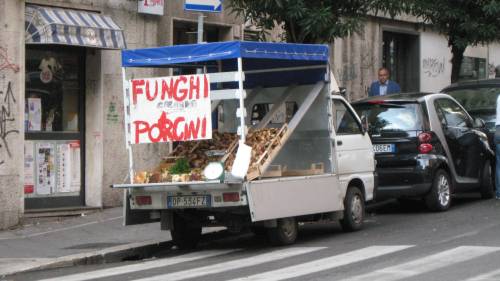
porcini cart

I’ve seen this truck full of gorgeous mushrooms on successive mornings for the past week.  I hadn’t stopped to buy any though, because we’ve had so many dinners there and everywhere, but not here, in our own dining room.  Yesterday, though, after bringing Jack to school, I walked back by a route that would take me past the fungi guy.

I asked for “some of those”—in Italian—and pointed.  That was enough.  He started loading up a small bag, and when I said, “basta, grazie,” he put it on the scale and mumbled something about “dieci.”  In other words, let’s make it an even ten. Euros that is.  He heaped some more in the bag, and I was too sheepish to say no.  Despite the cost, too, a part of me was thrilled to be walking away with such a mound of perfect chanterelles.
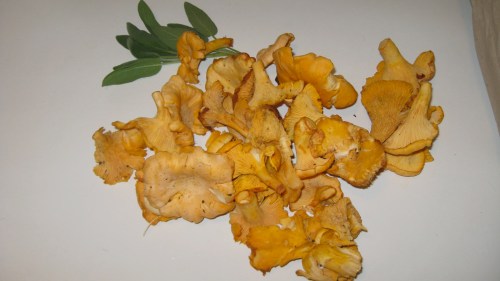
chanterelle pile

I’m not just trying to justify my spree by saying this, but this picture really doesn’t do justice to their size.  The biggest ones are as broad as my palm.

These mushrooms are so flavorful—with such a delicate combination of earthiness, sweetness, and nuttiness—that they’re best served by simple cooking.  Tonight, I’ll be making a pasta dish in which every ingredient is there only to stage and spotlight these graceful plants.

I don’t have hand-cut papardelle, but here’s a version of the dish I had at Pane e Salute, in Woodstock, Vermont.

Chanterelles with Fresh Papardelle

enough pasta to serve four as a first or main course
1 small shallot, minced
1 sage leaf, sliced, or some fresh thyme leaves
1/2 c. dry, light-bodied white wine
freshly shredded parmesan
a pile of chanterelles, sliced into nice, bite-sized pieces

Sauté chanterelles and shallot in butter over medium heat, seasoned with salt and pepper.  Remove them to a plate, and deglaze pan with wine.  Reduce it a bit.  Meanwhile, boil pasta until al dente.  Add the chanterelles back into the pan to warm.  Toss the pasta with olive oil and parmesan, and serve topped with chanterelles and more cheese.

Read Full Post »

I find that what I cook for dinner here in Rome is similar to what I cooked in Vermont or Alabama.  The only difference is that the ingredients are generally better or cheaper.  For example, last night I made bucatini (long, skinny tube pasta) with the ingredients I had in the fridge from previous days at the markets: chanterelles, dandelion greens, prosciutto, fresh onion, garlic, parmaggiano reggiano I’d grated with a hand-grater.

greens

It was delicious.   And made with ingredients that would have been much more expensive in the States and would have been seen with a halo, or rather a tiara, above them, which spelled out “e-l-i-t-e f-o-o-d.”  Ingredients like dandelion greens, for instance, are perversely seen as unusual, elitist, and foodie-fetishized by the general public.  This is unfortunate, because they are so delicious and easy (to grow and to cook).

Here in Rome, everyone buys and cooks huge bunches of dandelion greens, varieties of chicory, treviso, radicchio, and countless kinds of beans.  Everyone buys multiple varieties of tomatoes that actually taste like tomatoes and not like paper towels injected with citric acid.  I was talking to Mona, the chef at the American Academy, about this observation a few days ago.  She had a few explanations.  One is that Italian cuisine is based on greens, grains, and beans.  To Americans, this sounds like “health food,” but think about what an amazingly varied pyramid-foundation these food groups provide.  Everyone in every socio-economic group here eats greens, grains, and beans.  Another reason has to do with land ownership.  Historically, land has been owned by the church and leased to small-scale farmers.  The “get big or die” dictum doesn’t really work here.  Agricultural land and the regional cuisines are seen as part of a national heritage, too, and so there are social, cultural, and economic motives for preserving the status quo when it comes to food.

I don’t need to rehearse for my readers the problems with the farm bills of recent history or the problematic ramifications of agricultural subsidies in the U.S.  Everyone knows that large-scale monocultures of commodity crops like corn and soybeans end up being favored over diversified smaller farms that might grow dandelion greens alongside sweet onions, tomatoes, and melons.  The consequences of this kind of agribusiness are a dumbed-down or simply wiped-out cuisine, a boring selection of cheap food that must be jazzed up with corn-derived substances and packaging to sell, diet-related diseases, a general lack of cooking skills, and a silly politicization of good, real food, whereby fresh fava beans are seen as chi chi.

I’m learning things here that could be taken home.  (OK, get out your corn-tassel pom-poms for this): C’mon, America, let’s get real!

Read Full Post »

We find ourselves snacking on fruit a lot.  There are so many reasons why.  First of all, there so much of the juicy stuff in season.  I was walking along this morning, not planning on buying food, when I saw one lonely market stall, with the most bulbous figs! I bought a basket, and we ate most of them before I remembered to take a picture:

figgi

What I should have done is have my son hold his little fist on the plate, too.  Then, you would have gotten an idea of the size of these gorgeously squishy, heavy fruits.

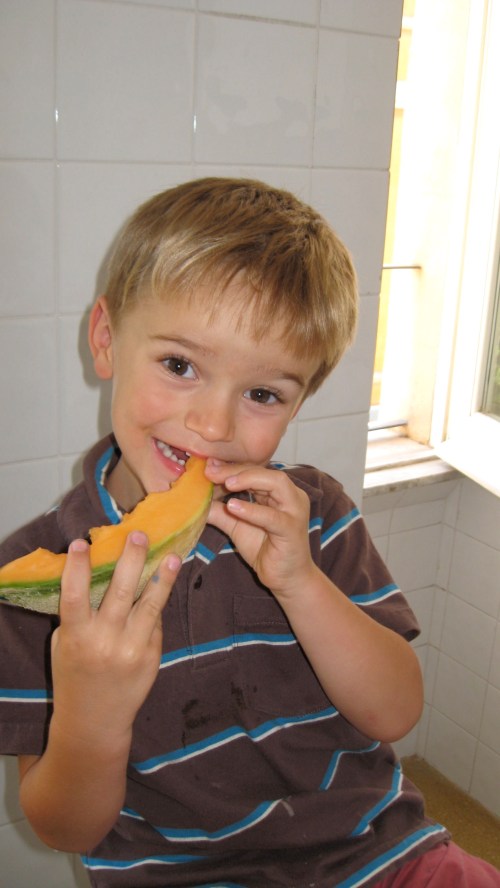
Jack loves the melon, though.  He’s not a fig guy, so far:

melone

Jack had his second day of school today.  I went with him again, and left for a short while.  Tomorrow he’ll stay through lunch.  I’m excited about their lunches.  The culture of food in general at Scuola Arcobaleno is no less Italian than you would expect.  Every morning, each parent leaves a piece of fruit in a basket by the classroom door.  This week we’ve seen bananas, pears, apples, peaches, plums, grapes, and kiwi (some of which are obviously not of Italian origin, but some of which are very local).  At 10:00, the teachers cut the fruit into pieces, and one of the children carries around a plate, and like a little caterer, offers everyone a piece.

Lunch puts a food-focused parent like me even more at ease.  Each child lays out his own place setting, and pours her own water out of a pitcher.  Then, they are all served a primi and a secondi.  A two-course lunch, involving fresh vegetables and big bowls of pasta!  And this is not the pasta that blubs out of a huge can with some sweet sauce distantly related to tomatoes.  This is the real thing.  The only thing that will disappoint me will be my four-year-old son’s ability to accurately report what he had for lunch.  The usual answer to that question, for any kid, is, “I don’t know.”  But I’m hoping he’ll be able to bring home some culinary tidbits in Italian for me.

It’s especially interesting to be having this school-lunch experience at the moment when there’s a parental, grass-roots uprising in the U.S. against the atrociousness of school lunch there.  That problem, which I hope schools, cities, states, and the Obama administration will work to solve, is of course part of the much larger problem in the U.S.: the lack of a culture of food, and the economics of food, in which the cheapest food is the worst for you.

Anyway, though, I want to touch on our other fun today: checking out the view from Fontana dell’ Aqua Paola, which is on a hilltop in our neighborhood:

view 1

(Is this really my life?)

view 2

taking a bus home from a long walk in Trastevere, (which we got to by taking the long staircase downhill from this fountain):

Jack on the bus

and spotting a cool weather vane that reminded me of home:

weathervane

Read Full Post »

Disclaimer: I didn’t sleep at all on the way over, and I walked about 7 miles today, so I don’t have much of a mind to write.  But there’s so much to be excited about.  And I did forget my camera in the supermarket, but that’s just as well, because I would have wanted to post about twenty pictures: of the twenty-two varieties of ham at the deli counter, of the low, low cheese prices, of the interesting juice selection (I bought a lemon-orange-carrot blend), and of the cute little carts that you tow behind you, rather than the “buggies” of the U.S. that, according to a John Cheever character, “unsex” you when you push one.

My new friend Antonia also took me to the market stalls this morning, where I practiced my Italian phrases associated with purchasing, etiquette, and numbers, and bought beautiful greens, figs (figi), eggplant, peppers, a microfiber sweeper, and a citronella fumigator.

I’ll bring my camera next time.

Later in the day, after a lunch of arugula, wheaty bread spread with tapenade, prosciutto, and fresh asiago (not hard due to age, and lighter and sweeter in flavor), we took the stairs down to the hipster neighborhood of Trastevere with our new friends.  I spotted the sticker of a like-minded person, on the window of a hand-crafted wooden instrument store (mandolins, tambourines):

omg sticker

We bought “pizza” for the kids along the way–and it isn’t quite what you think.  Some of it looked like its American progeny, but “pizza” also refers to thin bubbly bread sandwiching sliced cheese or prosciutto and mozzarella.  (Actually, Jack had this variety of pizza for breakfast, while Peter and I had nutella-spread cornetti (croissants) and cappuccino at “Cafe G.”)

We bought umbrellas for the boys, Nicholas and Jack, and they tried them out at a fountain, out of which flows rock-cold, clean, fresh water, with which we also filled our bottles:

umbrellas

We crossed the Tiber, and saw the remnants of an ancient Roman bridge:

Tiber

We saw a fountain, with fish, turtles, and men involved in a choreographed effort of ease:

turtle fountain

And, finally, we came back to the apartment to cook dinner.  In the fridge was a two-liter plastic bottle filled with Sardinian wine.  Really.  Our new friend Cory gave it to us last night.  He’d bought it—and had the emptied water bottle filled—at a local wine store that offers two whites and two reds—out of casks with taps.  Can’t wait to find that place.

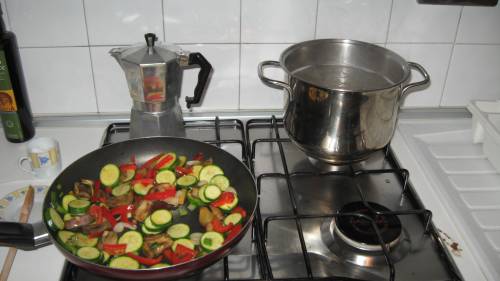
I made a bowl of pasta with all of the local veggies I’d picked up: round, bacci ball sized eggplant, fresh onions, zucchini, red pepper, Roma tomatoes.  Nothing unusual, really, but everything was fresh and local.

1st dinner

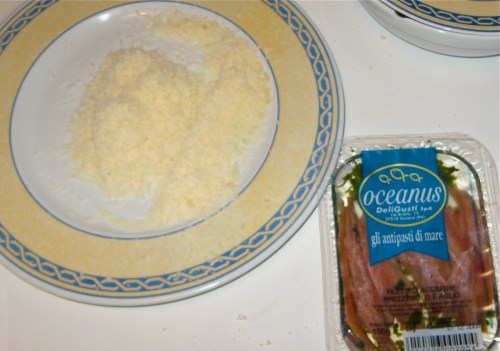
At the table, we added freshly grated parmigiana reggiano and anchovies, both of which were shockingly cheap at “the GS”!

anchovies

I like it here.

Read Full Post »

umrella hat

The other rainy night, we had a little casual dinner party with my parents’ best friends of four decades, who happen now to live on the same long dirt driveway in Norwich, Vermont.  I’d been wanting to make a recipe from one of my favorite bloggers, Tribeca Yummy Mummy, for roasted tomato pasta with scallops.  It was amazingly delicious, especially with picked-that-day organic sungolds and grape tomatoes and basil.  Here are the tomatoes, slicked with olive oil, sprinkled with salt and pepper, ready to get roasty:

roast tomat

We had spicy greens in a salad, and then a berry crumble.  I like making crumble, because it’s so easy.  You don’t even need to look at a recipe for the topping if you just remember “it’s all 1.”

Mixed Berry Crumble

Topping:
1 c. flour
1 c. sugar (mix brown and white)
1 stick butter, cut into small nobs
1 tsp. salt
1 handful sliced almonds (or walnuts, or oats)

Filling:

3-4 c. mixed berries (I used blueberries, raspberries, strawberries, and blackberries)
1/3 c. sugar
a sprinkle of almond extract

Preheat oven to 400.  Mix the filling in the baking pan. Frozen berries are ok.

With your fingertips, blend the topping until it all clings together in clumps.  Sprinkle the topping evenly over the filling. Bake for 40 minutes or so.

berry crumble

Get it before it’s gone!

crumble

Read Full Post »

Roving is a romantic way of saying moving from place to place.  At one time, the word contained more layers of significance than it does now, including something like “lookin’ for love.”  This sense finds its beautiful epitome in Byron’s love lyric, “We’ll go no more a-roving.” More than a poem of love, this is a poem of eros.  The short, simple poem, which Byron wrote while in Venice, speaks of the sweetness of longing and nostalgia as it relishes ironic double entendre.

Today, I’ve had a decidedly more banal, and boring, experience of roving: I drove all around this spread-out rural center of civilization in the northeast—seemingly just to keep the car capable of more driving.  It was a day of logistics: dropping the boys at camp; driving to White River Junction with my sister to get her tire repaired for $13, which took all day; driving to drop off my sister at my dad’s office so that she could use his car; driving to the library for two hours of 1794 literary journals on microfilm; driving to pick up my boy; driving to CVS and the Hanover Food Co-op; driving back to the back roads of Norwich to drop off the cold food; driving to my dad’s office to pick up my sister; driving to the mechanic’s to pick up her car.  On the way out of there, my automatic transmission problem alert signal came on.  It’s an orange-lighted gear with an exclamation point in the center.  Whoa!  So, then we drove, in caravan, to another mechanic’s, who directed us to another, farther south along route 5 in Vermont.  This will probably cost me quite a bit more than $13.

And then we drove back up route 5, which, happily, leads to Killdeer Farm Stand.  I dropped off my sister and the boys at the UPS warehouse to see the trucks (my nephew’s current obsession) and drove to Killdeer.  After a day of aggravation, this was bliss.

The vegetable baskets are more bountiful every day.  I wanted to make a pasta dish with a classic combination of vegetables.  I bought an eggplant, sweet green pepper, sweet onion, costata romanesca.  I looked at everything, admired everything, knew I’d be back tomorrow.

spring veg

I left, reluctantly, to do more driving.

For dinner we had farfalle with all of the above, and some sweet Italian sausage, flavored with fennel seeds, from Cloudland Farm, which we’d had in the freezer.  It was warm, green, springy, delicious.

Spring Pasta

Get the water boiling for pasta.  Meanwhile, break a half-pound of sweet Italian sausage into chunks, and slice half of a sweet onion, one or two Japanese eggplants (their skin is more tender), one sweet green pepper, and one costata romanesca.  Sauté the sausage until mid-rare and let drain in a bowl lined with paper towel.  Sauté the vegetables, beginning with the onion, followed by the eggplant, pepper, and eggplant.  Cook the pasta.  When the vegetables are lightly caramelized, spoon in a couple of big spoonfuls of pasta-cooking water, and cover for a minute or less.  Put the sausage back in the pan, and then combine pasta and vegetables in a big bowl or pot and toss with grated parmgiano  reggiano.  Serve with extra cheese at the table.

Read Full Post »

« Newer Posts