Feeds:
Posts
Comments

Archive for the ‘Meat’ Category

It’s a comfort, shaping meatballs.  Only my fingertips touch, shape, nudge, they are so delicate. Unlike the muscle and torque involved in kneading bread, the pressure here has to be slight.  The way you might hold an infant’s foot.

Yes, I know. I’m talking about raw meat.  But I love making these meatballs in part because I use a recipe from a friend I’ve lost touch with, and they remind me of the dinners he cooked for us–at once so scrupulous and so lax.  Jonathan was exact about ingredients, cooking temps and times, the composition of courses.  And relaxed about the way the evening stretched late into the night, about lipstick marks on wine glasses–from previous drinkers–about the terrifying mess in the kitchen.

We had a delicious rivalry.  He would cook us a multi-course meal with wines to match, and we’d follow up the next weekend at our apartment, just up the hill from his, on Euclid Ave. in Berkeley.  It went on, as we attempted amicably to one-up each other.

The meatballs were one of the best meals.  Here is his basic recipe, as I remember it, which came from his Nonna, his Italian grandmother.

Jonathan’s Meatballs

1 lb. ground beef
1 egg
1/2 eggshell water
1/3 c. fresh bread crumbs
small handful chopped parsley
4 cloves garlic, minced
plenty of salt and freshly ground black pepper or some red pepper flakes for spice

Combine all ingredients, and shape gently into meatballs, either large or small.  Cook over moderate heat in an oiled or buttered pan, turning occasionally, until done.  Serve immediately.

Tonight, I had the luxury of local grass fed ground beef, local fresh eggs, and of course local herbs.  I substituted blanched garlic scapes for the garlic cloves.


Read Full Post »

radishes
After a stop at the Norwich Bookstore and Nana’s apartment, we went to the Hanover farmers’ market, on the Dartmouth green.  I’d had some pent-up desire for this kind of variety and plenty, and I went a little wild.  Jack and I ate half of the bunch of salmon colored carrots right away.
carrot

Then, after craning my neck to assess the competition, I settled on Fable Farm for my armfuls of kale, lettuce, and motley radishes.

fable farm

Then there was raw-milk cheese from Piermont, New Hampshire to sample.  I bought some of the manchego style “Manch-vegas.”  (Did it have that name because it was so over-the-top-flashy-flavorful?  It had to be followed by a full-bodied red.)

cheese

Strawberries!  Next weekend Cedar Circle Farm will have their annual strawberry festival, but we had to stock up before then.

cedar strawberries
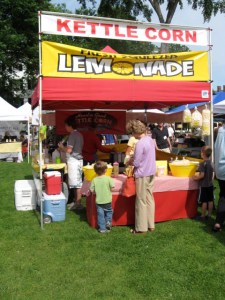
There were sausages, pasture-raised chickens, eggs, breads and baked things of all sorts, fresh-squeezed lemonade, popcorn popped in an aluminum vat the size of a bathtub:

lemondae

beef pork

And asparagus.

asparagus I got a big bunch.  The vendor suggested grilling them, which we did later.  I usually roast them, and I have to say, I’m going to stick with roasting.  They were fine grilled, but they got a bit black.  It’s easier to control the cooking when they’re on a pan in the oven, rolling around in olive oil rather than errant flames.

Around here, it almost goes without saying that the produce, poultry, meat, fruit, and fungi are raised without the help of synthetic chemicals.  Here is a fiercely proud bastion of organics where the suggestion of doubt would be taken as an affront to the dignity of the farmer and her land.  The collective identity of this community, which is scattered across mountains and back roads, is strong in spite of, or because of, the old New England ethos of pioneering individualism and eccentricity that is summed up on New Hampshire’s license plates: “Live Free or Die.”

Jack, exercising his right to sit down wherever he wants to.

Jack, exercising his right to sit down wherever he wants to.

Later on, for dinner, we grilled sausages and the asparagus, sautéed the kale with some crushed garlic, sliced the walnut ficelle, and ate outside while the sun went down.

Read Full Post »

Whew—I can finally relax.  I’m sitting on the deck in Vermont. The sun is shining, the Bloody Brook is rushing, Jack is loading a dump truck in the sand box, and a hummingbird is buzzing by.  This is nice.  Yesterday, Tuesday, was spent in buses, planes, cars, and waiting areas.  Monday, the moving van came, the house was emptied and then scrubbed from baseboards to ceiling vents.  I’ve never cleaned so hard!

But the real event I’ve been itching to address was Sunday night: the great picnic party at Matt and Christina’s which included a power outage, ice cream churned by hand, newborn rabbits, homebrew, a tree climb, and two antique MGs, to name just a few of the highlights.
tree

J & P

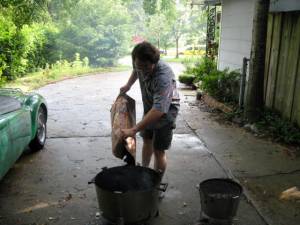
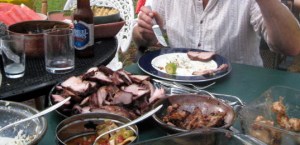
This was a real homegrown meal.   To begin with, there were simmered shell-on peanuts, along with a plateful of carrots and radishes from Red Root Farm for dipping in hummus.  We were standing around the table talking, eating these small bits, and sampling Matt’s dark, hoppy ale, when he brought in a bowl full of sliced, spice-rubbed local pork that he’d just grilled over a heap of smoking hickory coals.
Matt

And that wasn’t the only hunk of pork or the only grill.  There were two other steel buckets serving for grills, on which Matt was cooking long skewers of zucchini and summer squash slathered with olive oil and herbs, and rabbit—the most local of the items in this dinner, since it came from the back yard, where its kin still lolled in their cages, and where one of them had just given birth to her first litter.  He mentioned something about venison sausage too, but I don’t think I saw that….
Emma

rabbitThis was a great dinner not just for the company and its easy, rolling-along tempo, but also for the simplicity and bounty of the food that Matt and Christina spread on the table.  While he manned the grills, she was in the kitchen (where there was no electricity, Auburn having just been whipped up in an hysterical thunderstorm) stuffing poblano peppers with chipotle-spiced ground beef and its alternative for the poco picante palates, cheesy black beans.  She also mixed a quick peanut sauce so that one rabbit option was satay.  Others brought cornbread, salad, and the always idiosyncratic no-knead bread.  I brought wine from Spain.  It can’t all be local!
food

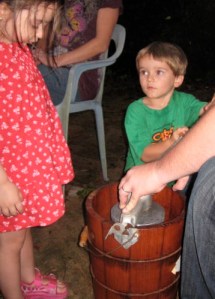
The kids started churning the lemon-almond ice cream as the sun went down.

round and round

round and round

getting sweaty

getting sweaty

Daddy's taking over

Daddy's taking over

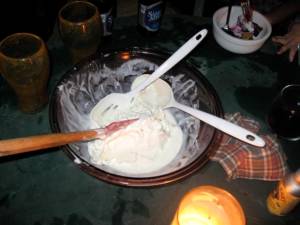
Eventually, after some serious help from the grown-ups, we could spoon big, soft dollops on top of Emma’s blueberry tart.  It went too fast for me to take a representative picture…
i c

Read Full Post »

We’re moving out in a few days, and have no more dinners at home, thanks to friends.  Peter and I packed all day, off and on, while listening to a random college-vintage shuffle.  All but the dinner dishes, cereal bowls, silverware, and a few other things from the kitchen were packed by 5.  And yet.  We had one last dinner party at 220 Cove Court!  Chantel brought the salad, but it was an impressive performance, I have to say.

I went to the meats lab soon after opening time, at 2 p.m., and it was really difficult not to stock up.  I knew I only needed two steaks at most, to supplement the ones Reuben was bringing.  But the eggs were so cheap and abundant!  The pork sausage so spicy! The steaks so beautifully thick and red.  I held back though, and went on to Kroger, where I got olives, some Toad Hollow Paso Robles “proprietary”—i.e. mystery—blend, which turned out to be delicious (I’m still sipping it now), some Terrapin India-style brown ale, a shallot, and pistachios.

Earlier in the day, I’d contemplated the pantry.  What would I do with these random bulk baggies?  The answer came in with style.  Arborio rice, dried porcinis, just a few sundried tomatoes.  Risotto.  Midway through the day, I threw together some brownies.  The menu was set: steaks—both rib eye and strip, which Reuben and I rubbed enthusiastically while in enthusiastic conversation about meat, with crushed garlic cloves—a little dried out—freshly snipped rosemary, olive oil, salt, and pepper; porcini-spiked risotto (as if it weren’t hot enough already); Chantel’s green bean salad; brownies; red wine, after a thirst quenching beer.

The occasion originated with the grill giveaway.  There’s no way that gas grill, which I bought on special last fall at K-mart for $65 and Peter assembled, was going to fit into our storage unit.  So we called Reuben, who said he’d take it, but only after bringing over some steaks to throw on it.  It was also a great pantry- and freezer-emptying event. (We gave Reuben the frozen ground beef.) Most of the time, my pantry is so full of stuff, it doesn’t set off any sparks in my mind.  So there’s something nice about thinning, weeding, giving away.  I haven’t made risotto for ages, and have had those porcinis for just as long.  There’s also something nice about uncomplicated cooking.  The only things I used for cooking were a knife for the shallot, a little bamboo cheese board, a wooden spoon (for both brownies and rice), a pot, a glass baking dish, tongs, and the tea kettle.  And, of course, the grill. Simplicity.  The pleasure of a pantry.

Porcini Risotto

Soak porcini in a bowl of hot hot water until they soften.  Slice porcini into bits and save water to use in risotto.

Pour 1 c. Arborio rice into a moderately hot saucepan with a melted nob of butter in it.  Stir the rice until it gains translucence around the edges of the grains.  Reduce heat to medium low.  Gradually stir in 1/2 c. white wine until absorbed.  Pour in mushroom soaking liquid. Add a bit of minced fresh thyme. Keep stirring as you gradually pour in about 3 cups of warm stock, over the course of 25 minutes or so.  Keep stirring and pouring until it has that silky soft risotto feel in your mouth.  Add 2 more tbs. or so of butter and 1/2 c. grated parmesan.  Serve immediately.

Read Full Post »

https://i0.wp.com/randlefarms.com/bberry/sheepinclover.jpg
Randle Farms is one of the CSA possibilities in the Auburn area.  They grow a wide variety of produce, and also offer eggs, beef, pork, and lamb, all of which is organic. When we joined in the fall, our first pick-up included two frozen lamb shoulders.  I had to do some research before cooking these hunks, and then had to turn my knife in all directions to carve the meat off the oddly shaped bone and make relatively uniform-sized chunks.  Because braising is the best way to cook this sinuous cut, I tried two variations on stew—one classic French, and the other Moroccan. Both were delicious, but the Moroccan spices and the mystery ingredient—honey—really brought out the distintiveness of the lamb.

Ras el hanoutThe dish is a variation on Mrouzia, traditionally made after the celebration of the slaughter of the lambs, and characterized by its sweet-spiciness.  The main spices are in the blend called Ras el hanout, which is popular across North Africa and the Middle East.  The blend includes cumin, coriander, cardamom, clove, paprika, cinnamon, nutmeg, peppercorn, turmeric, and mace.

First, in a dutch oven or heavy pot, whisk together the 2 tsp. Ras el hanout, 2tsp. salt, ½ tsp. black pepper, ¾ tsp. ground ginger, a pinch of crumbled saffron threads, and 1 cup of water.  Stir in 3 pounds of lamb chunks with 2 more cups water, 1 chopped onion, 2 minced garlic cloves, 2 cinnamon sticks, and ¼ cup butter.  Simmer, covered, for about 1½ hours.

Then add the sweets: stir in 1¼  cups raisins (I prefer goldens), 1¼ cups whole blanched almonds, ½ cup honey (which you can get locally), and 1 tsp. cinnamon.  Simmer, covered, for another 30 minutes.

Finally, uncover the pot and cook over moderate heat, stirring occasionally, until stew is thicker (about 15 minutes).  Serve with bowls of moist, fluffy cous cous.

Here’s a link to Randle Farms (randlefarms.com) where you can see the lambs munching clover.  (The photo at the top is theirs.)

Read Full Post »

Beef Cattle in Pasture

If you like meat, you’d enjoy a trip to the Lambert-Powell Meats Lab store at Auburn University.  They carry eggs, all kinds of cuts of beef and pork, fat packs of ground beef, and sausage in many varieties of traditional spice combinations, including chorizo and fennel-seed-dotted sweet Italian.  (The smoked sausage is delicious grilled and smothered in spicy mustard.) They also occasionally offer grass fed beef, which I prefer to buy because it’s produced more sustainably than its conventional, grain fed counterpart.

The distinction between grass fed and grain fed beef is pretty simple to explain, but the differences in the effects of these two production methods on the environment and human health are drastic.  Here’s how Heidi Finegan, the Research Associate in the Department of Animal Sciences at Auburn, describes the differences in the production methods:

Grass fed beef is just that, beef that is grown only on forages (the term “forage” encompasses many grasses and legumes).  Most beef you buy in the grocery store is finished on grain and considered “regular beef” by many consumers.  Generally, beef cattle are raised alongside their mothers in a pasture until they are weaned at 6-8 months of age, weighing around 500-550 pounds.   After weaning, they will remain on grass until they reach about 800 pounds.  At this point, they will be shipped to the mid-west to enter a commercial feedlot where they will be “finished” on a grain diet until reaching harvest weight at 1000-1200 pounds.  This usually takes around 100 days and the average age of harvest beef is 18-22 months.  So, the main distinction lies in the fact that some cattle never have grain and are marketed as “Grass fed” while feedlot cattle are grain fed.

Even though the grain-finished method is preferred by the beef industry and many consumers, because it takes less time and results in the flavorful white-fat marbling familiar to meat-eaters, it entails many problems.  I won’t go deeply into them, but let me offer a brief list to get your imagination going on some consequences of raising beef on an industrial scale: e. coli, antibiotics, manure “lagoons,” mass-production-style slaughter (or would that be destruction?), fossil fuels, fossil fuels, and more fossil fuels.  This week, Jane Brody wrote about beef in her weekly column for the New York Times, and proposed that “a reduced dependence on livestock for food could help to save the planet from the ravaging effects of environmental pollution, global warming and the depletion of potable water.”  She quotes Dr. Barry Popkin, an epidemiologist at the University of North Carolina, who says that, “in the United States, livestock production accounts for 55 percent of the erosion process, 37 percent of pesticides applied, 50 percent of antibiotics consumed, and a third of total discharge of nitrogen and phosphorus to surface water.”

And we all know that meat consumption contributes to the high rates of heart disease in the U.S.

Grass fed beef offers many advantages.  Heidi says that:

Grass fed cattle are easier to manage, are more cost effective to the producer, and play a key role in sustainable agriculture.  Properly managed grazing patterns can help maintain soil productivity and keep forages in healthy conditions where they can protect soil from erosion and fix nitrogen.  Local producers can also cut out shipping and delivery costs by keeping cattle on their own property and not sending them to Kansas or Texas.  Some negatives to grass fed productions are that it will take a longer amount of time for cattle to reach optimal harvest weight and as the animal ages the tenderness and quality of meat declines.

Some would dispute the point about quality.  Many foodies claim that there is a terroire aspect to grass fed beef—that the particular qualities of the forage and soil come through in the meat, and that the flavors of California- and Vermont-raised grass fed beef are different.  The distinctness of the flavor of grass fed beef may also be a result of contrast.  If you’re used to the water-bloated mass-produced steak from the big chain supermarkets, this beef will be a new experience.  Perhaps nutritional content affects flavor too: grass fed beef contains less saturated fat, and more antioxidants and omega-3 fatty acids than grain fed beef.  Heidi also pointed out that beef is high in zinc, vitamin B, and iron.

If you love a juicy steak, it seems that the best way to go is to buy grass fed, and only on occasion. But grass fed beef is not widely available yet, so when we just need to celebrate with steak and red wine, I’ll buy grain fed New York steaks from the Auburn meats lab.  At least I know it’s local and raised with education in mind. My favorite toppings for salt-and-pepper seasoned burgers are Colemans mustard, a tomato slice, and fresh basil leaves.  For steaks, simplest is best: I rub them all over with a fresh rosemary sprig (then stick some leaves in the fat-crevices), sprinkle them with salt and pepper, and grill to mid-rare.

Read Full Post »

« Newer Posts