Feeds:
Posts
Comments

Archive for the ‘Cheese’ Category

Mmmm… I have such a craving for a luscious tomato tart.  Roasting brings out such intense flavors.  And melted cheese: the deliciousness of the thought speaks for itself.

However, it’s pushing 90 today, and I won’t be turning on the oven.  How to celebrate high tomato season with something a little simpler, more “rustic” and conducive to lazing around than the pretty spiral of tomato, mozz, and basil (though I have nothing against that salad!)?

Panzanella!  A bread salad made with summer’s basics: stale bread, tomatoes, basil.

panz ingreds

The structure of this basic flavor combination provides a strong background for additions, if they come in as accents.  Have some leftover anchovies or olives?  A wedge of lemon?  Toss in a few capers, too, from that bottle that always seems full.  Some other backyard herbs would be nice too, as long as the basil sets the tone.

We’ll have this tonight, with grilled chicken.  Killdeer folks: see you soon.

For the cooler nights later this week, though, I’ll be turning to the tart.  I think I’ll try this recipe, recently posted in the Times.

Read Full Post »

This summer, while we live–on extended visits–with various units of extended family, my cooking life has been tyrannized.  Not by non-omnivores or picky children so much as by the need to please everyone.  How to do so?  In our family, it’s with the Square Meal.  Protein, veg, “starch,” bev.

Last night, I said, “forget it, I’m making what I want and I’m not cooking.”  Well, I did cook, but just two 8-minute eggs for Jack and a handful of green beans.  We ate a cold and warm assortment of fresh, ripe, local foods.  Remember those heirloom tomatoes I bought on Saturday?  Black and pink brandywines.  I sliced them thick and sprinkled them with fresh mozzarella, basil chiffonade, salt, pepper, and olive oil.  I cooked the green and yellow wax beans just a bit, and tossed them with leftover sweet corn that had been cut off the cob, and with an assortment of chopped herbs from the back yard.  We also had Tarentaise, the cheese made by the Putnams of Thistle Hill Farm in North Pomfret.  A bowlful of mixed greens with mustardy vinaigrette.  A King Arthur baguette.  Vinho Verde, the effervescent, airy as seagrass Portuguese white that I love.

I know, doesn’t sound like a very adventurous escape.  Ah, well.  It was a good meal.

And escape from the tyranny of square meals is a topic that warrants discussion.  We eat that way quite a bit more at home, and not just because we’re busy parents of a busy four-year-old.  It’s refreshing to eat picnics inside, or to make a meal of the humble egg.

Read Full Post »

Everything was burning yesterday evening.  For the most part, in the best way.

First, I roasted the two bunches of beets–chioggia and golden–and some of the juice oozed out of the foil onto the cookie sheet.  The whole house smelled of burned beet slime.  The result of roasting, however, was delicious: warm beet salad dressed lightly with vinaigrette, sprinkled with chives, salt, and pepper, and covered with crumbled local goat cheese.

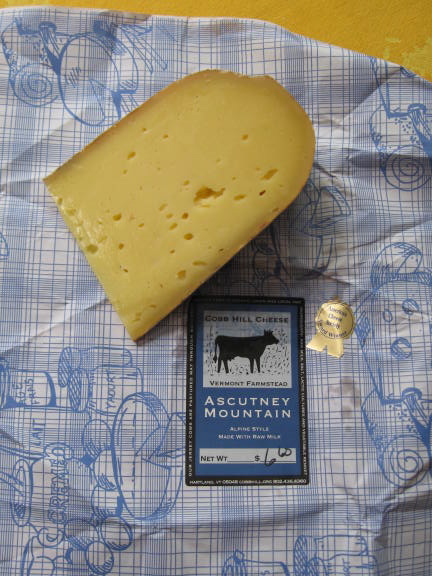
My parents’ best friends, the Ashleys, came down the steep driveway from their house for dinner.  Dad mixed martinis and mojitos (for different people–we didn’t mix).  We sat in the sun on the deck.  The tiki torches were flaming.  We snacked on corn chips and hummus, and the tender, nutty Cobb Hill cheese named Ascutney Mountain (for the Green mountain just south of here).

Ascutney chs

Along with a colorful salad made from our farmers’ market haul, we had sweet corn on the cob from Killdeer Farm, and those sausages from Hogwash Farm–Beer Bratwurst and Chorizo–which promptly caught on fire when Dad put them on the grill.  We moved them around, and the flames gave chase (it always cracks me up when baseball announcers use that phrase!).  In the end, there were some spots of char, but not too many, and the sausages were succulent.

This pyromeal was followed by a campfire, up on the hillside behind the Ashleys’ house, at their well-used fire pit.  The grown-ups nursed our drinks and constructed perfectly melted s’mores, while the boys torched marshmallows, pinecones, leftover Christmas candles, anything that would burn.

IMG_0177

IMG_0185

A good time was had by all.

Read Full Post »

Mmm…

Making a margherita pizza tonight with many scrumptious local ingredients.  It’s also sort of a Norwich Route 5 pizza, because Killdeer is just down the road from King Arthur Flour, and most of the ingredients were purchased at these favorite spots.  The fresh mozz is sold at Killdeer and made at Maplebrook Farm, in Bennington, VT–another of my old hometowns.  We lived on a straight-uphill narrow dead-end road preposterously, or optimistically, named Crescent Boulevard.

Traditionally, the only toppings on Margherita are sliced tomato and mozzarella, fresh basil, and olive oil.  I may jazz it up a bit, though.  It’s been a long rainy day.

I also want to avoid a scuffle with the carabinieri.  I think it’s illegal to call my pizza “Margherita,” which is a designation protected by the E.U.–like “Champagne” or “Manchego.”

Jazzed-Up Margherita Pizza

for the crust:
1 c. warm water
1 tsp. yeast
1 tsp. salt
1 tbs. olive oil
3 c. unbleached flour

fresh, local tomatoes
fresh, local basil (or homemade pesto)
fresh, local mozzarella
(And… stepping out of the locavore range by a long shot… kalamata olives or anchovies for kick)

Mix the dough, let rise for an hour.  Flatten and stretch on a semolina-dusted pan.  Pre-heat oven to 425.  Let the crust rise up a bit more, and then strew with the toppings.   Bake until the cheese is golden and sizzling.

za

Oops… I overloaded it.

Read Full Post »

hi

hi

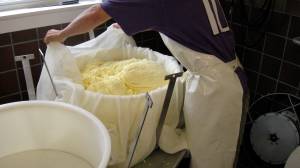
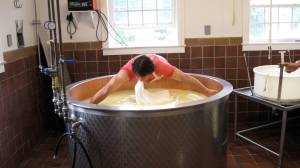
I spent the morning in the Pomfret, Vermont hills among cows and affable, talkative farmers happy to have me help to spread their gospel: eat locally and sustainably, and preserve the traditions of good food and respect for the land.  I’ll save Cloudland Farm for another post, because my visit to Thistle Hill Farm was so involved as to have me elbow deep in the copper vat of warm curds and whey.  This was the warm soup that would become the delicious, nutty Tarentaise.

John and Janine Putnam, the owners, farmers, and cheesemakers, were nice enough to let me watch and trail along and ask questions while they dealt with their uncharacteristically chaotic morning: it was a cheesemaking morning, which involves precise timing; and one of their cows had escaped the night before in search of a private place to birth her calf.  When I arrived with my sister and our two sons, the Putnams were harried.  John was measuring the temperature in the vat and watching the clock, while running in and out of the cheese house, changing his shoes each time, to keep dirt out of the cheese room.  Janine was walking all around the steep hills of the property searching for the new mother and her calf.  “Some are good mothers, some are bad.  The bad ones will just leave the calf, and we have to find it.”  They both disappeared for awhile, and Jack and Jeremiah found the Putnam children’s old tractor toys in the back of the barn, and played happily.  I snooped around the cheese house, where there is a wall covered with awards and accolades for their organic Vermont alpine cheese, named Tarentaise, and made in the style of the alpine cheeses of France and Switzerland.  On the wall a map of this region shows, with red circles, where the Putnams traveled with their four children, almost ten years ago, when they decided to make real cheese.

pasture

pasture

curds & whey in copper

curds & whey in copper

Jackboots

When we all bustled back into the cheese room with too big boots, Andrew, the Putnams’ 21-year-old son, was there to help his father lift out the heavy curds.  My glasses fogged up.  It was much hotter and more humid in the room, and the air smelled both sweeter and more acidic.  The curds had reached one degree shy of the critical 48 degrees Celsius.  John said he can tell where it is in the process by the smell.  When he was apprenticing, he said, he was told that at a certain point, “just put away the instruments and the thermometer.  Your senses will tell you what you need to know.”
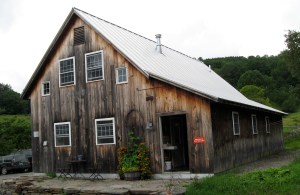
the cheesehouse

the cheesehouse

The American consumer, too, is learning to trust and hone his senses when it comes to cheese (and wine–the two go together).  The kind of business the Putnams run, and the kind of cheese they make, are helping to put Vermont in the vanguard of what some are calling the good food movement.  Consumers–literally–are willing to pay good money for good food.   John and Janine can speak both poetically and pragmatically about their chosen methods.  They love their loyal local customers, but they also love selling their cheese to D.C. restaurants.

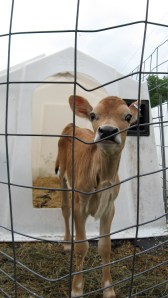
Suddenly, John was gone again, and we found him and Janine in the barn with the newborn 45-pound calf and its mother.  They’d been at the top of a woodsy hill, together, and Janine had carried the calf on her shoulders back to the barn.
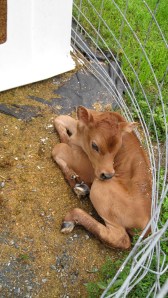
the newborn

the newborn

John ran away again, this time to the house to change his clothes and shoes.  You can’t go in the barn when you’re making cheese.  They even have the cheesehouse uphill and upwind from the barn, so that its “perfumes” won’t be detectable in the cheese.  The Tarentaise, instead, will carry the aromas of the terroir—the characteristic soil, grasses and forages of the North Pomfret hillsides.

Then, it was time to lift out the curds, with huge pieces of cheesecloth and one foot against the wall—so as not to fall into the vat when leaning down to scoop from the bottom.  John and Andrew worked together wordlessly, in sync, with the familiarity of father and son and habit.  They make cheese every other day.  “Cheesemakers don’t need to go to the gym or to the spa,” said John, in constant movement in the humid room.
curds 1
curds2

curds3

They first lifted the huge sacks of curds into draining-compressing vats, and then, after about 15 more minutes, when the curds had glommed together in big jiggly discs, John sliced them into quarters with a chef’s knife, and lifted the sections into the round containers where they’d be compressed with the weight of 65 pounds.

curds4
curds5

Then they cleaned up, which was a time consuming and wet process.  Part of the clean-up is lifting the “pig cheese”—the curds left at the bottom and no good for cheese but good for the local pigs—out of the vat, which John let me do.  (I’m using my teeth as a third hand to hold the corners of the cheesecloth.)

cheesecloth

then to the aging room

then to the aging room

The Putnams have an eloquent website which describes their practices and tells their story.  Here are some of their links:
About the farm
Story
Home

And don’t forget to heed Janine’s advice:

Janine's shirt

As for me, I’m already looking forward to the Norwich Farmers’ Market on Saturday morning, when I can buy some more of the delicious, honey-colored Tarentaise.

Read Full Post »

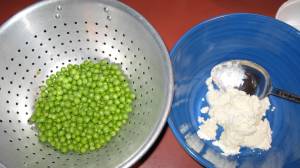
peas ricotta

Organic ricotta, fresh peas, local applewood smoked bacon, pasta, parmigiano-reggiano.

Sigh…

Read Full Post »

Since this is a locavore blog, in some ways, I have to admit, I misrepresent myself.  For example: beer versus wine.  I’ve written more about beer, and expressed a lot of enthusiasm about local ales, but I’m really much more of a wine drinker.  Lately it’s been Spanish reds, and vinho verde.  I love the different tones of garnacha, and the refreshing effervescence of that Portuguese “green wine.”  I also love the whites of Alsace.  And the infinite varieties of rosé! From the elegant Tavel to the earthy South African pinotage rosé, I love them all.  If I still lived in Berkeley, there wouldn’t be the whiff of hypocrisy in calling myself a locavore eater and drinker, because I’d still be drinking those great Sonoma, Paso Robles, Santa Cruz, and Mendocino wines we could get in the grocery store.  I miss you, Bonny Doon.  Wish I could be there in the tasting room to try your new, more restrained bottlings, which I’ve now only read about, wistfully, in the New York Times. (Not to mention all the great things I could be eating: mission figs and meyer lemons from neglected trees on my block of Euclid Ave., for example….)

Enough gushing, now.  The reason I started writing this post has to do more with ale and my country-girl nostalgia.  In Burlington, at Greg and Patti’s, we started the evening with Otter Creek Copper Ale, which I love, and which brought back memories (not all pleasant) of my stint as an “environmental educator” at a school-trip camp near Middlebury, Vermont.  We slept in cabins so rustic, the frosty mid-March air gusted in the cracks between the aged two-by-fours during the night.  I slept in my -40 down “mummy” sleeping bag in long underwear, a sweater, and a wool cap.  The kids arrived on full school buses on Monday, we introduced them to things like recycling, organic carrots, and sphagnum moss, and they were gone by Friday.  And then, if it was sunny, we’d drag all of the Adirondack chairs out to the middle of the lawn at the camp’s center overlooking the lake, set a bunch of six-packs of all of the Otter Creek brews here and there, and sample them all afternoon.  Copper Ale, Pale Ale, Stovepipe Porter, Spring Ale, Mud Bock!  We were single, outdoorsy, and glad to be free.

Otter Creek Brewery is a family owned business in Middlebury, Vermont, which also makes certified organic beers under the Wolaver’s label.  They host a regular beer and cheese tasting, which at first glance smacks of wine-culture-imitation opportunism, but then I remember how good I think the sharp Vermont cheeses taste with beer.  Here’s how they advertise it:

Not only is Vermont home to 19 craft brewers (at last count), the most breweries per capita in the country, we also are lucky enough to have 35+ artisanal cheesemakers here, too!  This makes us arguably the best state for cheese and beer pairings in the country!

You know what else is good with beer?  Peanut butter.

Read Full Post »

cheese sample

Vermont is, of course, known for its dairy farms, along with its maple syrup.    The two events I went to today, the Norwich Farmers’ Market and the Co-op’s annual Dairy Day, are really celebrations of the richness, variety, and history of Vermont’s dairies, which stretches back to the seventeenth century. While stories of small dairies going out of business or being bought out by large conglomerates are common these days, some of the most successful operations now are small.  They have simply shifted their market focus and serve the (expanding) niche markets defined by the desire for food that is of a high quality, is local, and is artisanal in some way.  The desire for these traits goes along with a conservationist ethos that looks both forward and back.  Heirloom seeds and techniques are prized for their history as well as for the continuity and contribution to biodiversity they offer to the future.

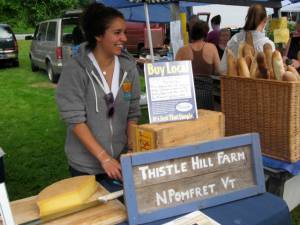
Today, I settled on a cheese from Thistle Hill Farm, in North Pomfret, Vermont, a dairy which epitomizes this cultural and environmental ethos in their cheesemaking.

pomfret cheese

They specialize in a semi-hard cheese named Tarentaise, after the Tarentaise Valley in the Savoie region of the French Alps.  The organic milk from their Jersey cows is combined with imported French cultures and their own rennet in a custom-made copper vat like those used in the Savoie.  The Putnams write on their website:

From its humble beginnings as organic raw milk to its natural aging and rind development, Thistle Hill Farm Tarentaise is as unadulterated a cheese as you will find. The imported French cultures impart flavor and texture. The traditional rennet provides structure and further complexity to the flavor of the cheese. Thistle Hill Farm Tarentaise has no added preservatives, synthetic flavors or additives. No herbs are used to hide its flavor; no waxes or plastics simplify its aging process.

Tarentaise is unique to North Pomfret Vermont’s terrior – its soil, geography, climate and flora – which gives Tarentaise its characteristic smooth, subtle nut flavor and complex finish. http://www.thistlehillfarm.com/default.htm

We sampled little cubes, and then bought a big slab.

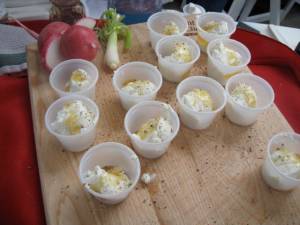
Just before lunch, we migrated to the Lebanon Food Co-op’s Dairy Day, where everything from root beer floats to Greek yogurt could make a mid-morning snack.  While Jack and his cousin went for the root beer and balloons, I sampled the Vermont Butter & Cheese Company’s creamy goat cheese dressed with honey and black pepper, and an assortment of other cheeses, including more Tarentaise.

VT B&C goat
But I was also on the hunt for a sweeter evocation of fields, forages, and herbs.  Some of you might recall my daydreams about the ice creams of Strafford Organic Creamery, the small Guernsey dairy in my first hometown (and the town where Peter and I got married in the meeting house).

Strafford

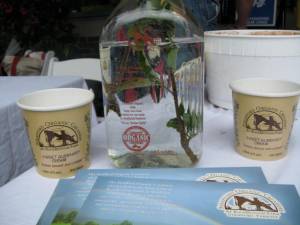
At last, I found their table, where melting ice cream in plastic buckets was being scooped into a constant stream of drippy cones.  I ordered fresh mint, and could taste the herb garden.  Bridget ordered coconut, and my mom got coffee, with its milk-brewed grounds.  Our favorites? It was a toss-up between fresh mint and coffee.  (Strafford Organic Creamery)

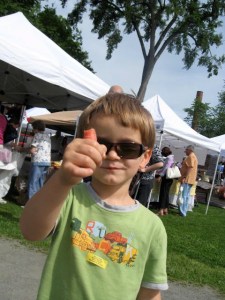
the kind of shot you get from a 4-year-old portraitist

the kind of shot you get from a 4-year-old portraitist

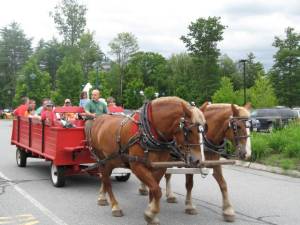
Since it was an event aimed mainly at children and their families, there were the requisite horse-drawn wagon rides around the parking lot.
horsesAnd, of course, Ben and Jerry’s:

B & J's

Read Full Post »

radishes
After a stop at the Norwich Bookstore and Nana’s apartment, we went to the Hanover farmers’ market, on the Dartmouth green.  I’d had some pent-up desire for this kind of variety and plenty, and I went a little wild.  Jack and I ate half of the bunch of salmon colored carrots right away.
carrot

Then, after craning my neck to assess the competition, I settled on Fable Farm for my armfuls of kale, lettuce, and motley radishes.

fable farm

Then there was raw-milk cheese from Piermont, New Hampshire to sample.  I bought some of the manchego style “Manch-vegas.”  (Did it have that name because it was so over-the-top-flashy-flavorful?  It had to be followed by a full-bodied red.)

cheese

Strawberries!  Next weekend Cedar Circle Farm will have their annual strawberry festival, but we had to stock up before then.

cedar strawberries
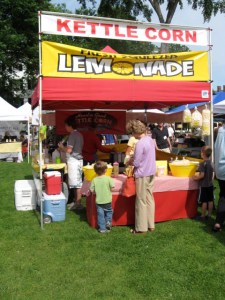
There were sausages, pasture-raised chickens, eggs, breads and baked things of all sorts, fresh-squeezed lemonade, popcorn popped in an aluminum vat the size of a bathtub:

lemondae

beef pork

And asparagus.

asparagus I got a big bunch.  The vendor suggested grilling them, which we did later.  I usually roast them, and I have to say, I’m going to stick with roasting.  They were fine grilled, but they got a bit black.  It’s easier to control the cooking when they’re on a pan in the oven, rolling around in olive oil rather than errant flames.

Around here, it almost goes without saying that the produce, poultry, meat, fruit, and fungi are raised without the help of synthetic chemicals.  Here is a fiercely proud bastion of organics where the suggestion of doubt would be taken as an affront to the dignity of the farmer and her land.  The collective identity of this community, which is scattered across mountains and back roads, is strong in spite of, or because of, the old New England ethos of pioneering individualism and eccentricity that is summed up on New Hampshire’s license plates: “Live Free or Die.”

Jack, exercising his right to sit down wherever he wants to.

Jack, exercising his right to sit down wherever he wants to.

Later on, for dinner, we grilled sausages and the asparagus, sautéed the kale with some crushed garlic, sliced the walnut ficelle, and ate outside while the sun went down.

Read Full Post »

« Newer Posts