Feeds:
Posts
Comments

Archive for July, 2009

beach jack

After a satisfyingly lazy afternoon on the beach, here in Westport, Mass., Peggy and I went to the fish market.  It was a bare bones kind of operation, but all of the fish and shellfish was glisteningly fresh and abundant.  We decided on striped bass.  On the way home, we stopped at the farm stand at Orr’s Farm—an organic vegetable farm run almost single-handedly by Andrew Orr, who is about 20 and is referred to proudly by locals as the town’s youngest farmer—and stocked up on potatoes, garlic, and a few others items.  Dinner was a locavore’s feast: striper grilled mid-rare and topped with fresh, coarse-chopped basil pesto, garlic mashed potatoes (yes, it’s a craze of mine now), and a salad of lettuces from the back yard mixed with local pea greens, tomatoes and radishes.

pesto striper

Yum!

Read Full Post »

Remember what I said about Deborah’s extraordinary vegetarian cooking?  She was gracious enough to send me her recipe for Swiss chard tart.  Here’s what she says:

As for chard tart, tip of the hat to Patricia Wells, from whose recipe this jumps off with a few modifications–it’s actually an olive-oil crust:
The crust is l cup of flour (I use something called white whole-wheat made by King Arthur, but you can use whole-wheat pastry, or some combo of wh wh and white),plus a couple of large pinches of salt, to which you add l/4 cup ice water–mix in–and then l/4 cup olive oil. It can be mixed with the hands, and it will be very moist and soft, like cookie dough sort of. Doesn’t need to be refrigerated–press it into the tart pan with your hands (the recipe fits something like an 8-9 inch pan, but can easily be multiplied to larger vessels). Filling is–well, I don’t know how to describe the amount of chard, but a very big bunch, anyhow–chop it roughly after washing, wilt it in its own water in a saucepan, add to 3 beaten eggs, l/2 to one cup Parmesan or other cheese, salt, pepper. Coat bottom of crust with Dijon mustard, put in filling, and bake at 400 degrees until firm and golden, roughly 30 minutes, depending on your oven.
Doesn’t need to be served absolutely hot from the oven–perhaps more flavorful having cooled off a bit…

Read Full Post »

Catskills

After spending the weekend driving up and down mountains in the Catskills, crossing rivers with names like Beaverkill and Deepkill, where flyfishermen waded in the sparkling water, and eating a late breakfast at Sweet Sue’s in Phoenicia—a destination breakfast spot for Brooklynites, where we had inch-thick mixed berry pancakes with maple syrup, poppyseed swirled challah French toast, lox-scrambled eggs, bacon, and iced lattes out at a sunny streetside table with Chris and Kate and baby Chloe—the day before Aaron and Kelly’s pastoral wedding, we drove east through the Berkshires to Boston.

the ring bearer

the ring bearer

me & J
The roadsign names and route numbers flashed childhood drives through my memory: visits to the grandparents outside Hartford, field trips to time-capsuled Sturbridge Village, highschool jaunts to the thrift stores and coffee shops of Northampton.

We stopped at a rest area on the Mass Pike, which was having a small farmers’ market.  There were two tables: one full of odd pesto medleys, soaps, and knick-nacks, the other stocked with blueberries and strawberries.  I bought some blueberries, and we snacked on them for the rest of the drive.  (Not organic, but infinitely better than anything else at the rest area.)

rest stop berries

We still had a container of Deborah’s berries, too, so that night I decided to throw together a blueberry dessert of some sort.  I was dreaming of buckle, but felt far too unmotivated to make a multi-step cake.    The solution for a last minute, lazy sweet-tooth? Clafoutis!

The dessert from the Limousin region of France is traditionally made with fresh unpitted cherries, (which reminds me of a trip Peter and I took to the Dordogne region of France, where we stopped at the most amazing country restaurant, Le Temps des Cerises…) but it lends itself well to fruit substitutions.  This recipe is an adaptation of Julia Child’s.  The combination of big cultivated blueberries, the small ones from Kenoza Lake, and the more tart huckleberries was delicious, and pretty, too.

Blueberry Clafoutis

3 eggs
1/3 c. sugar
¾ c. milk
¾ c. cream
1 tsp. vanilla
1 tsp. almond extract
1/8 tsp. salt
½ c. flour
3 c. blueberries
powdered sugar

Preheat oven to 350°.  Butter a 10-inch tart pan or cast iron pan, and sprinkle sugar to coat.  Pour in blueberries, in one layer.  With an electric mixer, beat eggs until foamy, then add sugar and continue mixing until thick and foamy.  Gradually add the flour.  Meanwhile, combine cream, vanilla, almond extract, and salt in a small bowl.  Mix these ingredients with the egg mixture.  Pour over the blueberries.  Bake for 20-30 minutes, or until it sets and is golden brown.  Dust with powdered sugar, and serve.

Read Full Post »

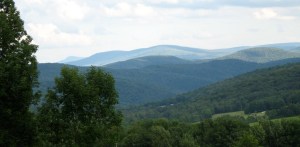
We’re roving through rural New York this long weekend.  After driving through the Green Mountains of Vermont, over countless hills and through countless valleys, we came into the Catskills with its countless rivers, having passed through the little towns where my mother’s mother and mother’s father were born and raised—Kingston, Callicoon Center—and where they married and started their own family—Liberty.

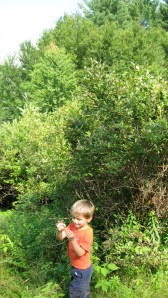
Our first stop was Kenoza Lake, where we visited our friends Deborah and Jed in their pewter-blue-painted farmhouse, fixed up with many windows, a writing room for him in the attic, a studio for her in the old barn or chicken house or mudroom adjacent the kitchen.  We arrived for a late lunch in the sun: plates of lox and ricotta, sourdough bread, babaganoush, hard-boiled eggs, farmhouse cheeses from around the corner, white wine for some, Coronas for others.  For dessert, we went into the hilly acres of bushes heavy with blueberries and huckleberries.  Because of all of the rain this summer, and the general cloud cover, we picked berry by berry, rather than cluster by cluster.  There were still plenty of berries for Jack.

blueberry picking
Deborah and I went into Jeffersonville to check out the small farmers’ market, where she bought striped Romanesco zucchini and a big head of romaine.

many currants, few zucchini

many currants, few zucchini

Deborah is a wonderful vegetarian cook.  For dinner, after their favorite aperitif—Campari with pulpy orange juice—she served Swiss chard pie (I’ll post a recipe soon…) in a buttery crust, quinoa with pinenuts and golden raisins, and roasted cauliflower with ginger and herbs—out of which she coaxed extraordinary carmelized flavors.

Our next stop will be Margaretville and Roxbury, for Aaron and Kelly’s wedding.  We hope these thunderheads roll on by.

Read Full Post »

I spotted a forager at the Farmers’ Market in Hanover.  He was busy behind another farmer’s stand, borrowing the scale to weigh his haul of early chanterelles.   He divvied out the cache of beatifully gouda-colored fungi into straw baskets.  $8 each.  6 hours of foraging had yielded six baskets, he told me.  I’m sure those six baskets were picked up in a flash, after which he probably ducked back into the woods.

chants

When cooking, they smell, and then taste, of nuts and apricots, earth and sunlit woods, fruity wine.

Lacking rabbit, I’ll cook them up and toss them over chicken.  Sauté until they release their juices, in butter, with pancetta, herbs, and minced shallot.  Maybe a few pinenuts.

Rosé…

Read Full Post »

Pork chops, like buttercups, are my Proustian objects.  At the taste of a chop, especially one brined in cider or served with applesauce, I’m back on Old City Falls Road, at the big yellow house in Strafford, Vermont.  Up the steep hill behind the house and barn—a catch-all space housing tools, lumber, a VW bus, my Dad’s darkroom, a sauna—was the pond where I learned to swim and skate, and the pig pen.  My parents, on the run from suburbia back to the land, had set up a small homestead with a vegetable garden, chickens, pigs, a goat, and two little girls running around in Wonder Woman Underoos in January, because the wood stove kept the living room so hot.

The pigs, Gruntly Squatwell and Squatly Gruntwell, were contented animals until that particular date when my uncle and a few other guys would show up in their pickup trucks for the big pig roundup.  Then the pigs ran around and around their pen squealing for their lives, though they didn’t know it.

The result was a freezer full of pork.  For some reason, I remember the chops best of all.  Sweetish and salty, for me the essence of pork—until I tasted pancetta, but that’s a different kind of experience.  The best, more recent, pork chops I’ve had were grilled by our friend Donia, the energetic and lovely Palo Alto chef and writer.  Her cooking—whether in her restaurant or home—is less a performance than an expression of her nurturing nature.  The food is loved and cared for, as are the friends she feeds.

The technique here is so simple, it barely warrants the formalization of a recipe, but here goes:

Donia’s Pork Chops

In the morning, place four thick-cut bone-in pork chops (organic if possible) in a large baking dish, and pour in a fruity red wine—a Beaujolais, or a zinfandel, perhaps—just to cover them.  Turn them over once or twice during the day.  Just before grilling—preferably over charcoal—season them liberally with salt and pepper.  Grill to mid-rare over moderate heat.  Throw some perfectly ripe buttered halved peaches onto the grill too, for a taste sensation.  Donia also served cornbread and salad, outside on the deck.  What a memorable meal!

Read Full Post »

Is that some kind of summer-in-Vermont activity for kids?  Do you ride it or eat it?
Microbreweries in New England | Norwich Inn | Brewery logo
Actually, you drink it!  It’s a red ale brewed by Jasper Murdock’s at the Norwich Inn, on Main St. in Norwich, Vermont.  The microbrewery makes English style ales which are served only in the little pub at the back of the Inn.

jasper m's

When we stopped in yesterday, on tap as well as Whistling Pig Red Ale were Oh Be Joyful, JM’s Extra Special Bitter, and Second Wind Oatmeal Stout.  The names are all clever little snatches of idiom, some of which are particular to New England.  (The only reason the word “wicked” doesn’t show up is, I’m sure, because of Pete’s so-called Wicked Ale, about which there isn’t much wicked, as far as I’m concerned.)

Let these sentences from their website wet your whistle:

Jasper Murdock’s Ales are crafted from fine English malts, with hops grown in England and in our own hop garden at the Inn. Because filtration can strip flavor and body from a beer, the ale yeast is allowed to settle out naturally in an extended cold-aging period to ensure that all the goodness reaches your palate. The beer is then pumped underground from the beer cellars to our pub at the Inn.

Normally, at this spot, I’d go for a fat pint of extra hoppy ale to be sipped slowly in a rocker on the front porch.  But last night I was feeling sassy, and ordered a Bombay Sapphire martini—up, dry, twist—instead.   Peter and I found two rockers at the corner of the porch.  We discussed my dissertation, poems, upcoming trips, and Rome, and watched the comings and goings of Dan & Whit’s shoppers—including a recumbent cyclist (whose personality, I think, like those who share his practice, must combine exhibitionism with an unwavering belief in scientific studies and an abiding love of corny puns).

Read Full Post »

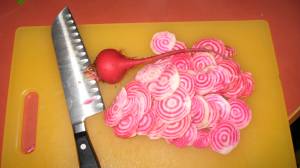
This is a delicious side dish which is also very pretty.  These beets are sweet, as their name implies, and decorative, like Victorian stencilling.  Slice them horizontally to see the concentric pink and cream circles.  These organic beets are from Killdeer Farm.

chioggia

Dolce di Chioggia and Carrots

a small side for 4

Slice 8-10 Dolce di Chioggia beets 2 mm. thin–or even thinner if you have a mandoline.
Slice carrots on the diagonal to the same width.
Melt 1-2 tbs. butter in a large saute pan.
Slide in the beets and carrots and saute on high for a minute, then reduce heat and cover. Season with salt and pepper.  Cook over low-moderate heat until fork-tender.
Toss in a splash of red or white wine vinegar and a handful of chopped parsley.

Serve as a side with grilled chicken.

Read Full Post »

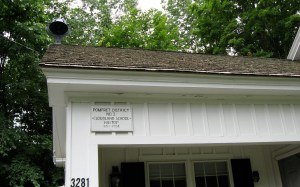
We had the most delicious meal last night.  Sauteed broccoli raab, beet greens, and green garlic from Killdeer, polenta, and spicy grass fed beef sausages.  After our morning with the Jersey cows at Thistle Hill in North Pomfret, Vermont, yesterday, we drove up and down the winding roads and along River Road in search of more cows—this time the black Angus steers of Cloudland Farm.

cloudland steers
“Cloudland” is an appropriate name for the farm at the top of the mountain road of the same name.  There are some long tunnels of trees along this climb that then break open into gorgeous vistas.  Before the twentieth century, the whole hill was most likely a cloudland—open pastures that seemed to touch the sky, for sheep and cattle and countless stone walls.  New growth forest has filled in some of this land, but Cloudland Farm still maintains a thousand acres of pastureland for its herd of grass fed steers.  (They’ve farmed this land for one hundred years.)  Like the population of grazing animals, that of farming families has thinned over the decades, too.  This empty hilltop school is evidence of a once-thriving community:

cloudland school
(The bigger Pomfret school down in the valley is underenrolled, now.  Old farmhouses are being bought up by wealthy non-farmers whose kids have already grown up and stayed in the cities.)

While I shopped around in their farm store, Jack and his cousin stood in the driveway admiring all of the vehicular activity. There was a big John Deere tractor, a skid steer, two ATVs, and a kid-sized pedal tractor.  The boys were happy.

cloudland sign
So was I.  I bought a whole variety of frozen beef, and started thinking about dinner.  Outside, the sun was streaming down at intervals between the big cumulonimbus clouds that have covered this region for over a month, drenching it again and again.  Bill Emmons, the Cloudland farmer, was talking about how little haying he’s been able to do, because of the constant rain.  He was enjoying the chit-chat, but was also twitching to get away and grab this sunny moment to hay.  “I hope I remember how,” he joked.

Visit their website here.

Read Full Post »

hi

hi

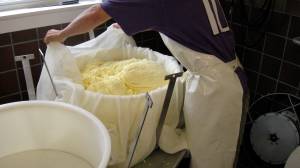
I spent the morning in the Pomfret, Vermont hills among cows and affable, talkative farmers happy to have me help to spread their gospel: eat locally and sustainably, and preserve the traditions of good food and respect for the land.  I’ll save Cloudland Farm for another post, because my visit to Thistle Hill Farm was so involved as to have me elbow deep in the copper vat of warm curds and whey.  This was the warm soup that would become the delicious, nutty Tarentaise.

John and Janine Putnam, the owners, farmers, and cheesemakers, were nice enough to let me watch and trail along and ask questions while they dealt with their uncharacteristically chaotic morning: it was a cheesemaking morning, which involves precise timing; and one of their cows had escaped the night before in search of a private place to birth her calf.  When I arrived with my sister and our two sons, the Putnams were harried.  John was measuring the temperature in the vat and watching the clock, while running in and out of the cheese house, changing his shoes each time, to keep dirt out of the cheese room.  Janine was walking all around the steep hills of the property searching for the new mother and her calf.  “Some are good mothers, some are bad.  The bad ones will just leave the calf, and we have to find it.”  They both disappeared for awhile, and Jack and Jeremiah found the Putnam children’s old tractor toys in the back of the barn, and played happily.  I snooped around the cheese house, where there is a wall covered with awards and accolades for their organic Vermont alpine cheese, named Tarentaise, and made in the style of the alpine cheeses of France and Switzerland.  On the wall a map of this region shows, with red circles, where the Putnams traveled with their four children, almost ten years ago, when they decided to make real cheese.

pasture

pasture

curds & whey in copper

curds & whey in copper

Jackboots

When we all bustled back into the cheese room with too big boots, Andrew, the Putnams’ 21-year-old son, was there to help his father lift out the heavy curds.  My glasses fogged up.  It was much hotter and more humid in the room, and the air smelled both sweeter and more acidic.  The curds had reached one degree shy of the critical 48 degrees Celsius.  John said he can tell where it is in the process by the smell.  When he was apprenticing, he said, he was told that at a certain point, “just put away the instruments and the thermometer.  Your senses will tell you what you need to know.”
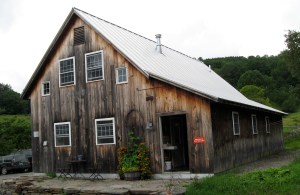
the cheesehouse

the cheesehouse

The American consumer, too, is learning to trust and hone his senses when it comes to cheese (and wine–the two go together).  The kind of business the Putnams run, and the kind of cheese they make, are helping to put Vermont in the vanguard of what some are calling the good food movement.  Consumers–literally–are willing to pay good money for good food.   John and Janine can speak both poetically and pragmatically about their chosen methods.  They love their loyal local customers, but they also love selling their cheese to D.C. restaurants.

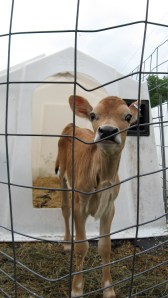
Suddenly, John was gone again, and we found him and Janine in the barn with the newborn 45-pound calf and its mother.  They’d been at the top of a woodsy hill, together, and Janine had carried the calf on her shoulders back to the barn.
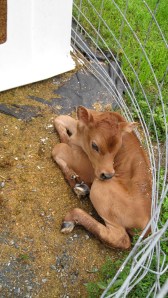
the newborn

the newborn

John ran away again, this time to the house to change his clothes and shoes.  You can’t go in the barn when you’re making cheese.  They even have the cheesehouse uphill and upwind from the barn, so that its “perfumes” won’t be detectable in the cheese.  The Tarentaise, instead, will carry the aromas of the terroir—the characteristic soil, grasses and forages of the North Pomfret hillsides.

Then, it was time to lift out the curds, with huge pieces of cheesecloth and one foot against the wall—so as not to fall into the vat when leaning down to scoop from the bottom.  John and Andrew worked together wordlessly, in sync, with the familiarity of father and son and habit.  They make cheese every other day.  “Cheesemakers don’t need to go to the gym or to the spa,” said John, in constant movement in the humid room.
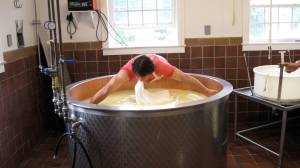
curds 1
curds2

curds3

They first lifted the huge sacks of curds into draining-compressing vats, and then, after about 15 more minutes, when the curds had glommed together in big jiggly discs, John sliced them into quarters with a chef’s knife, and lifted the sections into the round containers where they’d be compressed with the weight of 65 pounds.

curds4
curds5

Then they cleaned up, which was a time consuming and wet process.  Part of the clean-up is lifting the “pig cheese”—the curds left at the bottom and no good for cheese but good for the local pigs—out of the vat, which John let me do.  (I’m using my teeth as a third hand to hold the corners of the cheesecloth.)

cheesecloth

then to the aging room

then to the aging room

The Putnams have an eloquent website which describes their practices and tells their story.  Here are some of their links:
About the farm
Story
Home

And don’t forget to heed Janine’s advice:

Janine's shirt

As for me, I’m already looking forward to the Norwich Farmers’ Market on Saturday morning, when I can buy some more of the delicious, honey-colored Tarentaise.

Read Full Post »

« Newer Posts - Older Posts »