Feeds:
Posts
Comments

Posts Tagged ‘Amy Campion’

cukes
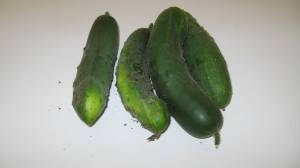
Cucumbers are on that list: the dirty dozen.  These are the fruits and vegetables that, when grown with synthetic fertilizers and pesticides, involve the heaviest use and retain the heaviest residues of these chemicals.  Many of these are the sweetest, most thin-skinned, or most water-dense of our favorite produce.  Remember my posts about peaches and grapes?  Cucumbers are just as bad.  Out of fifty pesticides typically used on cucumber plants, nineteen are PAN “Bad Actors,” which means that they are proven to be highly toxic.  These include several organophosphates, which can damage the functioning of nerves.  I gave a taste of William Cowper’s advice on how to grow an organic cucumber in my last post… which won’t really help you if you’re a novice gardener who’s also impatient with eighteenth-century poetry.  My advice about shopping for cucumbers is much less complex: always buy organic.

Cucumbers are such a versatile vegetable for the cook who likes to play with many different cuisines.  There are old-school British cucumber sandwiches, there’s cucumber dressed simply with sesame oil and sesame seeds, there’s raita (the cooling Indian yogurt sauce made with cucumbers, mint, cumin, and yogurt), there’s cold cucumber soup, there’s tzatziki (yogurt, cucumber, dill, garlic), there’s so much more, all of which is good.  One of our friends served just a dish of thinly sliced salted cucumbers along with his stiff martinis.

Jack and Peggy spent some time weeding and harvesting in the kitchen garden this morning.  The yield was high!

herbs
J&P

Read Full Post »

cukes
“If you think I am going to make
A sexual joke in this poem, you are mistaken.”

So says Robert Hass, in his playful poem, dryly titled “Poem With a Cucumber In It.”  The poem contains etymological musings on “cumbersome” and “encumber,” musings on the Berkeley sky, memories of travel, and a rough recipe for cucumber salad with dill and yogurt.

Perhaps the most famous poem with a cucumber in it is “The Task,” published in 1775 by William Cowper.  Like Hass’s, this poem contains something of a recipe: for growing a hothouse cucumber.  Cowper meditates for pages on the challenges of growing this sun loving plant in the English winter.  He describes the construction of the greenhouse, the creation of fertile soil out of a “rage of fermentation,” the coddling of seeds and sprouts, the fertilization which in winter requires that “assistant art/ then acts in nature’s office.”

The cucumber takes on social significance as well.  It is the object in a meditation on two main topics of eighteenth century political economy: value (“when rare/ so coveted, else base and disesteemed—/ Food for the vulgar merely”) and labor (“To raise the prickly and green-coated goard/ So grateful to the palate […] is an art” requiring intensive, careful labor unappreciated and unacknowledged by the wealthy purchasers of winter cucumbers).  Cowper advises “ye rich” to “grudge not the cost” because:

Ye little know the cares,
The vigilance, the labor and the skill
That day and night are exercised, and hang
Upon the ticklish balance of suspense,
That ye may garnish your profuse regales
With summer fruits brought forth by wintry suns.

Cowper’s socioeconomically-conscious advice might sound familiar to those of us who write and think and read about our current food culture: learn about how the foods you take for granted are grown; don’t take them for granted; consider the farmer’s labor; grow some food yourself; keep a compost heap; build a cold frame; consider the social and economic costs of unseasonal foods.

To read this eighteenth-century meditation on the economics, culture, and cultivation of cucumbers is to be reminded that our current “good food movement” exists in an historical context.  Skepticism about and moral indignation toward the modernization of food—whether that means hothouse-cultivation, refrigeration, or genetic modification—is as old as modernity itself, and probably older.   Praise for farmers and their ancient art—and injunctions to praise them—are as old as the art itself.

Read Full Post »

We had to ditch plans for the beach when we heard the constant rain pouring down as we dozed this morning.  But Jack’s Uncle Grady arrived just in time for a big lunch at Bayside, just off of Horseneck Beach.  Bayside is an officially “green” restaurant certified by the Green Restaurant Association.

green cert
The greenness in evidence took the form of compostable soda straws and many local ingredients, including a range of seafood from lobster and crabs to cod and striped bass (which, around here, is called striper, and further down the East Coast, in Maryland, where we lived for a short while, is called rockfish).  The local beer menu offered many choices; I had an IPA made on Martha’s Vineyard by Offshore Ale Company: it was amber and hoppy, as I like it.

MV ale

IPA & chowdah

We quickly polished off a plate of fried calamari topped with spicy banana peppers.  I tried the Rhode Island style, brothy quahog chowder, but remain a fan of “New England” chowder, with its cream and whole clams.

calamari
Grady and I ordered the lobster rolls, which in normative New England parlance means a warm, limp hotdog bun lined with a lettuce leaf, and a pile of lobster chunks and diced celery held together with a dollop of mayonnaise.   Bayside serves a pared down version which gives the consumer more control (in the manner of the Starbucksification of to-go food consumption) and evokes the simplicity of “sustainable” eating.  The bun lined with lettuce holds a generous heap of lobster meat, and a little dish of mayonnaise or melted butter sits on the side.  I liked the lobster, of course, but missed the celery and mixed-up-edness of a traditional roll.

lob roll

Also on the table were fried clams, a salmon-asparagus wrap, and a gingery salmon salad.

We were full of good food, but had seen the pies on our way in.  The Bayside bakers make at least four kinds of pie every day.  Today there was lemon meringue, blueberry, apple, and strawberry rhubarb.

pies

We ordered “Indian Pudding”—a traditional New England custard made with milk, molasses, eggs, butter, and cornmeal, and seasoned with cinnamon, nutmeg, alspice, and cloves, and topped with a spoonful of melty vanilla ice cream—and one slice of strawberry rhubarb, which, curiously, was spiced with cardamom.   Now we were really full.

My first move when we got back to the house, was to brew a big pot of strong Gorilla coffee, a bag of which Chris and Kate brought us from Brooklyn.  I finished The City of Falling Angels, Jack watched the classic version of Winnie the Pooh, others took naps, Peggy baked banana bread…

A satisfying rainy day.

I also looked into green restaurant certification.  There are seven areas of greenness in which a restaurant must qualify:

1. Water Effciency
2. Waste Reduction and Recycling
3. Sustainable Furnishings and Building Materials
4. Sustainable Food
5. Energy
6. Disposables
7. Chemical and Pollution Reduction

For more information on this worthy cause, check out the Green Restaurant Association’s website.

Read Full Post »

beach jack

After a satisfyingly lazy afternoon on the beach, here in Westport, Mass., Peggy and I went to the fish market.  It was a bare bones kind of operation, but all of the fish and shellfish was glisteningly fresh and abundant.  We decided on striped bass.  On the way home, we stopped at the farm stand at Orr’s Farm—an organic vegetable farm run almost single-handedly by Andrew Orr, who is about 20 and is referred to proudly by locals as the town’s youngest farmer—and stocked up on potatoes, garlic, and a few others items.  Dinner was a locavore’s feast: striper grilled mid-rare and topped with fresh, coarse-chopped basil pesto, garlic mashed potatoes (yes, it’s a craze of mine now), and a salad of lettuces from the back yard mixed with local pea greens, tomatoes and radishes.

pesto striper

Yum!

Read Full Post »

Remember what I said about Deborah’s extraordinary vegetarian cooking?  She was gracious enough to send me her recipe for Swiss chard tart.  Here’s what she says:

As for chard tart, tip of the hat to Patricia Wells, from whose recipe this jumps off with a few modifications–it’s actually an olive-oil crust:
The crust is l cup of flour (I use something called white whole-wheat made by King Arthur, but you can use whole-wheat pastry, or some combo of wh wh and white),plus a couple of large pinches of salt, to which you add l/4 cup ice water–mix in–and then l/4 cup olive oil. It can be mixed with the hands, and it will be very moist and soft, like cookie dough sort of. Doesn’t need to be refrigerated–press it into the tart pan with your hands (the recipe fits something like an 8-9 inch pan, but can easily be multiplied to larger vessels). Filling is–well, I don’t know how to describe the amount of chard, but a very big bunch, anyhow–chop it roughly after washing, wilt it in its own water in a saucepan, add to 3 beaten eggs, l/2 to one cup Parmesan or other cheese, salt, pepper. Coat bottom of crust with Dijon mustard, put in filling, and bake at 400 degrees until firm and golden, roughly 30 minutes, depending on your oven.
Doesn’t need to be served absolutely hot from the oven–perhaps more flavorful having cooled off a bit…

Read Full Post »

We’re roving through rural New York this long weekend.  After driving through the Green Mountains of Vermont, over countless hills and through countless valleys, we came into the Catskills with its countless rivers, having passed through the little towns where my mother’s mother and mother’s father were born and raised—Kingston, Callicoon Center—and where they married and started their own family—Liberty.

Our first stop was Kenoza Lake, where we visited our friends Deborah and Jed in their pewter-blue-painted farmhouse, fixed up with many windows, a writing room for him in the attic, a studio for her in the old barn or chicken house or mudroom adjacent the kitchen.  We arrived for a late lunch in the sun: plates of lox and ricotta, sourdough bread, babaganoush, hard-boiled eggs, farmhouse cheeses from around the corner, white wine for some, Coronas for others.  For dessert, we went into the hilly acres of bushes heavy with blueberries and huckleberries.  Because of all of the rain this summer, and the general cloud cover, we picked berry by berry, rather than cluster by cluster.  There were still plenty of berries for Jack.

blueberry picking
Deborah and I went into Jeffersonville to check out the small farmers’ market, where she bought striped Romanesco zucchini and a big head of romaine.

many currants, few zucchini

many currants, few zucchini

Deborah is a wonderful vegetarian cook.  For dinner, after their favorite aperitif—Campari with pulpy orange juice—she served Swiss chard pie (I’ll post a recipe soon…) in a buttery crust, quinoa with pinenuts and golden raisins, and roasted cauliflower with ginger and herbs—out of which she coaxed extraordinary carmelized flavors.

Our next stop will be Margaretville and Roxbury, for Aaron and Kelly’s wedding.  We hope these thunderheads roll on by.

Read Full Post »

I spotted a forager at the Farmers’ Market in Hanover.  He was busy behind another farmer’s stand, borrowing the scale to weigh his haul of early chanterelles.   He divvied out the cache of beatifully gouda-colored fungi into straw baskets.  $8 each.  6 hours of foraging had yielded six baskets, he told me.  I’m sure those six baskets were picked up in a flash, after which he probably ducked back into the woods.

chants

When cooking, they smell, and then taste, of nuts and apricots, earth and sunlit woods, fruity wine.

Lacking rabbit, I’ll cook them up and toss them over chicken.  Sauté until they release their juices, in butter, with pancetta, herbs, and minced shallot.  Maybe a few pinenuts.

Rosé…

Read Full Post »

Pork chops, like buttercups, are my Proustian objects.  At the taste of a chop, especially one brined in cider or served with applesauce, I’m back on Old City Falls Road, at the big yellow house in Strafford, Vermont.  Up the steep hill behind the house and barn—a catch-all space housing tools, lumber, a VW bus, my Dad’s darkroom, a sauna—was the pond where I learned to swim and skate, and the pig pen.  My parents, on the run from suburbia back to the land, had set up a small homestead with a vegetable garden, chickens, pigs, a goat, and two little girls running around in Wonder Woman Underoos in January, because the wood stove kept the living room so hot.

The pigs, Gruntly Squatwell and Squatly Gruntwell, were contented animals until that particular date when my uncle and a few other guys would show up in their pickup trucks for the big pig roundup.  Then the pigs ran around and around their pen squealing for their lives, though they didn’t know it.

The result was a freezer full of pork.  For some reason, I remember the chops best of all.  Sweetish and salty, for me the essence of pork—until I tasted pancetta, but that’s a different kind of experience.  The best, more recent, pork chops I’ve had were grilled by our friend Donia, the energetic and lovely Palo Alto chef and writer.  Her cooking—whether in her restaurant or home—is less a performance than an expression of her nurturing nature.  The food is loved and cared for, as are the friends she feeds.

The technique here is so simple, it barely warrants the formalization of a recipe, but here goes:

Donia’s Pork Chops

In the morning, place four thick-cut bone-in pork chops (organic if possible) in a large baking dish, and pour in a fruity red wine—a Beaujolais, or a zinfandel, perhaps—just to cover them.  Turn them over once or twice during the day.  Just before grilling—preferably over charcoal—season them liberally with salt and pepper.  Grill to mid-rare over moderate heat.  Throw some perfectly ripe buttered halved peaches onto the grill too, for a taste sensation.  Donia also served cornbread and salad, outside on the deck.  What a memorable meal!

Read Full Post »

Is that some kind of summer-in-Vermont activity for kids?  Do you ride it or eat it?
Microbreweries in New England | Norwich Inn | Brewery logo
Actually, you drink it!  It’s a red ale brewed by Jasper Murdock’s at the Norwich Inn, on Main St. in Norwich, Vermont.  The microbrewery makes English style ales which are served only in the little pub at the back of the Inn.

jasper m's

When we stopped in yesterday, on tap as well as Whistling Pig Red Ale were Oh Be Joyful, JM’s Extra Special Bitter, and Second Wind Oatmeal Stout.  The names are all clever little snatches of idiom, some of which are particular to New England.  (The only reason the word “wicked” doesn’t show up is, I’m sure, because of Pete’s so-called Wicked Ale, about which there isn’t much wicked, as far as I’m concerned.)

Let these sentences from their website wet your whistle:

Jasper Murdock’s Ales are crafted from fine English malts, with hops grown in England and in our own hop garden at the Inn. Because filtration can strip flavor and body from a beer, the ale yeast is allowed to settle out naturally in an extended cold-aging period to ensure that all the goodness reaches your palate. The beer is then pumped underground from the beer cellars to our pub at the Inn.

Normally, at this spot, I’d go for a fat pint of extra hoppy ale to be sipped slowly in a rocker on the front porch.  But last night I was feeling sassy, and ordered a Bombay Sapphire martini—up, dry, twist—instead.   Peter and I found two rockers at the corner of the porch.  We discussed my dissertation, poems, upcoming trips, and Rome, and watched the comings and goings of Dan & Whit’s shoppers—including a recumbent cyclist (whose personality, I think, like those who share his practice, must combine exhibitionism with an unwavering belief in scientific studies and an abiding love of corny puns).

Read Full Post »

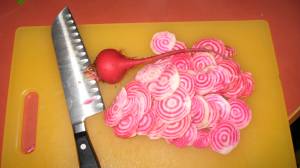
This is a delicious side dish which is also very pretty.  These beets are sweet, as their name implies, and decorative, like Victorian stencilling.  Slice them horizontally to see the concentric pink and cream circles.  These organic beets are from Killdeer Farm.

chioggia

Dolce di Chioggia and Carrots

a small side for 4

Slice 8-10 Dolce di Chioggia beets 2 mm. thin–or even thinner if you have a mandoline.
Slice carrots on the diagonal to the same width.
Melt 1-2 tbs. butter in a large saute pan.
Slide in the beets and carrots and saute on high for a minute, then reduce heat and cover. Season with salt and pepper.  Cook over low-moderate heat until fork-tender.
Toss in a splash of red or white wine vinegar and a handful of chopped parsley.

Serve as a side with grilled chicken.

Read Full Post »

« Newer Posts - Older Posts »